• Fri frakt över 249 kr
  • •
  • Snabba leveranser
  • •
  • Billiga böcker
Kundservice

Du är på sajten för privatpersoner.

Företag, bibliotek eller offentlig verksamhet?

Du handlar på classic.bokus.com, där alla dina funktioner finns intakta.
Till classic.bokus.com
Bokus logotyp. Gå till startsidan.
  • Erbjudanden
  • Student
  • Topplistor
  • Barn & ungdom
  • Bokus Play
  • E-böcker
  • Ljudböcker
  • Pocketböcker
  • Spel och pussel

Pocketfynda! Hundratals böcker för 49 kr/st →

Sidfot

Mina sidor

    Hjälp

    • Kundservice
    • Vanliga frågor och svar
    • Frakt och leverans
    • Retur vid ångerrätt
    • Reklamera vara
    • Betalning
    • Köpvillkor
    • Allmänna villkor
    • Information om webbplatsens tillgänglighet

    Om Bokus

    • Om oss
    • Pressrum
    • För studenter
    • För företag
    • För bibliotek och offentlig verksamhet
    • För leverantörer
    • Hållbarhet

    Populärt

    • Aktuella erbjudanden
    • Presentkort
    • Studentlitteratur
    • Nya böcker
    • Topplistor
    • Signerade böcker
    • Engelska böcker

    Inspiration

    • Boktips
    • BookTok
    • Barnbokskaraktärer
    • Populära författare
    Logotyp för Bokus
    Följ oss på Facebook (extern länk)Följ oss på Instagram (extern länk)Följ oss på YouTube (extern länk)Följ oss på TikTok (extern länk)
    bokus @ CookiesAnpassa cookiesIntegritetspolicyKöpvillkor
    Till Citymail hemsida (extern länk)Till Budbee hemsida (extern länk)Till Postnord hemsida (extern länk)Till Schenker hemsida (extern länk)Till Early Bird hemsida (extern länk)Till Walleys hemsida (extern länk)
    1. Naturvetenskap och teknik
    2. Geovetenskap
    3. Miljövetenskap och miljöpolitik

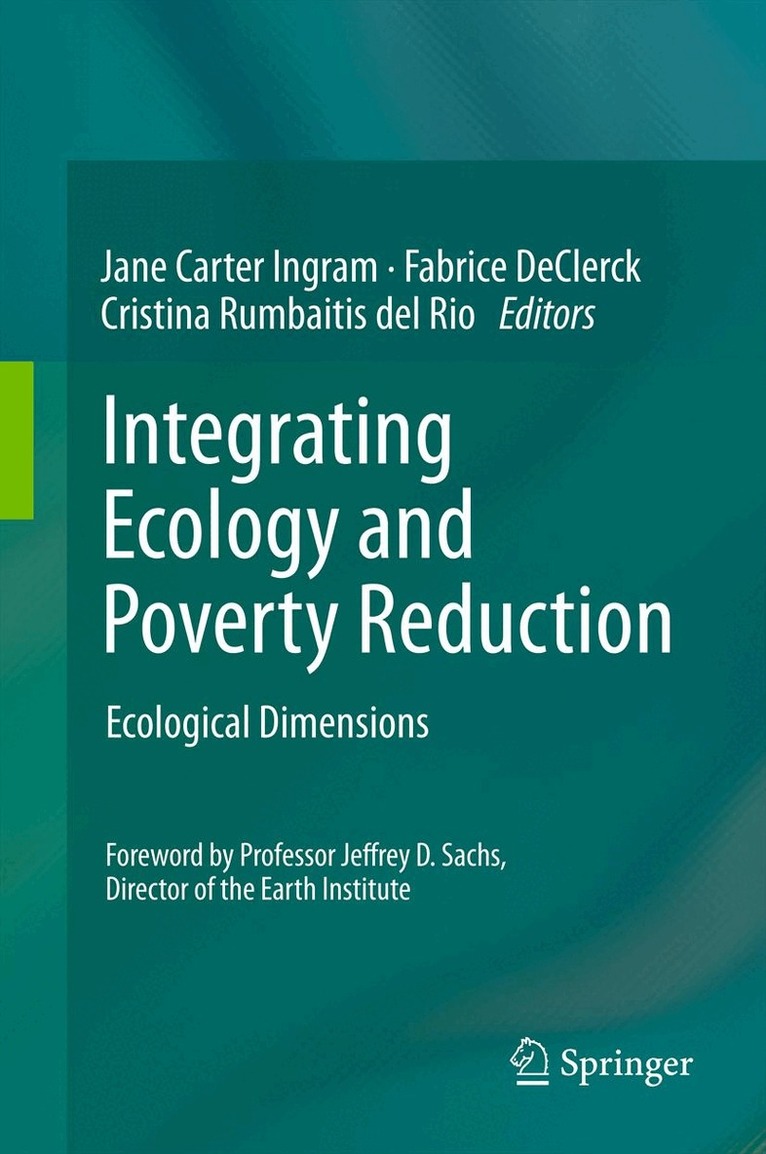
    Integrating Ecology and Poverty Reduction

    Ecological Dimensions

    AvJane Carter Ingram,Fabrice DeClerck

    Häftad, Engelska, 2014

    1 485 kr

    Beställningsvara. Skickas inom 10-15 vardagar. Fri frakt över 249 kr.

    Beskrivning

    In the past, the science of ecology has frequently been excluded from the development agenda for various reasons. Increasingly however there has been a renewed interest in finding more ecologically sustainable means of development that have required a strong foundation in ecological knowledge (for example EcoAgriculture Partnerships, EcoHealth presented at ESA, and EcoNutrition proposed by Deckelbaum et al). Each of these examples has already taken the critical first step at integrating ecological knowledge with agriculture, health and nutrition, respectively. However, this is only the first step; more attention needs to be placed not only on the role that two fields can play towards poverty alleviation, but on the role of a truly integrated, interdisciplinary approach towards development goals that is firmly grounded in ecological understanding. We feel that a critical look at what ecology can and cannot provide to the development agenda, in light of the Millennium Development goals, is timely and crucial. The introduction and the final section of the book will then integrate the lessons and principles outlined in each of the chapters. All chapter authors will be heavily encouraged to focus on how their sub-discipline in ecology impacts overall human well-being and environmental sustainability.

    Produktinformation

    • Utgivningsdatum:2014-04-13
    • Mått:155 x 235 x 25 mm
    • Vikt:674 g
    • Format:Häftad
    • Språk:Engelska
    • Antal sidor:428
    • Upplaga:2012
    • Förlag:Springer-Verlag New York Inc.
    • ISBN:9781489994288

    Utforska kategorier

    • Miljövetenskap och miljöpolitik inom Naturvetenskap och teknik
    • Miljö-, transport- och planeringsrätt inom Juridik

    Mer om författaren

    The three editors of this volume, Jane Carter Ingram, Fabrice DeClerck, and Cristina Rumbatis del Rio, have collaborated on multiple projects addressing the role of ecology in poverty reduction and began working together at the Earth Institute of Columbia University. Their educational and professional backgrounds in ecology, geography, and sustainable development have served as the inspiration for this book and their professional pursuits. The editors hope that the issues presented and explored in this volume will serve to encourage ecological scientists and practitioners in international development fields to collaborate together to identify creative, sustainable and viable solutions to challenges preventing poverty alleviation around the world. J. Carter Ingram is the lead of the Ecosystem Services and Payments for Ecosystem Services group at the Wildlife Conservation Society in New York, NY.  Cristina Rumbaitis del Rio is an Associate Director at the Rockefeller Foundation in New York, NY (USA). Fabrice DeClerck is a professor of community and landscape ecology at CATIE in Costa Rica.

    Innehållsförteckning

    • From the contents Foreword - Importance of ecology to poverty reduction.- Part 1: Introduction.- Part 2: The Ecological Dimensions and Solutions to Global Development Challenges. Section 2.1. Hunger. Section 2.2. Water Resources. Section 2.3. Human Health. Section 2.4. Energy. Section 2.5. Disasters. Section 2.6 Climate Change. Section 2.7. Education. Section 2.8. Gender equality. Section 2.9. Synthesis of Direct Application of Ecological Theory.- Part 3: Mediating Forces for Leveraging Ecology towards Poverty Reduction in a Globalized World. Section 3.1. Population. Section 3.2. Ecological Restoration. Section 3.3. Financing. Section 3.4. Economics: Payments for Ecosystem Services. Section 3.5. Governance & Social Movements. Section 3.6. International Policy Mechanisms. Section 3.7. Synthesis of Mediating Forces.- Part 4. Conclusions.