Falah Alobaid – författare
Visar alla böcker från författaren Falah Alobaid. Handla med fri frakt och snabb leverans.
6 produkter
6 produkter
Häftad, Engelska, 2019
1 244 kr
Skickas inom 10-15 vardagar
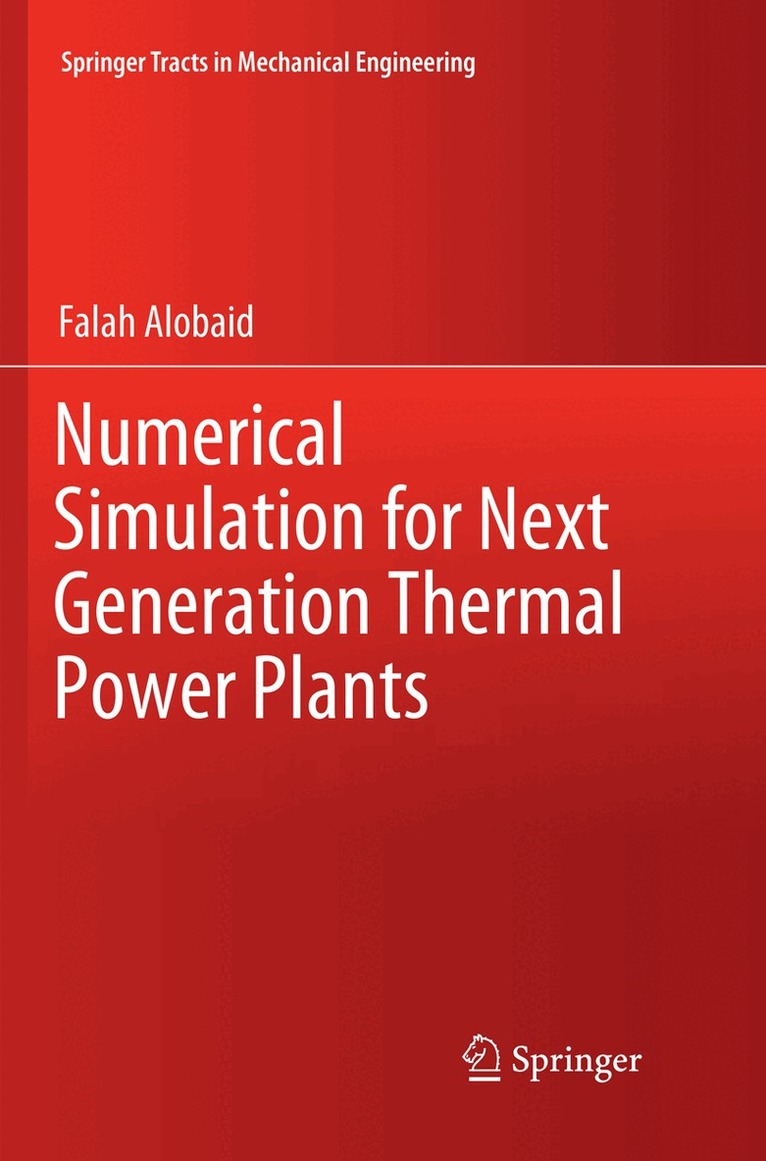
The book provides highly specialized researchers and practitioners with a major contribution to mathematical models’ developments for energy systems. First, dynamic process simulation models based on mixture flow and two-fluid models are developed for combined-cycle power plants, pulverised coal-fired power plants, concentrated solar power plant and municipal waste incineration. Operation data, obtained from different power stations, are used to investigate the capability of dynamic models to predict the behaviour of real processes and to analyse the influence of modeling assumptions on simulation results. Then, a computational fluid dynamics (CFD) simulation programme, so-called DEMEST, is developed. Here, the fluid-solid, particle-particle and particle-wall interactions are modeled by tracking all individual particles. To this purpose, the deterministic Euler-Lagrange/Discrete Element Method (DEM) is applied and further improved. An emphasis is given to the determination of inter-phase values, such as volumetric void fraction, momentum and heat transfers, using a new procedure known as the offset-method and to the particle-grid method allowing the refinement of the grid resolution independently from particle size. Model validation is described in detail. Moreover, thermochemical reaction models for solid fuel combustion are developed based on quasi-single-phase, two-fluid and Euler-Lagrange/MP-PIC models. Measurements obtained from actual power plants are used for validation and comparison of the developed numerical models.
Inbunden, Engelska, 2018
1 728 kr
Skickas inom 10-15 vardagar
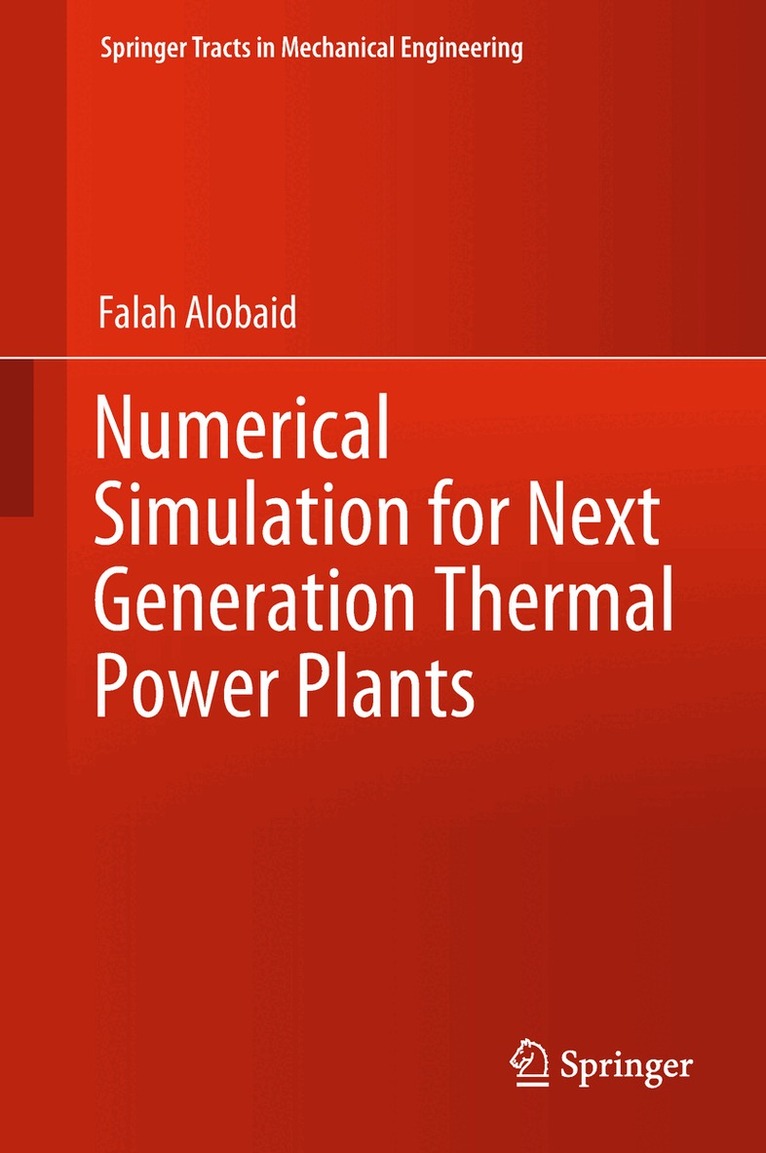
The book provides highly specialized researchers and practitioners with a major contribution to mathematical models’ developments for energy systems. First, dynamic process simulation models based on mixture flow and two-fluid models are developed for combined-cycle power plants, pulverised coal-fired power plants, concentrated solar power plant and municipal waste incineration. Operation data, obtained from different power stations, are used to investigate the capability of dynamic models to predict the behaviour of real processes and to analyse the influence of modeling assumptions on simulation results. Then, a computational fluid dynamics (CFD) simulation programme, so-called DEMEST, is developed. Here, the fluid-solid, particle-particle and particle-wall interactions are modeled by tracking all individual particles. To this purpose, the deterministic Euler-Lagrange/Discrete Element Method (DEM) is applied and further improved. An emphasis is given to the determination of inter-phase values, such as volumetric void fraction, momentum and heat transfers, using a new procedure known as the offset-method and to the particle-grid method allowing the refinement of the grid resolution independently from particle size. Model validation is described in detail. Moreover, thermochemical reaction models for solid fuel combustion are developed based on quasi-single-phase, two-fluid and Euler-Lagrange/MP-PIC models. Measurements obtained from actual power plants are used for validation and comparison of the developed numerical models.
E-bok
Engelska, 20181 575 kr
Läs direkt efter köp
The book provides highly specialized researchers and practitioners with a major contribution to mathematical models’ developments for energy systems. First, dynamic process simulation models based on mixture flow and two-fluid models are developed for combined-cycle power plants, pulverised coal-fired power plants, concentrated solar power plant and municipal waste incineration. Operation data, obtained from different power stations, are used to investigate the capability of dynamic models to predict the behaviour of real processes and to analyse the influence of modeling assumptions on simulation results. Then, a computational fluid dynamics (CFD) simulation programme, so-called DEMEST, is developed. Here, the fluid-solid, particle-particle and particle-wall interactions are modeled by tracking all individual particles. To this purpose, the deterministic Euler-Lagrange/Discrete Element Method (DEM) is applied and further improved. An emphasis is given to the determination of inter-phase values, such as volumetric void fraction, momentum and heat transfers, using a new procedure known as the offset-method and to the particle-grid method allowing the refinement of the grid resolution independently from particle size. Model validation is described in detail. Moreover, thermochemical reaction models for solid fuel combustion are developed based on quasi-single-phase, two-fluid and Euler-Lagrange/MP-PIC models. Measurements obtained from actual power plants are used for validation and comparison of the developed numerical models.
Inbunden, Engelska, 2026
2 031 kr
Skickas inom 3-6 vardagar
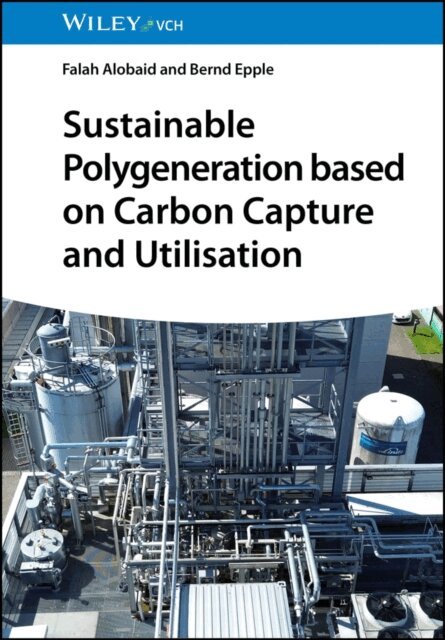
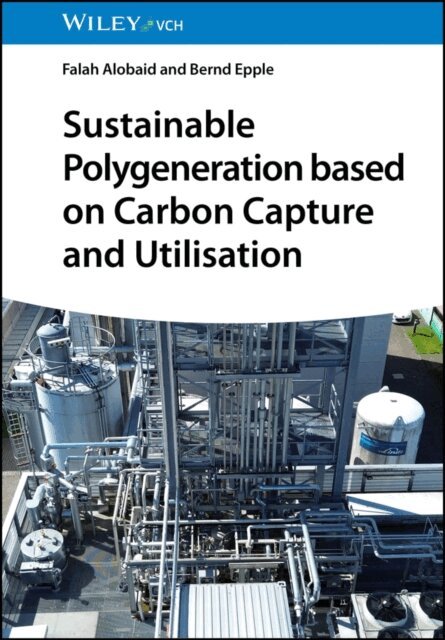
An original and up-to-date discussion of a promising sustainable energy technology In Sustainable Polygeneration based on Carbon Capture and Utilisation, Falah Alobaid and Bernd Epple present a comprehensive and authoritative investigation of state-of-the-art technologies for converting solid fuels, including both fossil fuels and biomass, into energy services, chemicals, and other valuable products. The book covers advanced combustion, gasification, pyrolysis, hydrothermal processes, and steam reforming, integrating these conversion methods with Carbon Capture and Utilisation (CCU) technologies. It also examines the numerical simulation of polygeneration plants using one-dimensional process models, both steady-state and dynamic, as well as three-dimensional CFD models, highlighting their applications in system design, optimisation, and performance evaluation. Organised into four major thematic areas, the book begins with an in-depth treatment of conversion processes for solid fuels, followed by a detailed exploration of carbon capture and utilisation technologies for emission sources. It then presents sustainable polygeneration plants before concluding with a thorough examination of the mathematical and computational models used for polygeneration plant simulations. The text is enriched with experimental results from one of the world’s largest research pilot plants, providing real-world performance data that validates key technologies and demonstrates the practical integration of conversion, capture, and utilisation processes. Ideal for chemical engineers, process engineers, industrial chemists, and environmental engineers, Sustainable Polygeneration based on Carbon Capture and Utilisation combines theoretical foundations with practical insights, making it an essential resource for both researchers and practitioners.
E-bok
Engelska, 20262 136 kr
Läs direkt efter köp
An original and up-to-date discussion of a promising sustainable energy technology In Sustainable Polygeneration based on Carbon Capture and Utilisation, Falah Alobaid and Bernd Epple present a comprehensive and authoritative investigation of state-of-the-art technologies for converting solid fuels, including both fossil fuels and biomass, into energy services, chemicals, and other valuable products. The book covers advanced combustion, gasification, pyrolysis, hydrothermal processes, and steam reforming, integrating these conversion methods with Carbon Capture and Utilisation (CCU) technologies. It also examines the numerical simulation of polygeneration plants using one-dimensional process models, both steady-state and dynamic, as well as three-dimensional CFD models, highlighting their applications in system design, optimisation, and performance evaluation. Organised into four major thematic areas, the book begins with an in-depth treatment of conversion processes for solid fuels, followed by a detailed exploration of carbon capture and utilisation technologies for emission sources. It then presents sustainable polygeneration plants before concluding with a thorough examination of the mathematical and computational models used for polygeneration plant simulations. The text is enriched with experimental results from one of the world s largest research pilot plants, providing real-world performance data that validates key technologies and demonstrates the practical integration of conversion, capture, and utilisation processes. Ideal for chemical engineers, process engineers, industrial chemists, and environmental engineers, Sustainable Polygeneration based on Carbon Capture and Utilisation combines theoretical foundations with practical insights, making it an essential resource for both researchers and practitioners.
E-bok
PDF, Engelska, 20262 061 kr
Läs direkt efter köp
An original and up-to-date discussion of a promising sustainable energy technology In Sustainable Polygeneration based on Carbon Capture and Utilisation, Falah Alobaid and Bernd Epple present a comprehensive and authoritative investigation of state-of-the-art technologies for converting solid fuels, including both fossil fuels and biomass, into energy services, chemicals, and other valuable products. The book covers advanced combustion, gasification, pyrolysis, hydrothermal processes, and steam reforming, integrating these conversion methods with Carbon Capture and Utilisation (CCU) technologies. It also examines the numerical simulation of polygeneration plants using one-dimensional process models, both steady-state and dynamic, as well as three-dimensional CFD models, highlighting their applications in system design, optimisation, and performance evaluation. Organised into four major thematic areas, the book begins with an in-depth treatment of conversion processes for solid fuels, followed by a detailed exploration of carbon capture and utilisation technologies for emission sources. It then presents sustainable polygeneration plants before concluding with a thorough examination of the mathematical and computational models used for polygeneration plant simulations. The text is enriched with experimental results from one of the world s largest research pilot plants, providing real-world performance data that validates key technologies and demonstrates the practical integration of conversion, capture, and utilisation processes. Ideal for chemical engineers, process engineers, industrial chemists, and environmental engineers, Sustainable Polygeneration based on Carbon Capture and Utilisation combines theoretical foundations with practical insights, making it an essential resource for both researchers and practitioners.