Falk Schreiber - Böcker
Visar alla böcker från författaren Falk Schreiber. Handla med fri frakt och snabb leverans.
4 produkter
4 produkter
1 409 kr
Skickas inom 7-10 vardagar
An introduction to biological networks and methods for their analysis Analysis of Biological Networks is the first book of its kind to provide readers with a comprehensive introduction to the structural analysis of biological networks at the interface of biology and computer science. The book begins with a brief overview of biological networks and graph theory/graph algorithms and goes on to explore: global network properties, network centralities, network motifs, network clustering, Petri nets, signal transduction and gene regulation networks, protein interaction networks, metabolic networks, phylogenetic networks, ecological networks, and correlation networks.Analysis of Biological Networks is a self-contained introduction to this important research topic, assumes no expert knowledge in computer science or biology, and is accessible to professionals and students alike. Each chapter concludes with a summary of main points and with exercises for readers to test their understanding of the material presented. Additionally, an FTP site with links to author-provided data for the book is available for deeper study.This book is suitable as a resource for researchers in computer science, biology, bioinformatics, advanced biochemistry, and the life sciences, and also serves as an ideal reference text for graduate-level courses in bioinformatics and biological research.
Del 16 - Computational Biology
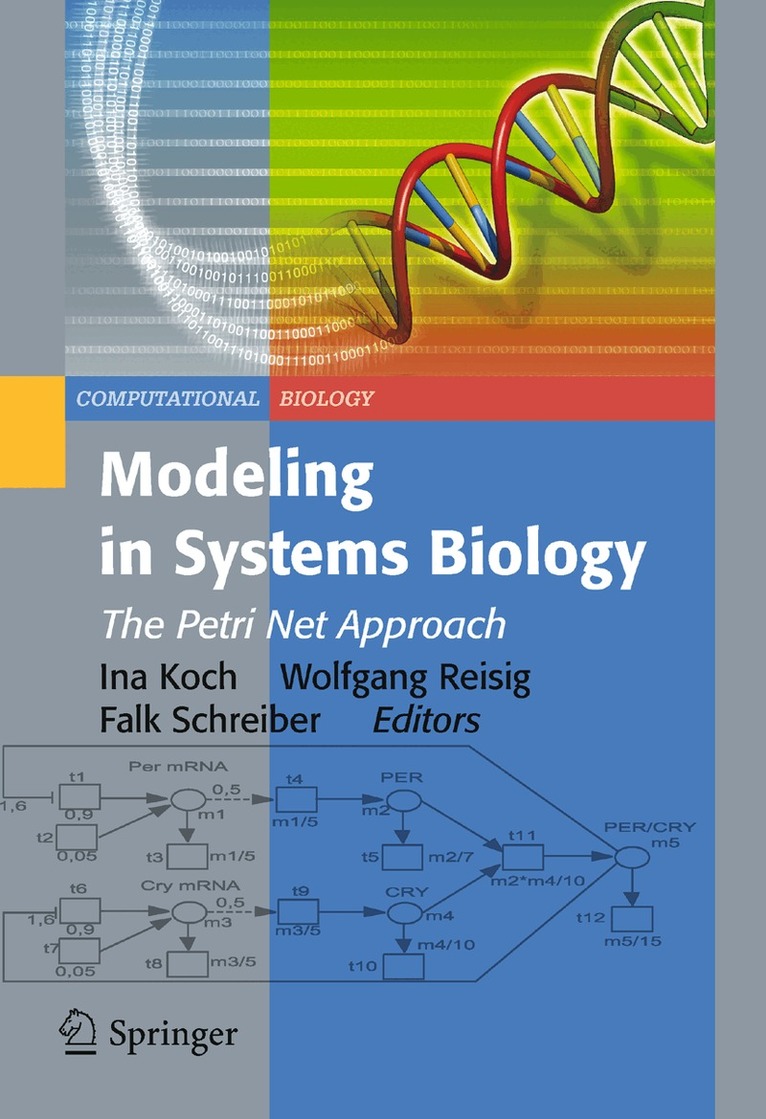
Modeling in Systems Biology
The Petri Net Approach
Häftad, Engelska, 2012
1 064 kr
Skickas inom 10-15 vardagar
The emerging, multi-disciplinary field of systems biology is devoted to the study of the relationships between various parts of a biological system, and computer modeling plays a vital role in the drive to understand the processes of life from an holistic viewpoint. Advancements in experimental technologies in biology and medicine have generated an enormous amount of biological data on the dependencies and interactions of many different molecular cell processes, fueling the development of numerous computational methods for exploring this data. The mathematical formalism of Petri net theory is able to encompass many of these techniques.This essential text/reference presents a comprehensive overview of cutting-edge research in applications of Petri nets in systems biology, with contributions from an international selection of experts. Those unfamiliar with the field are also provided with a general introduction to systems biology, the foundations of biochemistry, and the basics of Petri net theory. Further chapters address Petri net modeling techniques for building and analyzing biological models, as well as network prediction approaches, before reviewing the applications to networks of different biological classification.Topics and features: investigates the modular, qualitative modeling of regulatory networks using Petri nets, and examines an Hybrid Functional Petri net simulation case study; contains a glossary of the concepts and notation used in the book, in addition to exercises at the end of each chapter; covers the topological analysis of metabolic and regulatory networks, the analysis of models of signaling networks, and the prediction of network structure; provides a biological case study on the conversion of logical networks into Petri nets; discusses discrete modeling, stochastic modeling, fuzzy modeling, dynamic pathway modeling, genetic regulatory network modeling, and quantitative analysis techniques; includes a Foreword by Professor Jens Reich, Professor of Bioinformatics at Humboldt University and Max Delbrück Center for Molecular Medicine in Berlin.This unique guide to the modeling of biochemical systems using Petri net concepts will be of real utility to researchers and students of computational biology, systems biology, bioinformatics, computer science, and biochemistry.
Del 16 - Computational Biology
Modeling in Systems Biology
The Petri Net Approach
Inbunden, Engelska, 2010
1 064 kr
Skickas inom 10-15 vardagar
The emerging, multi-disciplinary field of systems biology is devoted to the study of the relationships between various parts of a biological system, and computer modeling plays a vital role in the drive to understand the processes of life from an holistic viewpoint. Advancements in experimental technologies in biology and medicine have generated an enormous amount of biological data on the dependencies and interactions of many different molecular cell processes, fueling the development of numerous computational methods for exploring this data. The mathematical formalism of Petri net theory is able to encompass many of these techniques.This essential text/reference presents a comprehensive overview of cutting-edge research in applications of Petri nets in systems biology, with contributions from an international selection of experts. Those unfamiliar with the field are also provided with a general introduction to systems biology, the foundations of biochemistry, and the basics of Petri net theory. Further chapters address Petri net modeling techniques for building and analyzing biological models, as well as network prediction approaches, before reviewing the applications to networks of different biological classification.Topics and features: investigates the modular, qualitative modeling of regulatory networks using Petri nets, and examines an Hybrid Functional Petri net simulation case study; contains a glossary of the concepts and notation used in the book, in addition to exercises at the end of each chapter; covers the topological analysis of metabolic and regulatory networks, the analysis of models of signaling networks, and the prediction of network structure; provides a biological case study on the conversion of logical networks into Petri nets; discusses discrete modeling, stochastic modeling, fuzzy modeling, dynamic pathway modeling, genetic regulatory network modeling, and quantitative analysis techniques; includes a Foreword by Professor Jens Reich, Professor of Bioinformatics at Humboldt University and Max Delbrück Center for Molecular Medicine in Berlin.This unique guide to the modeling of biochemical systems using Petri net concepts will be of real utility to researchers and students of computational biology, systems biology, bioinformatics, computer science, and biochemistry.
933 kr
Skickas inom 10-15 vardagar
Immersive Analytics is a new research initiative that aims to remove barriers between people, their data and the tools they use for analysis and decision making. Here the aims of immersive analytics research are clarified, its opportunities and historical context, as well as providing a broad research agenda for the field. In addition, it is reviewed how the term immersion has been used to refer to both technological and psychological immersion, both of which are central to immersive analytics research.