Farhad Hossain – författare
656 kr
Skickas inom 10-15 vardagar
2 176 kr
Skickas inom 10-15 vardagar
2 246 kr
Skickas inom 10-15 vardagar
795 kr
Läs direkt efter köp
Over recent decades, decentralization has emerged as a key Public Sector Reform strategy in a wide variety of international contexts. Yet, despite its emergence as a ubiquitous activity that cuts across disciplinary lines in international development, decentralization is understood and applied in many different ways by parties acting from contrary perspectives.
This book offers a fascinating insight into theory and practice surrounding decentralization activities in the Public Sectors of developing and transitional countries. In drawing on the expertise of established scholars, the book explores the contexts, achievements, progress and challenges of decentralization and local governance. Notably, the contributions contained in this book are genuinely international in nature; the chapters explore aspects of decentralization and local governance in contexts as diverse as Ghana, Hong Kong, India, Indonesia, Kazakhstan, Morocco, Tanzania, Uganda, and Viet Nam. In summary, by examining the subject of decentralization with reference to specific developing and transitional Public Sector contexts in which it has been practiced, this book offers an excellent contribution towards a better understanding of the theory and practice of decentralization and local governance in international settings.
This book was published as a special double issue of the International Journal of Public Administration.
795 kr
Läs direkt efter köp
Over recent decades, decentralization has emerged as a key Public Sector Reform strategy in a wide variety of international contexts. Yet, despite its emergence as a ubiquitous activity that cuts across disciplinary lines in international development, decentralization is understood and applied in many different ways by parties acting from contrary perspectives.
This book offers a fascinating insight into theory and practice surrounding decentralization activities in the Public Sectors of developing and transitional countries. In drawing on the expertise of established scholars, the book explores the contexts, achievements, progress and challenges of decentralization and local governance. Notably, the contributions contained in this book are genuinely international in nature; the chapters explore aspects of decentralization and local governance in contexts as diverse as Ghana, Hong Kong, India, Indonesia, Kazakhstan, Morocco, Tanzania, Uganda, and Viet Nam. In summary, by examining the subject of decentralization with reference to specific developing and transitional Public Sector contexts in which it has been practiced, this book offers an excellent contribution towards a better understanding of the theory and practice of decentralization and local governance in international settings.
This book was published as a special double issue of the International Journal of Public Administration.
844 kr
Läs direkt efter köp
844 kr
Läs direkt efter köp
693 kr
Skickas inom 10-15 vardagar
470 kr
Skickas inom 10-15 vardagar
2 241 kr
Skickas inom 10-15 vardagar
777 kr
Skickas inom 10-15 vardagar
1 230 kr
Skickas inom 10-15 vardagar
752 kr
Läs direkt efter köp
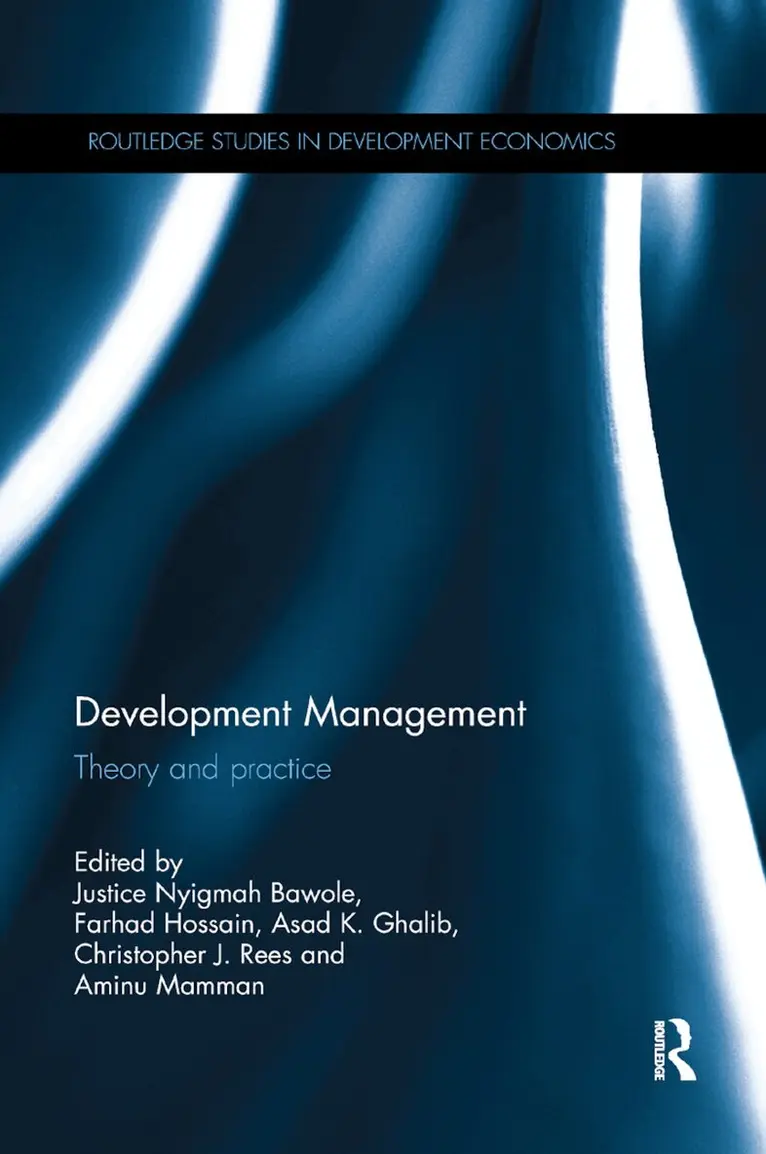
Despite significant financial investments, the rate of development and pace of poverty reduction in developing and transitional countries has not always matched expectations. Development management typically involves complex interactions between governmental and non-governmental organisations, donors and members of the public, and can be difficult to navigate.
This volume brings together a group of international contributors to explore the theoretical and empirical underpinnings of development management, and to consider the prospects and challenges associated with it in the context of both developing and transitional countries. Referring to dominant norms and values in public and developmental organisations, development management is tied up with the attitudes and perceptions of various stakeholders including: government officials, public sector managers, aid workers, donors and members of the public. Attempting to make sense of complex interactions between these actors is highly problematic and calls for new approaches, models and insights. Based on cutting-edge research, the chapters challenge much of the previous discourse on the subject and evaluate the challenges and opportunities that it presents.
Development Management offers academics, researchers and practitioners of public administration, business and management, international development and political science a comprehensive and state-of-the-art review of current research on development management in the context of developing and transitional countries.
538 kr
Läs direkt efter köp
The book explores theoretical, methodological, and empirical underpinnings of administrative culture as well as prospects and challenges associated with it in the context of and across developing and transitional countries. Referring to dominant norms and values in public organizations administrative culture is about the attitudes and perceptions of public officials. In many countries civil servants are criticised for being corrupt, incompetent, unreliable and self-centred.Their attitudes, norms and values and the way they act are in constant conflict with rule of law. Recently the virtues of the Weberian model of bureaucracy have been reclaimed as an alternative to New Public Management (NPM): i.e. as a model which emphasizes impartiality, rule-following, expertise, and hierarchy rather than manipulation of incentive structures and market competition. In particular it has been argued that a system of meritocratic recruitment and predictable, long-term careers increases the professional competence of the bureaucrats and fosters a culture of professionalism among them. Still it is unclear how and under what conditions such a model can be adopted.Among main hindrances seems to be established power structures and the existing political and societal culture which undermine the effective implementation of the Weberian model.
This book was published a s aspecial issue of the International Journal of Public Administration.
542 kr
Läs direkt efter köp
The book explores theoretical, methodological, and empirical underpinnings of administrative culture as well as prospects and challenges associated with it in the context of and across developing and transitional countries. Referring to dominant norms and values in public organizations administrative culture is about the attitudes and perceptions of public officials. In many countries civil servants are criticised for being corrupt, incompetent, unreliable and self-centred.Their attitudes, norms and values and the way they act are in constant conflict with rule of law. Recently the virtues of the Weberian model of bureaucracy have been reclaimed as an alternative to New Public Management (NPM): i.e. as a model which emphasizes impartiality, rule-following, expertise, and hierarchy rather than manipulation of incentive structures and market competition. In particular it has been argued that a system of meritocratic recruitment and predictable, long-term careers increases the professional competence of the bureaucrats and fosters a culture of professionalism among them. Still it is unclear how and under what conditions such a model can be adopted.Among main hindrances seems to be established power structures and the existing political and societal culture which undermine the effective implementation of the Weberian model.
This book was published a s aspecial issue of the International Journal of Public Administration.