Farhana Sultana - Böcker
Visar alla böcker från författaren Farhana Sultana. Handla med fri frakt och snabb leverans.
8 produkter
8 produkter
398 kr
Skickas inom 10-15 vardagar
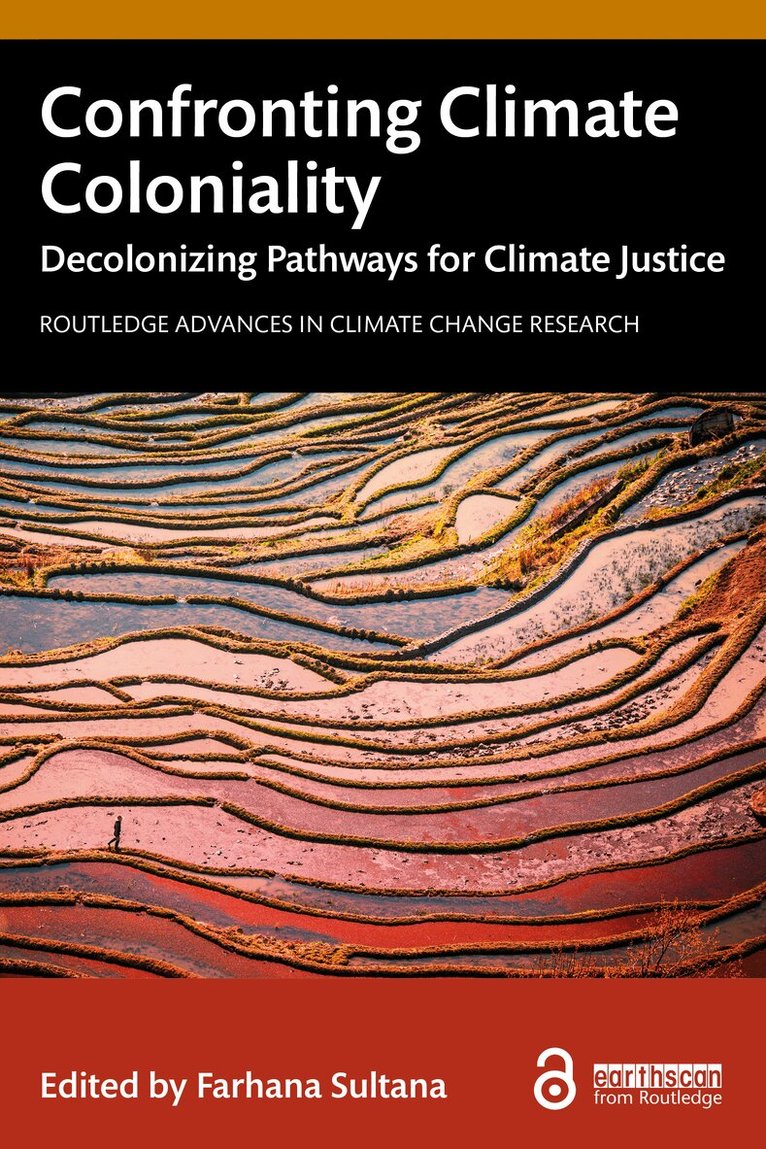
This timely and urgent collection brings together cutting-edge interdisciplinary scholarship and ideas from around the world to present critical examinations of climate coloniality.Confronting Climate Coloniality exposes how legacies of colonialism, imperialism, and capitalism co-produce and exacerbate the climate crisis, create disproportionate impacts on those who contributed the least to climate change, and influence global and local responses. Climate coloniality is perpetuated through processes of neoliberalism, racial capitalism, development interventions, economic growth models, media, and education. Confronting climate coloniality entails decolonizing climate discourses and governance, challenging the dominant framings and policies, interrogating material, geopolitical, and institutional arrangements for tackling the climate crisis, and centering Global South and Indigenous knowledge, experiences, strategies, and solutions. Confronting Climate Coloniality: Decolonizing Pathways for Climate Justice provides critical insights and strategies for transformative action and fosters deeper understandings of the structural injustices entangled with climate change in governance, framings, policies, responses, and praxis. This collection offers pioneering interdisciplinary research on alternative frameworks for decolonized approaches for more meaningful climate justice.With originality, scholarly rigor, and emphasis on amplifying marginalized voices, this collection is an indispensable resource for interdisciplinary scholars, policymakers, and activists committed to advancing climate justice.
1 765 kr
Skickas inom 10-15 vardagar
This timely and urgent collection brings together cutting-edge interdisciplinary scholarship and ideas from around the world to present critical examinations of climate coloniality.Confronting Climate Coloniality exposes how legacies of colonialism, imperialism, and capitalism co-produce and exacerbate the climate crisis, create disproportionate impacts on those who contributed the least to climate change, and influence global and local responses. Climate coloniality is perpetuated through processes of neoliberalism, racial capitalism, development interventions, economic growth models, media, and education. Confronting climate coloniality entails decolonizing climate discourses and governance, challenging the dominant framings and policies, interrogating material, geopolitical, and institutional arrangements for tackling the climate crisis, and centering Global South and Indigenous knowledge, experiences, strategies, and solutions. Confronting Climate Coloniality: Decolonizing Pathways for Climate Justice provides critical insights and strategies for transformative action and fosters deeper understandings of the structural injustices entangled with climate change in governance, framings, policies, responses, and praxis. This collection offers pioneering interdisciplinary research on alternative frameworks for decolonized approaches for more meaningful climate justice.With originality, scholarly rigor, and emphasis on amplifying marginalized voices, this collection is an indispensable resource for interdisciplinary scholars, policymakers, and activists committed to advancing climate justice.
2 100 kr
Skickas inom 10-15 vardagar
Scholarship on the right to water has proliferated in interesting and unexpected ways in recent years. This book broadens existing discussions on the right to water in order to shed critical light on the pathways, pitfalls, prospects, and constraints that exist in achieving global goals, as well as advancing debates around water governance and water justice. The book shows how both discourses and struggles around the right to water have opened new perspectives, and possibilities in water governance, fostering new collective and moral claims for water justice, while effecting changes in laws and policies around the world. In light of the 2010 UN ratification on the human right to water and sanitation, shifts have taken place in policy, legal frameworks, local implementation, as well as in national dialogues. Chapters in the book illustrate the novel ways in which the right to water has been taken up in locations drawn globally, highlighting the material politics that are enabled and negotiated through this framework in order to address ongoing water insecurities. This book reflects the urgent need to take stock of debates in light of new concerns around post-neoliberal political developments, the challenges of the Anthropocene and climate change, the transition from the Millennium Development Goals (MDGs) to the Sustainable Development Goals (SDGs), as well as the mobilizations around the right to water in the global North. This book is essential reading for scholars and students of water governance, environmental policy, politics, geography, and law. It will be of great interest to policymakers and practitioners working in water governance, as well as the human right to water and sanitation.
614 kr
Skickas inom 10-15 vardagar
Scholarship on the right to water has proliferated in interesting and unexpected ways in recent years. This book broadens existing discussions on the right to water in order to shed critical light on the pathways, pitfalls, prospects, and constraints that exist in achieving global goals, as well as advancing debates around water governance and water justice. The book shows how both discourses and struggles around the right to water have opened new perspectives, and possibilities in water governance, fostering new collective and moral claims for water justice, while effecting changes in laws and policies around the world. In light of the 2010 UN ratification on the human right to water and sanitation, shifts have taken place in policy, legal frameworks, local implementation, as well as in national dialogues. Chapters in the book illustrate the novel ways in which the right to water has been taken up in locations drawn globally, highlighting the material politics that are enabled and negotiated through this framework in order to address ongoing water insecurities. This book reflects the urgent need to take stock of debates in light of new concerns around post-neoliberal political developments, the challenges of the Anthropocene and climate change, the transition from the Millennium Development Goals (MDGs) to the Sustainable Development Goals (SDGs), as well as the mobilizations around the right to water in the global North. This book is essential reading for scholars and students of water governance, environmental policy, politics, geography, and law. It will be of great interest to policymakers and practitioners working in water governance, as well as the human right to water and sanitation.
818 kr
Skickas inom 10-15 vardagar
The right to clean water has been adopted by the United Nations as a basic human right. Yet how such universal calls for a right to water are understood, negotiated, experienced and struggled over remain key challenges. The Right to Water elucidates how universal calls for rights articulate with local historical geographical contexts, governance, politics and social struggles, thereby highlighting the challenges and the possibilities that exist. Bringing together a unique range of academics, policy-makers and activists, the book analyzes how struggles for the right to water have attempted to translate moral arguments over access to safe water into workable claims. This book is an intervention at a crucial moment into the shape and future direction of struggles for the right to water in a range of political, geographic and socio-economics contexts, seeking to be pro-active in defining what this struggle could mean and how it might be taken forward in a far broader transformative politics. The Right to Water engages with a range of approaches that focus on philosophical, legal and governance perspectives before seeking to apply these more abstract arguments to an array of concrete struggles and case studies. In so doing, the book builds on empirical examples from Africa, Asia, Oceania, Latin America, the Middle East, North America and the European Union.
2 171 kr
Skickas inom 10-15 vardagar
The right to clean water has been adopted by the United Nations as a basic human right. Yet how such universal calls for a right to water are understood, negotiated, experienced and struggled over remain key challenges. The Right to Water elucidates how universal calls for rights articulate with local historical geographical contexts, governance, politics and social struggles, thereby highlighting the challenges and the possibilities that exist. Bringing together a unique range of academics, policy-makers and activists, the book analyzes how struggles for the right to water have attempted to translate moral arguments over access to safe water into workable claims. This book is an intervention at a crucial moment into the shape and future direction of struggles for the right to water in a range of political, geographic and socio-economics contexts, seeking to be pro-active in defining what this struggle could mean and how it might be taken forward in a far broader transformative politics. The Right to Water engages with a range of approaches that focus on philosophical, legal and governance perspectives before seeking to apply these more abstract arguments to an array of concrete struggles and case studies. In so doing, the book builds on empirical examples from Africa, Asia, Oceania, Latin America, the Middle East, North America and the European Union.
Eating, Drinking: Surviving
The International Year of Global Understanding - IYGU
Häftad, Engelska, 2016
218 kr
Skickas inom 10-15 vardagar
This publication addresses the global challenges of food and water security in a rapidly changing and complex world.
478 kr
Skickas inom 5-8 vardagar