Fengzhu Sun – författare
Visar alla böcker från författaren Fengzhu Sun. Handla med fri frakt och snabb leverans.
5 produkter
5 produkter
Del 15 - Computational Biology
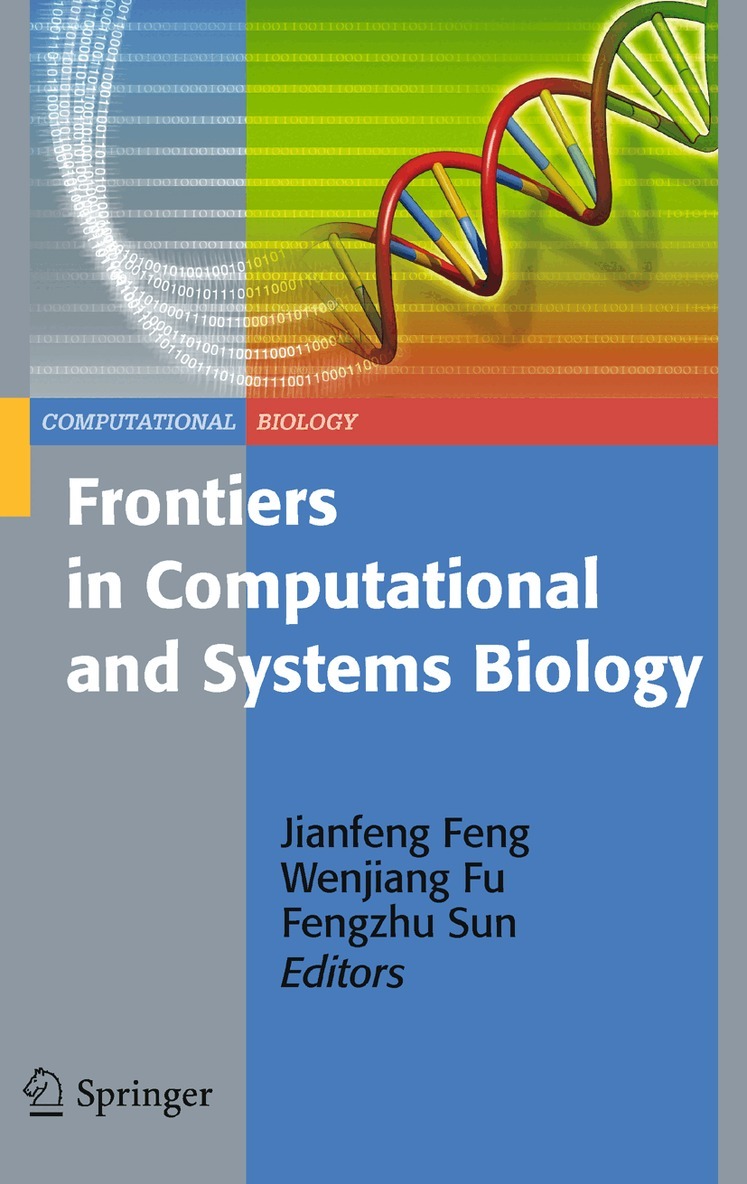
Frontiers in Computational and Systems Biology
Häftad, Engelska, 2012
1 633 kr
Skickas inom 10-15 vardagar
Biological and biomedical studies have entered a new era over the past two decades thanks to the wide use of mathematical models and computational approaches. A booming of computational biology, which sheerly was a theoretician’s fantasy twenty years ago, has become a reality. Obsession with computational biology and theoretical approaches is evidenced in articles hailing the arrival of what are va- ously called quantitative biology, bioinformatics, theoretical biology, and systems biology. New technologies and data resources in genetics, such as the International HapMap project, enable large-scale studies, such as genome-wide association st- ies, which could potentially identify most common genetic variants as well as rare variants of the human DNA that may alter individual’s susceptibility to disease and the response to medical treatment. Meanwhile the multi-electrode recording from behaving animals makes it feasible to control the animal mental activity, which could potentially leadto the development of useful brain–machine interfaces. - bracing the sheer volume of genetic, genomic, and other type of data, an essential approach is, ?rst of all, to avoid drowning the true signal in the data. It has been witnessed that theoretical approach to biology has emerged as a powerful and st- ulating research paradigm in biological studies, which in turn leads to a new - search paradigm in mathematics, physics, and computer science and moves forward with the interplays among experimental studies and outcomes, simulation studies, and theoretical investigations.
Del 15 - Computational Biology
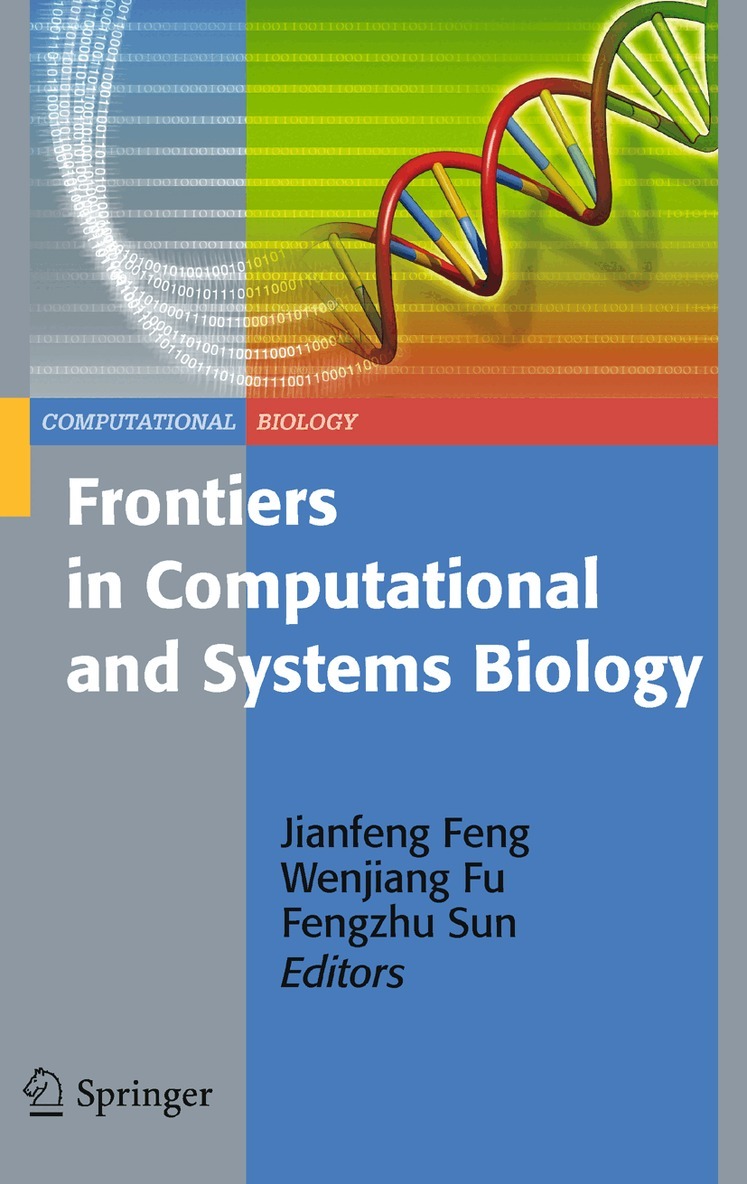
Frontiers in Computational and Systems Biology
Inbunden, Engelska, 2010
1 633 kr
Skickas inom 10-15 vardagar
Biological and biomedical studies have entered a new era over the past two decades thanks to the wide use of mathematical models and computational approaches. A booming of computational biology, which sheerly was a theoretician’s fantasy twenty years ago, has become a reality. Obsession with computational biology and theoretical approaches is evidenced in articles hailing the arrival of what are va- ously called quantitative biology, bioinformatics, theoretical biology, and systems biology. New technologies and data resources in genetics, such as the International HapMap project, enable large-scale studies, such as genome-wide association st- ies, which could potentially identify most common genetic variants as well as rare variants of the human DNA that may alter individual’s susceptibility to disease and the response to medical treatment. Meanwhile the multi-electrode recording from behaving animals makes it feasible to control the animal mental activity, which could potentially leadto the development of useful brain–machine interfaces. - bracing the sheer volume of genetic, genomic, and other type of data, an essential approach is, ?rst of all, to avoid drowning the true signal in the data. It has been witnessed that theoretical approach to biology has emerged as a powerful and st- ulating research paradigm in biological studies, which in turn leads to a new - search paradigm in mathematics, physics, and computer science and moves forward with the interplays among experimental studies and outcomes, simulation studies, and theoretical investigations.
E-bok
PDF, Engelska, 20101 977 kr
Läs direkt efter köp
Biological and biomedical studies have entered a new era over the past two decades thanks to the wide use of mathematical models and computational approaches. A booming of computational biology, which sheerly was a theoretician’s fantasy twenty years ago, has become a reality. Obsession with computational biology and theoretical approaches is evidenced in articles hailing the arrival of what are va- ously called quantitative biology, bioinformatics, theoretical biology, and systems biology. New technologies and data resources in genetics, such as the International HapMap project, enable large-scale studies, such as genome-wide association st- ies, which could potentially identify most common genetic variants as well as rare variants of the human DNA that may alter individual’s susceptibility to disease and the response to medical treatment. Meanwhile the multi-electrode recording from behaving animals makes it feasible to control the animal mental activity, which could potentially leadto the development of useful brain–machine interfaces. - bracing the sheer volume of genetic, genomic, and other type of data, an essential approach is, ?rst of all, to avoid drowning the true signal in the data. It has been witnessed that theoretical approach to biology has emerged as a powerful and st- ulating research paradigm in biological studies, which in turn leads to a new - search paradigm in mathematics, physics, and computer science and moves forward with the interplays among experimental studies and outcomes, simulation studies, and theoretical investigations.
Häftad, Engelska, 2013
549 kr
Skickas inom 10-15 vardagar
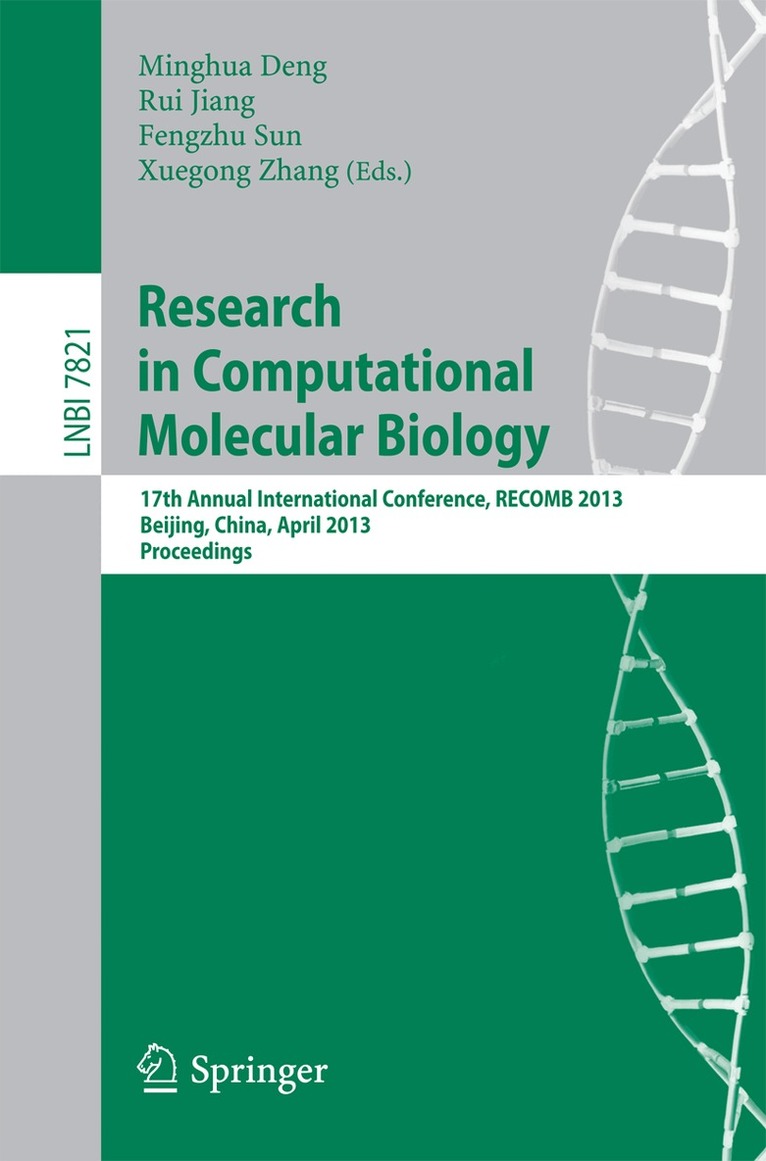
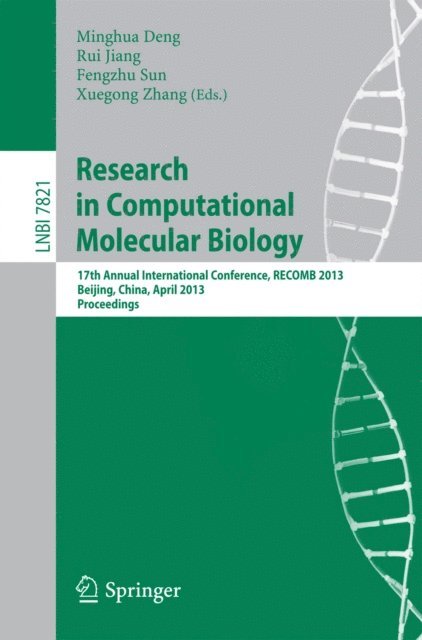
This book constitutes the refereed proceedings of the 17th Annual International Conference on Research in Computational Molecular Biology, RECOMB 2013, held in Beijing, China, in April 2013. The 32 revised full papers were carefully reviewed and selected from 167 submissions. The papers cover a wide range of topics including molecular sequence analysis; genes and regulatory elements; molecular evolution; gene expression; biological networks; sequencing and genotyping technologies; genomics; epigenomics; metagenomics; population, statistical genetics; systems biology; computational proteomics; computational structural biology; imaging; large-scale data management.
E-bok
PDF, Engelska, 2013693 kr
Läs direkt efter köp
This book constitutes the refereed proceedings of the 17th Annual International Conference on Research in Computational Molecular Biology, RECOMB 2013, held in Beijing, China, in April 2013. The 32 revised full papers were carefully reviewed and selected from 167 submissions. The papers cover a wide range of topics including molecular sequence analysis; genes and regulatory elements; molecular evolution; gene expression; biological networks; sequencing and genotyping technologies; genomics; epigenomics; metagenomics; population, statistical genetics; systems biology; computational proteomics; computational structural biology; imaging; large-scale data management.