F.K. Hwang – författare
Visar alla böcker från författaren F.K. Hwang. Handla med fri frakt och snabb leverans.
4 produkter
4 produkter
E-bok
PDF, Engelska, 1992763 kr
Läs direkt efter köp
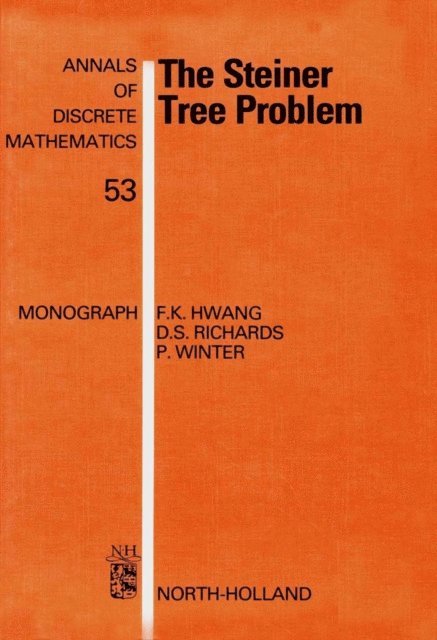
The Steiner problem asks for a shortest network which spans a given set of points. Minimum spanning networks have been well-studied when all connections are required to be between the given points. The novelty of the Steiner tree problem is that new auxiliary points can be introduced between the original points so that a spanning network of all the points will be shorter than otherwise possible. These new points are called Steiner points - locating them has proved problematic and research has diverged along many different avenues.This volume is devoted to the assimilation of the rich field of intriguing analyses and the consolidation of the fragments. A section has been given to each of the three major areas of interest which have emerged. The first concerns the Euclidean Steiner Problem, historically the original Steiner tree problem proposed by Jarník and Kössler in 1934. The second deals with the Steiner Problem in Networks, which was propounded independently by Hakimi and Levin and has enjoyed the most prolific research amongst the three areas. The Rectilinear Steiner Problem, introduced by Hanan in 1965, is discussed in the third part. Additionally, a forth section has been included, with chapters discussing areas where the body of results is still emerging.The collaboration of three authors with different styles and outlooks affords individual insights within a cohesive whole.
Inbunden, Engelska, 2000
1 123 kr
Skickas inom 10-15 vardagar
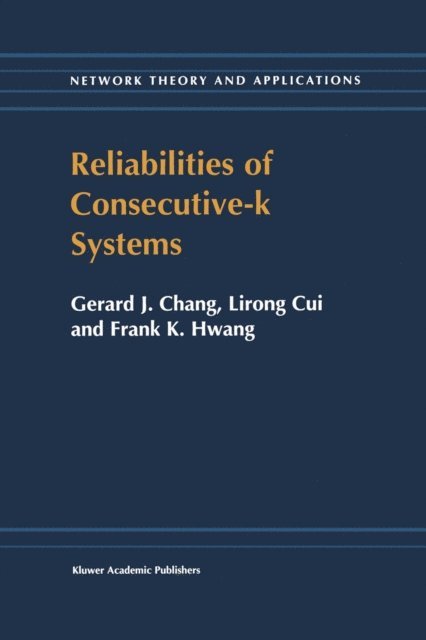
The consecutive-k system was first studied around 1980, and it soon became a very popular subject. The reasons were many-folded, includ ing: 1. The system is simple and natural. So most people can understand it and many can do some analysis. Yet it can grow in many directions and there is no lack of new topics. 2. The system is simple enough to become a prototype for demonstrat ing various ideas related to reliability. For example, the interesting concept of component importance works best with the consecutive-k system. 3. The system is supported by many applications. Twenty years have gone and hundreds of papers have been published on the subject. This seems to be a good time for retrospect and to sort the scattered material into a book. Besides providing our own per spective, the book will also serve as an easy reference to the numerous ramifications of the subject. It is hoped that a summary of work in the current period will become the seed of future break-through.
E-bok
PDF, Engelska, 20131 367 kr
Läs direkt efter köp
The consecutive-k system was first studied around 1980, and it soon became a very popular subject. The reasons were many-folded, includ ing: 1. The system is simple and natural. So most people can understand it and many can do some analysis. Yet it can grow in many directions and there is no lack of new topics. 2. The system is simple enough to become a prototype for demonstrat ing various ideas related to reliability. For example, the interesting concept of component importance works best with the consecutive-k system. 3. The system is supported by many applications. Twenty years have gone and hundreds of papers have been published on the subject. This seems to be a good time for retrospect and to sort the scattered material into a book. Besides providing our own per spective, the book will also serve as an easy reference to the numerous ramifications of the subject. It is hoped that a summary of work in the current period will become the seed of future break-through.
Häftad, Engelska, 2011
1 091 kr
Skickas inom 10-15 vardagar
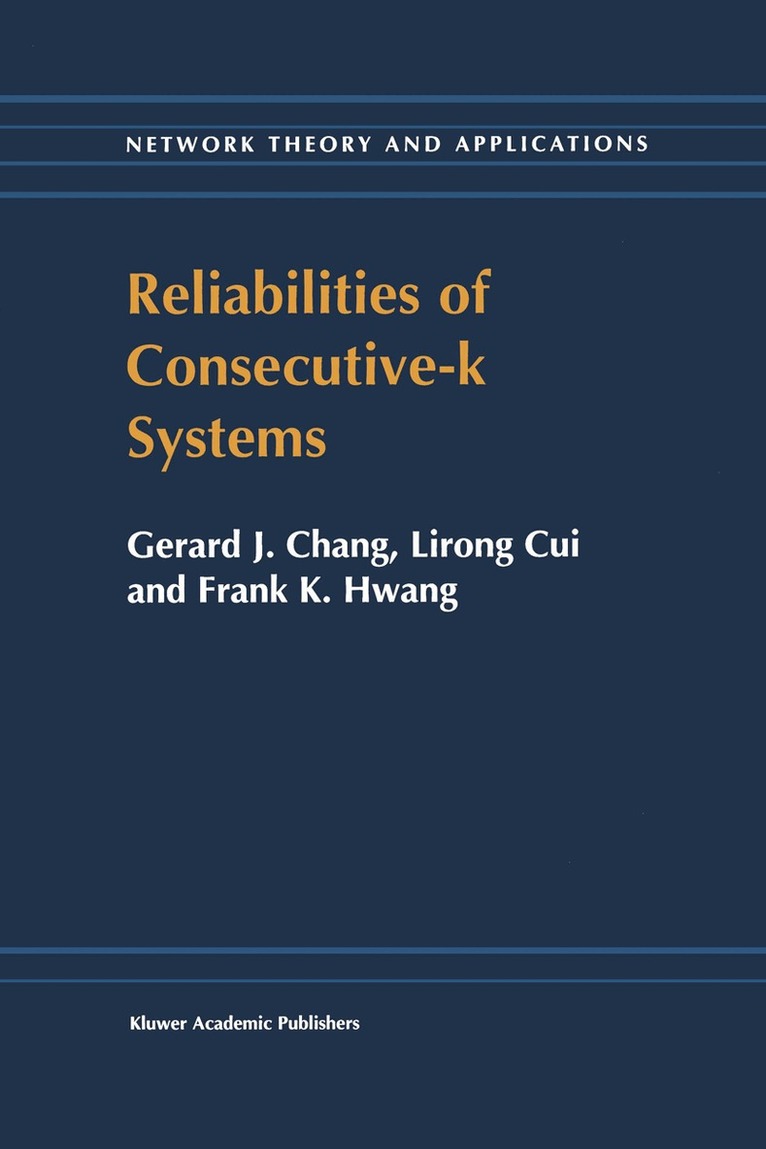
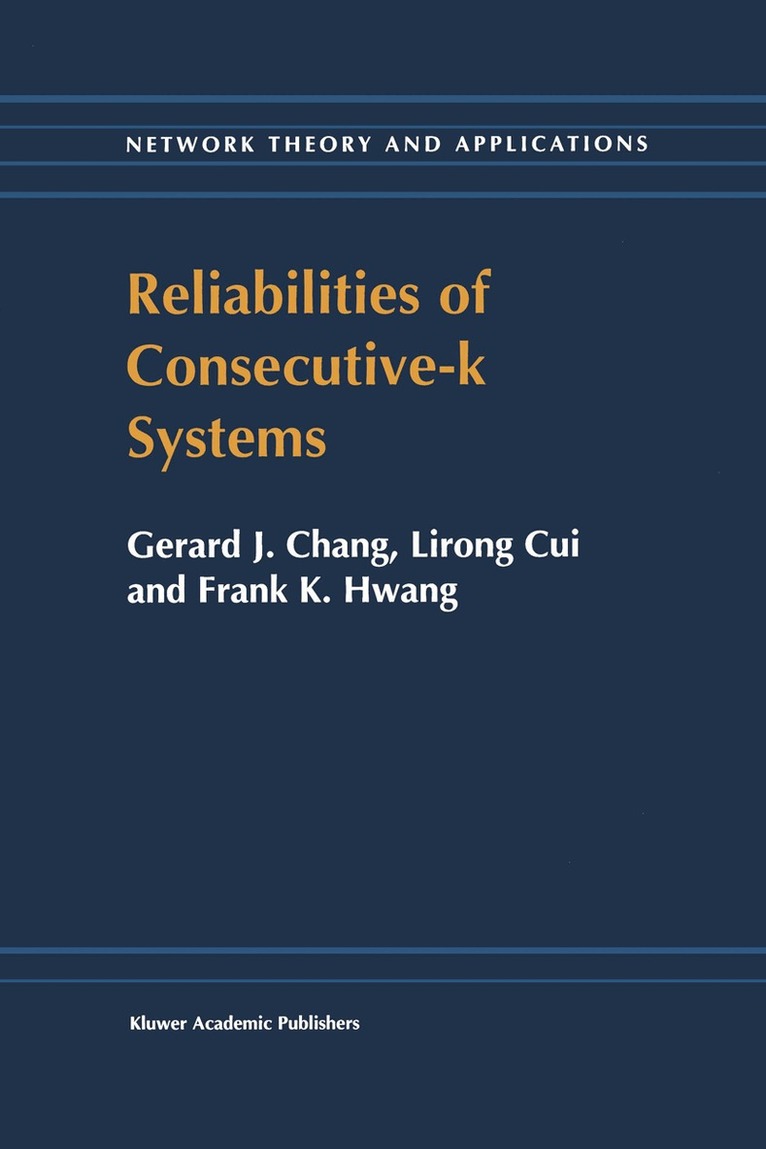
The consecutive-k system was first studied around 1980, and it soon became a very popular subject. The reasons were many-folded, includ ing: 1. The system is simple and natural. So most people can understand it and many can do some analysis. Yet it can grow in many directions and there is no lack of new topics. 2. The system is simple enough to become a prototype for demonstrat ing various ideas related to reliability. For example, the interesting concept of component importance works best with the consecutive-k system. 3. The system is supported by many applications. Twenty years have gone and hundreds of papers have been published on the subject. This seems to be a good time for retrospect and to sort the scattered material into a book. Besides providing our own per spective, the book will also serve as an easy reference to the numerous ramifications of the subject. It is hoped that a summary of work in the current period will become the seed of future break-through.