F.R. Amrine – författare
Visar alla böcker från författaren F.R. Amrine. Handla med fri frakt och snabb leverans.
5 produkter
5 produkter
Inbunden, Engelska, 1989
1 619 kr
Skickas inom 10-15 vardagar
On the 25th anniversary of the founding of the Boston Studies series in 1985, Cohen, Elkana, and Wartofsky wrote in another preface such as this that the time had come for establishing institutions supporting a vision to which the series had been devoted since its inception, namely that of a more broadly conceived, interdisciplinary study of the history and philosophy of science: In recent years it has become evident that, in addition to serious and competent disciplinary work on the specifics of the History of Science, the Philosophy of Science and the Sociology of Science, there is now a growing need to develop a problem oriented approach which no longer distinguishes between these three specialties in a cut and dried way. Since the time has come for such an approach, the institutional tools should be provided. A way to do so would be . . . to organize colloquia and to publish good papers stemming from these, without attempting to organize the papers under the separate rubrics of History of Philosophy or Sociology of Science; and moreover to consider it natural that any fundamental issue of the foundations of the sciences, or their place in a culture and the way they are institutionalized in the societal web, is still our concern, no matter whether we are a professional scientist, historian or philosopher who deals with the problem (p. vii).
Del 97 - Boston Studies in the Philosophy and History of Science
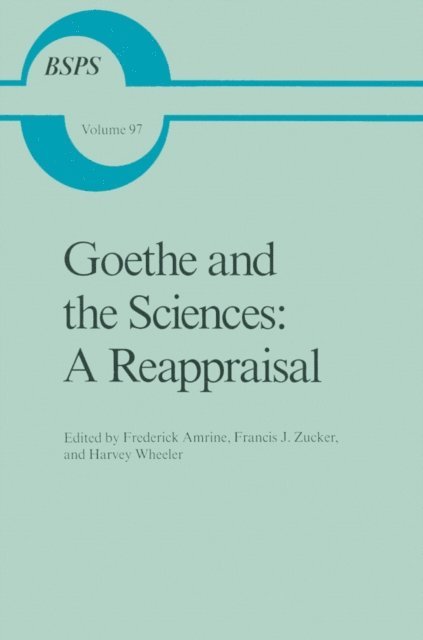
Goethe and the Sciences: A Reappraisal
Häftad, Engelska, 1987
2 387 kr
Skickas inom 10-15 vardagar
But how far will Goethe share the devotion of these cosmic rationalists to the beautiful harmonies of mathematics, so distant from any pure and 'direct observation'? When such would be found, Goethe would be content, for (as he said to Eckermann, Feb. 18, 1829): .
E-bok
PDF, Engelska, 20121 995 kr
Läs direkt efter köp
On the 25th anniversary of the founding of the Boston Studies series in 1985, Cohen, Elkana, and Wartofsky wrote in another preface such as this that the time had come for establishing institutions supporting a vision to which the series had been devoted since its inception, namely that of a more broadly conceived, interdisciplinary study of the history and philosophy of science: In recent years it has become evident that, in addition to serious and competent disciplinary work on the specifics of the History of Science, the Philosophy of Science and the Sociology of Science, there is now a growing need to develop a problem oriented approach which no longer distinguishes between these three specialties in a cut and dried way. Since the time has come for such an approach, the institutional tools should be provided. A way to do so would be . . . to organize colloquia and to publish good papers stemming from these, without attempting to organize the papers under the separate rubrics of History of Philosophy or Sociology of Science; and moreover to consider it natural that any fundamental issue of the foundations of the sciences, or their place in a culture and the way they are institutionalized in the societal web, is still our concern, no matter whether we are a professional scientist, historian or philosopher who deals with the problem (p. vii).
E-bok
PDF, Engelska, 20122 947 kr
Läs direkt efter köp
of him in like measure within myself, that is my highest wish. This noble individual was not conscious of the fact that at that very moment the divine within him and the divine of the universe were most intimately united. So, for Goethe, the resonance with a natural rationality seems part of the genius of modern science. Einstein''s ''cosmic religion'', which reflects Spinoza, also echoes Goethe''s remark (Ibid. , Item 575 from 1829): Man must cling to the belief that the incomprehensible is comprehensible. Else he would give up investigating. But how far will Goethe share the devotion of these cosmic rationalists to the beautiful harmonies of mathematics, so distant from any pure and ''direct observation''? Kepler, Spinoza, Einstein need not, and would not, rest with discovery of a pattern within, behind, as a source of, the phenomenal world, and they would not let even the most profound of descriptive generalities satisfy scientific curiosity. For his part, Goethe sought fundamental archetypes, as in his intuition of a Urpjlanze, basic to all plants, infinitely plastic. When such would be found, Goethe would be content, for (as he said to Eckermann, Feb. 18, 1829): . . . to seek something behind (the Urphaenomenon) is futile. Here is the limit. But as a rule men are not satisfied to behold an Urphaenomenon. They think there must be something beyond. They are like children who, having looked into a mirror, turn it around to see what is on the other side.
Del 115 - Boston Studies in the Philosophy and History of Science
Literature and Science as Modes of Expression
Häftad, Engelska, 2011
1 653 kr
Skickas inom 10-15 vardagar
On the 25th anniversary of the founding of the Boston Studies series in 1985, Cohen, Elkana, and Wartofsky wrote in another preface such as this that the time had come for establishing institutions supporting a vision to which the series had been devoted since its inception, namely that of a more broadly conceived, interdisciplinary study of the history and philosophy of science: In recent years it has become evident that, in addition to serious and competent disciplinary work on the specifics of the History of Science, the Philosophy of Science and the Sociology of Science, there is now a growing need to develop a problem oriented approach which no longer distinguishes between these three specialties in a cut and dried way. Since the time has come for such an approach, the institutional tools should be provided. A way to do so would be . . . to organize colloquia and to publish good papers stemming from these, without attempting to organize the papers under the separate rubrics of History of Philosophy or Sociology of Science; and moreover to consider it natural that any fundamental issue of the foundations of the sciences, or their place in a culture and the way they are institutionalized in the societal web, is still our concern, no matter whether we are a professional scientist, historian or philosopher who deals with the problem (p. vii).