Francis J. Zucker – författare
Visar alla böcker från författaren Francis J. Zucker. Handla med fri frakt och snabb leverans.
5 produkter
5 produkter
Del 97 - Boston Studies in the Philosophy and History of Science
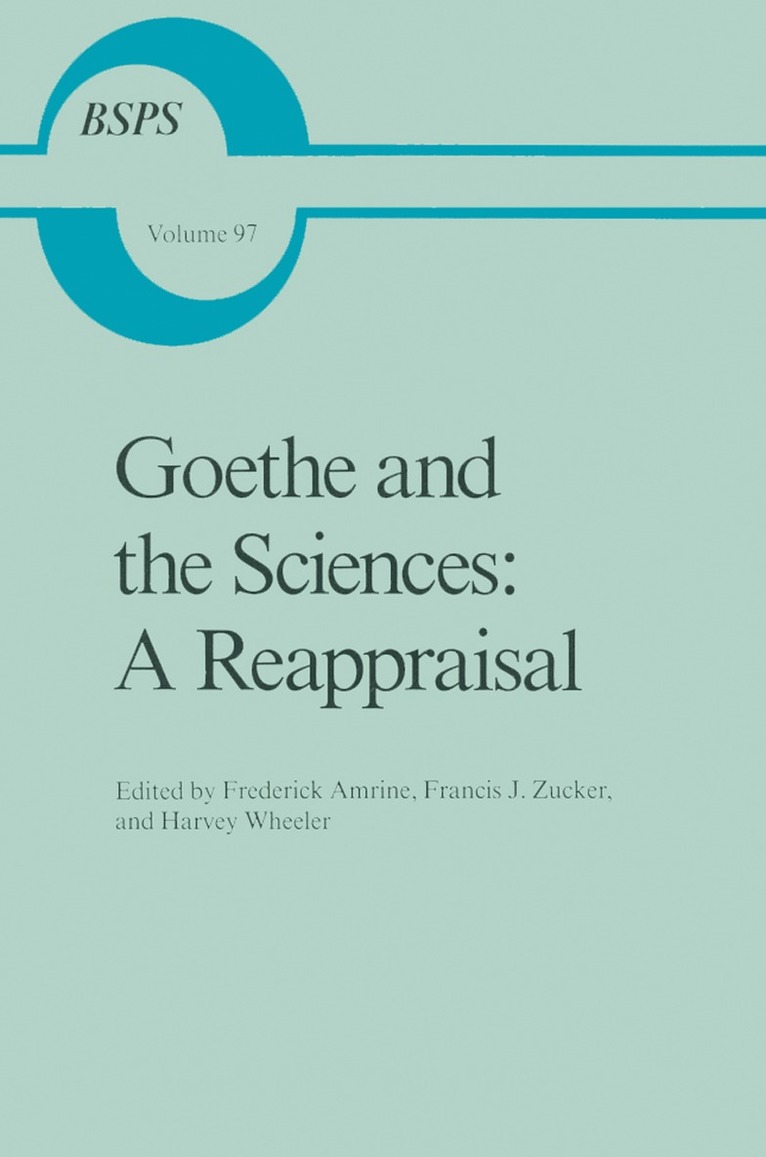
Goethe and the Sciences: A Reappraisal
Häftad, Engelska, 1987
2 387 kr
Skickas inom 10-15 vardagar
But how far will Goethe share the devotion of these cosmic rationalists to the beautiful harmonies of mathematics, so distant from any pure and 'direct observation'? When such would be found, Goethe would be content, for (as he said to Eckermann, Feb. 18, 1829): .
E-bok
PDF, Engelska, 2012693 kr
Läs direkt efter köp
It has been said that "never in the history of human progress has a better and cheaper method of preventing illness been developed than immunization". This is well illustrated by the WHO Expanded Programme on Immunization (EPI) which in developing countries is now preventing nearly a million deaths annually from measles, pertussis and neonatal tetanus, and for which there is a commitment by the WHO and UNICEF to protect all children by immunization by the end of the decade. This enormous undertaking will be facilitated by the rapid advances in molecular biology and recombinant DNA technology, in the understanding of immunological mechanisms and by the production and application of monoclonal antibodies so that the structure and location of important antigenic determinants or epitopes can be determined. Chemical synthesis of oligopeptides has been simplified, and computer programmes and X-ray crystallography provide the tools for the determination of three-dimensional structure of proteins, so that the structure and location of important antigenic determinants or epitopes can be predicted. These techniques have opened the way to the improvement of existing vaccines and to the development and production of new vaccines against infections for which vaccines are not available. New vaccines under development include vaccines against hepatitis B, hepatitis A, malaria, vaccines for typhoid, cholera, rota virus infection and other diarrhoeal diseases, leprosy, rabies, the acquired immune deficiency syndrome (AIDS), rubella, EB virus, schistosomiasis and other infections. These recent developments are discussed in the volume by internationally recognized experts assembled from several countries.
E-bok
PDF, Engelska, 20122 947 kr
Läs direkt efter köp
of him in like measure within myself, that is my highest wish. This noble individual was not conscious of the fact that at that very moment the divine within him and the divine of the universe were most intimately united. So, for Goethe, the resonance with a natural rationality seems part of the genius of modern science. Einstein''s ''cosmic religion'', which reflects Spinoza, also echoes Goethe''s remark (Ibid. , Item 575 from 1829): Man must cling to the belief that the incomprehensible is comprehensible. Else he would give up investigating. But how far will Goethe share the devotion of these cosmic rationalists to the beautiful harmonies of mathematics, so distant from any pure and ''direct observation''? Kepler, Spinoza, Einstein need not, and would not, rest with discovery of a pattern within, behind, as a source of, the phenomenal world, and they would not let even the most profound of descriptive generalities satisfy scientific curiosity. For his part, Goethe sought fundamental archetypes, as in his intuition of a Urpjlanze, basic to all plants, infinitely plastic. When such would be found, Goethe would be content, for (as he said to Eckermann, Feb. 18, 1829): . . . to seek something behind (the Urphaenomenon) is futile. Here is the limit. But as a rule men are not satisfied to behold an Urphaenomenon. They think there must be something beyond. They are like children who, having looked into a mirror, turn it around to see what is on the other side.
Del 12 - Immunology and Medicine
Recent Developments in Prophylactic Immunization
Häftad, Engelska, 2011
556 kr
Skickas inom 10-15 vardagar
It has been said that "never in the history of human progress has a better and cheaper method of preventing illness been developed than immunization". This is well illustrated by the WHO Expanded Programme on Immunization (EPI) which in developing countries is now preventing nearly a million deaths annually from measles, pertussis and neonatal tetanus, and for which there is a commitment by the WHO and UNICEF to protect all children by immunization by the end of the decade. This enormous undertaking will be facilitated by the rapid advances in molecular biology and recombinant DNA technology, in the understanding of immunological mechanisms and by the production and application of monoclonal antibodies so that the structure and location of important antigenic determinants or epitopes can be determined. Chemical synthesis of oligopeptides has been simplified, and computer programmes and X-ray crystallography provide the tools for the determination of three-dimensional structure of proteins, so that the structure and location of important antigenic determinants or epitopes can be predicted. These techniques have opened the way to the improvement of existing vaccines and to the development and production of new vaccines against infections for which vaccines are not available. New vaccines under development include vaccines against hepatitis B, hepatitis A, malaria, vaccines for typhoid, cholera, rota virus infection and other diarrhoeal diseases, leprosy, rabies, the acquired immune deficiency syndrome (AIDS), rubella, EB virus, schistosomiasis and other infections. These recent developments are discussed in the volume by internationally recognized experts assembled from several countries.
Inbunden, Engelska
1 416 kr
Tillfälligt slut