Francesca Rizzo – författare
Visar alla böcker från författaren Francesca Rizzo. Handla med fri frakt och snabb leverans.
5 produkter
5 produkter
Häftad, Engelska, 2024
436 kr
Skickas inom 10-15 vardagar
This open access book presents a catalogue of over one thousand indicators which can be used by cities' public administrators to monitor and evaluate social innovation action plans to support people-centred, collaborative or co-designed solutions to lower carbon emissions. Indicators are clustered according to a framework of social innovation solutions for climate neutrality at city level, developed by merging top-down academic knowledge with bottom-up pragmatic case studies. There is currently limited guidance on how to embed social innovations in their cities’ action plans with the aim of reaching climate neutrality, and on how to assess the progress and impacts of such people-centred projects in cities. The book addresses this gap and is thus relevant for scholars in the field of policy-making and design, as well as cities’ transition teams, policymakers and consultants. Based on the work developed within the EU-funded project NetZeroCities, intervention logics are provided for each of the ten categories of action, with related indicators clustered by category and evaluation criteria (effectiveness, efficiency, relevance, replicability, and scalability). Guidelines to implement the framework support city administrators in defining steps they need to follow to apply the indicators to their local case, making social innovation a crucial lever for accelerating systemic transformation.
Häftad, Engelska, 2024
320 kr
Skickas inom 5-8 vardagar
This open access book examines how the adoption of Design Thinking (DT) can support public organisations in overcoming some of the current barriers in e-participation. Scholars have discussed the adoption of technology to strengthen public engagement through e-participation, streamline and enhance the relationship between government and society, and improve accessibility and effectiveness. However, barriers persist, necessitating further research in this area. By analysing e-participation barriers emerging from the literature and aligning them with notions in the DT literature, this book identifies five core DT practices to enhance e-participation: (i) Meaning creation and sense-making, (ii) Publics formation, (iii) Co-production, (iv) Experimentation and prototyping, and (v) Changing organisational culture. As a result, this book provides insights into enhancing tech-aided public engagement and promoting inclusivity for translating citizen input into tangible service implementations. The book triangulates qualitative analysis of relevant literature in the fields of e-participation and DT with knowledge from European projects experimenting with public participation activities implying experimentation with digital tools. This research aims to bridge the gap between theoretical frameworks and practical application, ultimately contributing to more effective e-participation and digital public services.
Inbunden, Engelska, 2016
1 618 kr
Skickas inom 10-15 vardagar
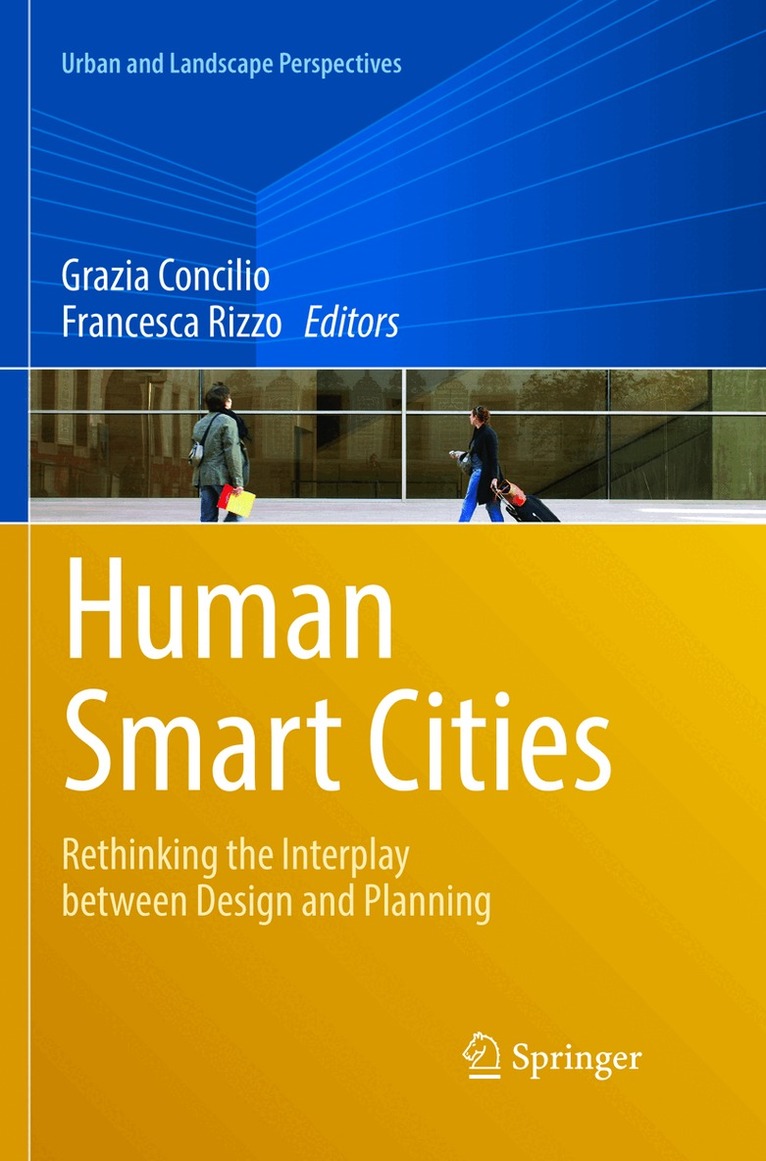
Within the most recent discussion on smart cities and the way this vision is affecting urban changes and dynamics, this book explores the interplay between planning and design both at the level of the design and planning domains’ theories and practices.Urban transformation is widely recognized as a complex phenomenon, rich in uncertainty. It is the unpredictable consequence of complex interplay between urban forces (both top-down or bottom-up), urban resources (spatial, social, economic and infrastructural as well as political or cognitive) and transformation opportunities (endogenous or exogenous).The recent attention to Urban Living Lab and Smart City initiatives is disclosinga promising bridge between the micro-scale environments, with the dynamics of such forces and resources, and the urban governance mechanisms. This bridge is represented by those urban collaborative environments, where processes of smart service co-design take place throughdialogic interaction with and among citizens within a situated and cultural-specific frame.
E-bok
PDF, Engelska, 20161 575 kr
Läs direkt efter köp
Within the most recent discussion on smart cities and the way this vision is affecting urban changes and dynamics, this book explores the interplay between planning and design both at the level of the design and planning domains’ theories and practices.Urban transformation is widely recognized as a complex phenomenon, rich in uncertainty. It is the unpredictable consequence of complex interplay between urban forces (both top-down or bottom-up), urban resources (spatial, social, economic and infrastructural as well as political or cognitive) and transformation opportunities (endogenous or exogenous).The recent attention to Urban Living Lab and Smart City initiatives is disclosinga promising bridge between the micro-scale environments, with the dynamics of such forces and resources, and the urban governance mechanisms. This bridge is represented by those urban collaborative environments, where processes of smart service co-design take place throughdialogic interaction with and among citizens within a situated and cultural-specific frame.
Häftad, Engelska, 2018
1 188 kr
Skickas inom 10-15 vardagar
Within the most recent discussion on smart cities and the way this vision is affecting urban changes and dynamics, this book explores the interplay between planning and design both at the level of the design and planning domains’ theories and practices.Urban transformation is widely recognized as a complex phenomenon, rich in uncertainty. It is the unpredictable consequence of complex interplay between urban forces (both top-down or bottom-up), urban resources (spatial, social, economic and infrastructural as well as political or cognitive) and transformation opportunities (endogenous or exogenous).The recent attention to Urban Living Lab and Smart City initiatives is disclosinga promising bridge between the micro-scale environments, with the dynamics of such forces and resources, and the urban governance mechanisms. This bridge is represented by those urban collaborative environments, where processes of smart service co-design take place throughdialogic interaction with and among citizens within a situated and cultural-specific frame.