Francesco Fronterotta – författare
1 435 kr
Kommande
531 kr
Kommande
Nietzsches persönliche Bibliothek
2 931 kr
Skickas inom 5-8 vardagar
1 538 kr
Skickas inom 5-8 vardagar
1 423 kr
Läs direkt efter köp
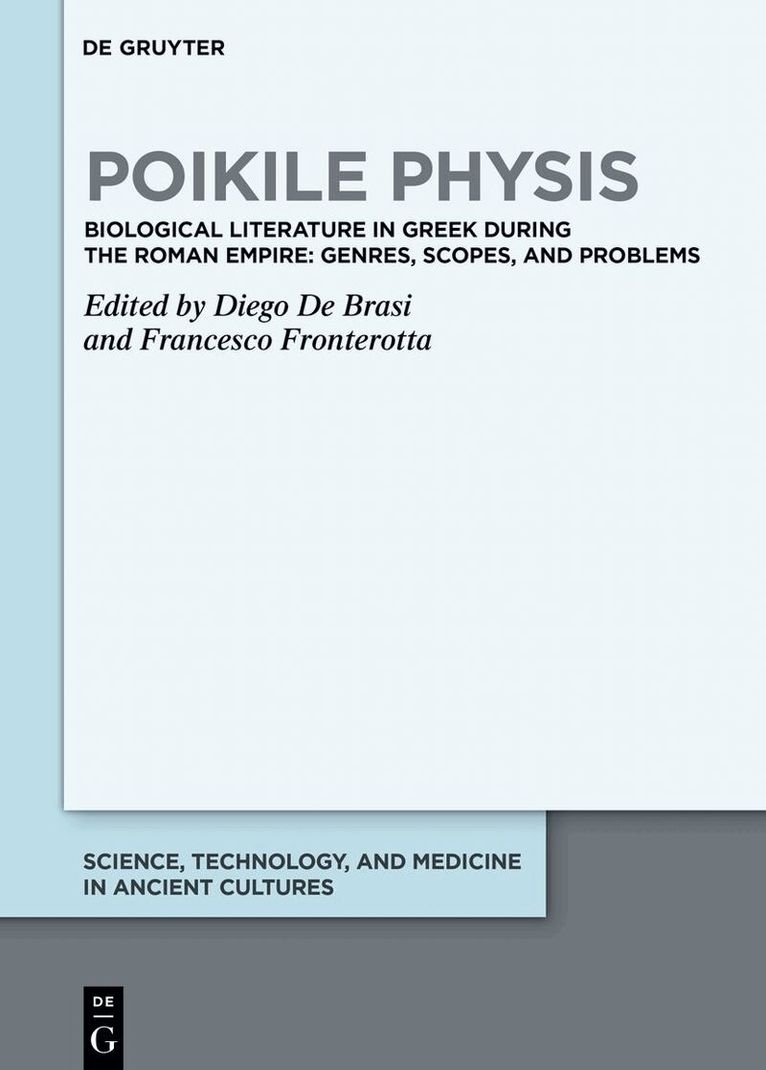
Biological literature of the Roman imperial period remains somehow ‘underestimated’. It is even quite difficult to speak of biological literature for this period at all: biology (apart from medicine) did not represent, indeed, a specific ‘subgenre’ of scientific literature. Nevertheless, writings as disparate as Philo of Alexandria’s Alexander, Plutarch’s De sollertia animalium or Bruta ratione uti, Aelian’s De Natura Animalium, Oppian’s Halieutika, Pseudo-Oppian’s Kynegetika, and Basil of Caeserea’s Homilies on the Creation engage with zoological, anatomic, or botanical questions. Poikile Physis examines how such writings appropriate, adapt, classify, re-elaborate and present biological knowledge which originated within the previous, mainly Aristotelian, tradition. It offers a holistic approach to these works by considering their reception of scientific material, their literary as well as rhetorical aspects, and their interaction with different socio-cultural conditions. The result of an interdisciplinary discussion among scholars of Greek studies, philosophy and history of science, the volume provides an initial analysis of forms and functions of biological literature in the imperial period.
1 423 kr
Läs direkt efter köp
Biological literature of the Roman imperial period remains somehow ‘underestimated’. It is even quite difficult to speak of biological literature for this period at all: biology (apart from medicine) did not represent, indeed, a specific ‘subgenre’ of scientific literature. Nevertheless, writings as disparate as Philo of Alexandria’s Alexander, Plutarch’s De sollertia animalium or Bruta ratione uti, Aelian’s De Natura Animalium, Oppian’s Halieutika, Pseudo-Oppian’s Kynegetika, and Basil of Caeserea’s Homilies on the Creation engage with zoological, anatomic, or botanical questions. Poikile Physis examines how such writings appropriate, adapt, classify, re-elaborate and present biological knowledge which originated within the previous, mainly Aristotelian, tradition. It offers a holistic approach to these works by considering their reception of scientific material, their literary as well as rhetorical aspects, and their interaction with different socio-cultural conditions. The result of an interdisciplinary discussion among scholars of Greek studies, philosophy and history of science, the volume provides an initial analysis of forms and functions of biological literature in the imperial period.
2 685 kr
Läs direkt efter köp