Franck Hofmann - Böcker
Visar alla böcker från författaren Franck Hofmann. Handla med fri frakt och snabb leverans.
8 produkter
8 produkter
1 753 kr
Skickas inom 5-8 vardagar
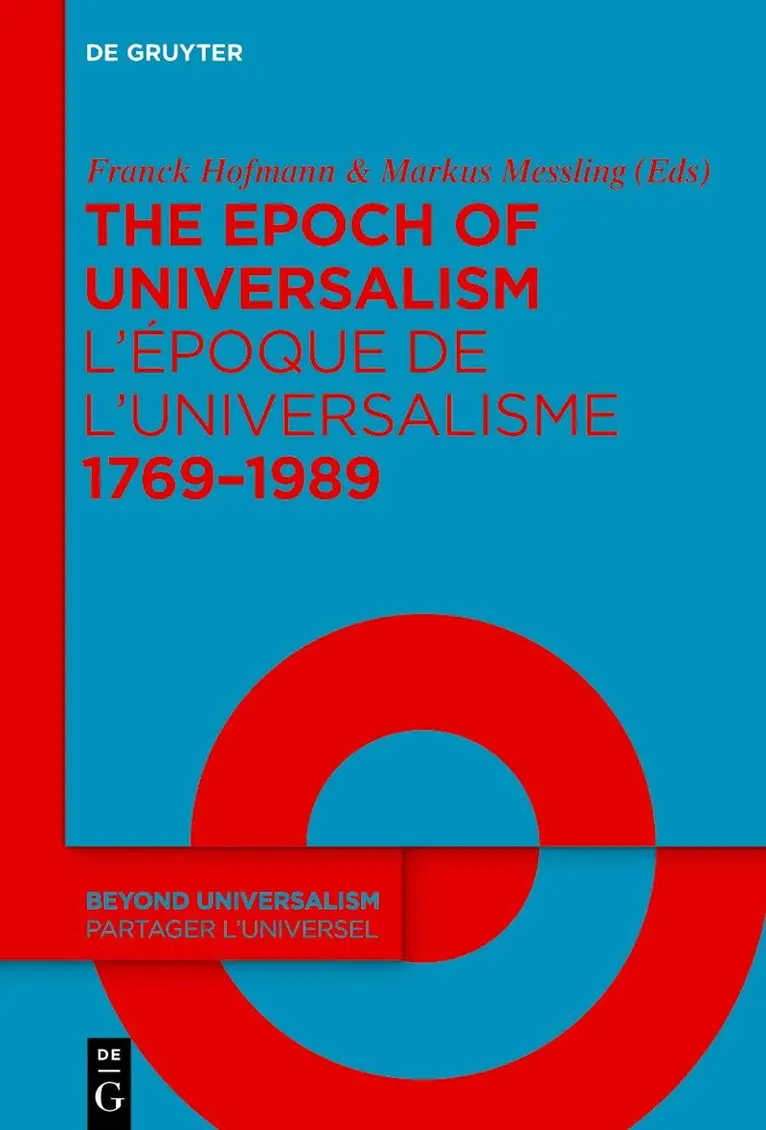
2019 witnessed the 30th anniversary of the German reunification. But the remembrance of the fall of the Berlin Wall coincided with another event of global importance that caught much less attention: the 250th anniversary of Napoleon Bonaparte’s birth. There is an undeniable historical and philosophical dimension to this coincidence. Napoleon’s appearance on the scene of world history seems to embody European universalism (soon thereafter in the form of a ‘modern’ imperial project); whilst scholars such as Francis Fukuyama saw in the events of 1989 its historical fulfilment. Today, we see more clearly that the fall of the Berlin Wall stands for an epistemic earthquake, which generated a world that can no longer be grasped through universal concepts. Here, we deal with the idea of Europe and of its relation to the world itself. Picking up on this contingency of world history with an ironic wink, the volume analyses in retrospect the epoch of European universalism. It focusses on its dialectics, polemically addressing and remembering both 1769 and 1989. L’année 2019 a été marquée par le 30e anniversaire de la réunification de l’Allemagne, éclipsant un autre événement d’envergure mondiale : le 250e anniversaire de Napoléon Bonaparte. La dimension philosophico-historique de cette coïncidence ne peut pourtant pas être négligée : si l’arrivée de Bonaparte sur la scène de l’histoire mondiale semble incarner l’avènement de l’universalisme européen (bientôt amené à prendre sa forme « moderne » et impériale), certains penseurs ont suggéré, avec Francis Fukuyama, que « 1989 » marquait son accomplissement historique. Aujourd’hui, il apparaît au contraire que la chute du mur de Berlin a été un véritable tremblement de terre épistémique, et rendu inopérants les concepts universels. Dans le monde d’après, c’est à l’idée d’Europe et à sa relation au monde que nous avons affaire. Revenant par un geste ironique sur cette contingence historique, le présent volume se veut une analyse rétrospective de l’époque de l’universalisme, dans toute la dialectique que les commémorations de 1769/1989 ont fait surgir.
313 kr
Skickas inom 5-8 vardagar
2019 witnessed the 30th anniversary of the German reunification. But the remembrance of the fall of the Berlin Wall coincided with another event of global importance that caught much less attention: the 250th anniversary of Napoleon Bonaparte’s birth. There is an undeniable historical and philosophical dimension to this coincidence. Napoleon’s appearance on the scene of world history seems to embody European universalism (soon thereafter in the form of a ‘modern’ imperial project); whilst scholars such as Francis Fukuyama saw in the events of 1989 its historical fulfilment. Today, we see more clearly that the fall of the Berlin Wall stands for an epistemic earthquake, which generated a world that can no longer be grasped through universal concepts. Here, we deal with the idea of Europe and of its relation to the world itself. Picking up on this contingency of world history with an ironic wink, the volume analyses in retrospect the epoch of European universalism. It focusses on its dialectics, polemically addressing and remembering both 1769 and 1989. L’année 2019 a été marquée par le 30e anniversaire de la réunification de l’Allemagne, éclipsant un autre événement d’envergure mondiale : le 250e anniversaire de Napoléon Bonaparte. La dimension philosophico-historique de cette coïncidence ne peut pourtant pas être négligée : si l’arrivée de Bonaparte sur la scène de l’histoire mondiale semble incarner l’avènement de l’universalisme européen (bientôt amené à prendre sa forme « moderne » et impériale), certains penseurs ont suggéré, avec Francis Fukuyama, que « 1989 » marquait son accomplissement historique. Aujourd’hui, il apparaît au contraire que la chute du mur de Berlin a été un véritable tremblement de terre épistémique, et rendu inopérants les concepts universels. Dans le monde d’après, c’est à l’idée d’Europe et à sa relation au monde que nous avons affaire. Revenant par un geste ironique sur cette contingence historique, le présent volume se veut une analyse rétrospective de l’époque de l’universalisme, dans toute la dialectique que les commémorations de 1769/1989 ont fait surgir.
1 594 kr
Skickas inom 3-6 vardagar
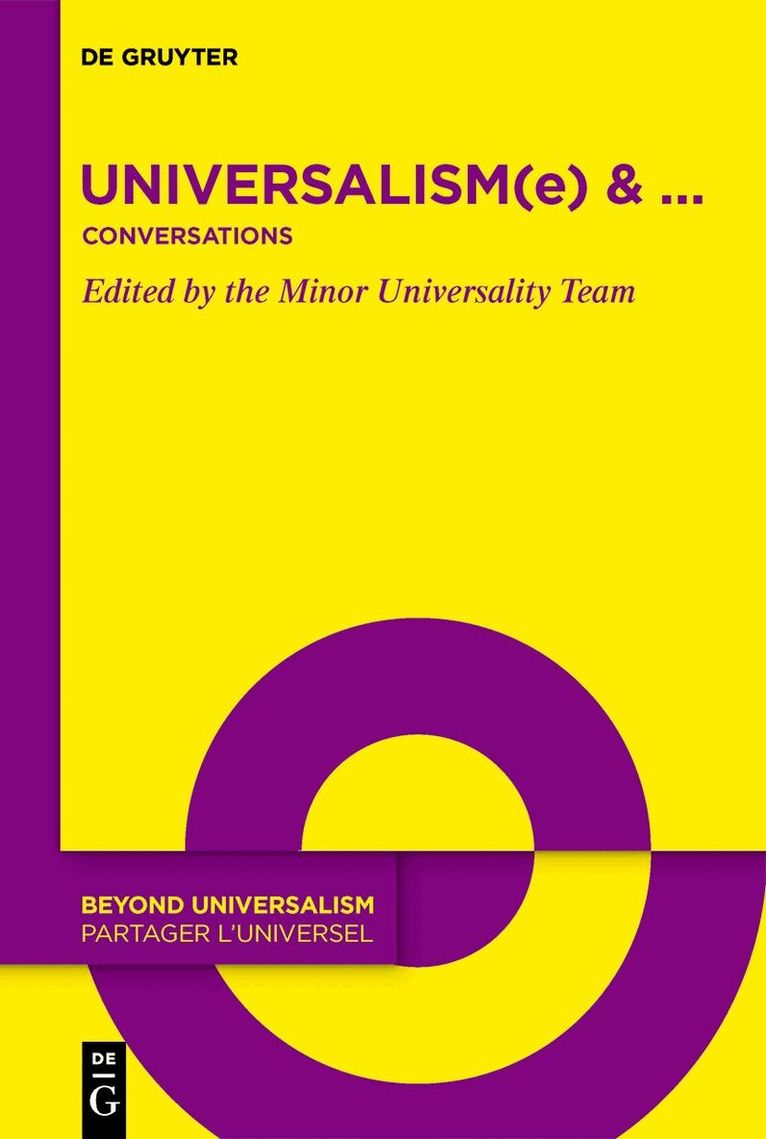
This book confronts the history and legitimacy of Western Universalism. In the form of conversations, it documents thinking-in-process about how new forms of universality after hegemonic universalism can be thought and practised. Bringing into play their practices and theories, the interlocutors of Universalism(e) & … lay their own traces of a minor universality, situated in the troubling present of our times. Ce livre s’attaque à l'histoire et à la légitimité de l’universalisme occidental. Sous la forme de conversations, il documente la réflexion en cours sur les façons de penser et de pratiquer de nouvelles formes d’universalité après l’universalisme hégémonique. À partir de leurs pratiques et de leurs théories, les interlocuteurs d’Universalism(e) & ... font apparaître leur propre cheminement autour de cette universalité mineure située dans le présent troublant de notre époque. Universalism(e) & … révolution, histoires concrètes, préhistoire, multiláteralisme, savoir(s), the partisan position, narration, reparation Entretiens avec / Conversations with: Arjun Appadurai, Leyla Dakhli, Souleymane Bachir Diagne, Giovanni Levi, Gisèle Sapiro, David Scott, Adania Shibli, Maria Stavrinaki
224 kr
Skickas inom 3-6 vardagar
224 kr
Skickas inom 3-6 vardagar
269 kr
Skickas inom 3-6 vardagar
266 kr
Skickas inom 3-6 vardagar
266 kr
Skickas inom 3-6 vardagar