François Grin – författare
Visar alla böcker från författaren François Grin. Handla med fri frakt och snabb leverans.
11 produkter
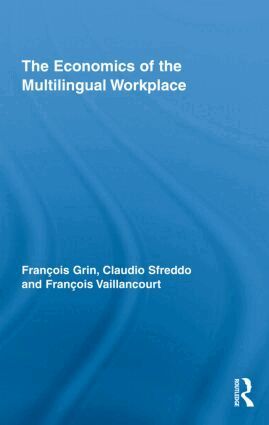
Economics of the Multilingual Workplace
Av François Grin, Claudio Sfreddo m. fl.
Inbunden, 2010
2586 kr
Lägg i varukorg
This book proposes a path-breaking study of the economics of multilingualism at work, proposing a systematic approach to the identification and measurement of the ways in which language skills and economic performance are related.Using the instruments of economic investigation, but also explicitly …
Economics of the Multilingual Workplace
Av François Grin, Claudio Sfreddo m. fl.
Häftad, 2013
937 kr
Lägg i varukorg
This book proposes a path-breaking study of the economics of multilingualism at work, proposing a systematic approach to the identification and measurement of the ways in which language skills and economic performance are related.Using the instruments of economic investigation, but also explicitly …
Routledge Handbook of Language Policy and Planning
Av Kathleen Heugh, Linda Cardinal m. fl.
E-bok, 2023
831 kr
Lägg i varukorg
The Routledge Handbook of Language Policy and Planning is a comprehensive and authoritative survey, including original contributions from leading senior scholars and rising stars to provide a basis for future research in language policy and planning in international, national, regional, and local …
Routledge Handbook of Language Policy and Planning
Av Kathleen Heugh, Linda Cardinal m. fl.
E-bok, 2023
831 kr
Lägg i varukorg
The Routledge Handbook of Language Policy and Planning is a comprehensive and authoritative survey, including original contributions from leading senior scholars and rising stars to provide a basis for future research in language policy and planning in international, national, regional, and local …
Status of the Translation Profession in the European Union
Av Anthony Pym, Claudio Sfreddo m. fl.
Inbunden, 2013
1190 kr
Lägg i varukorg
Based on thorough and extensive research, this book examines in detail traditional status signals in the translation profession. It provides case studies of eight European and non-European countries, with further chapters on sociological and economic modelling, and goes on to identify a number of …
Routledge Handbook of Language Policy and Planning
Av Michele Gazzola, François Grin m. fl.
Häftad, 2025
793 kr
Lägg i varukorg
The Routledge Handbook of Language Policy and Planning is a comprehensive and authoritative survey, including original contributions from leading senior scholars and rising stars to provide a basis for future research in language policy and planning in international, national, regional, and local …
Economics of the Multilingual Workplace
Av Francois Vaillancourt, Claudio Sfreddo m. fl.
E-bok, 2011
1106 kr
Lägg i varukorg
This book proposes a path-breaking study of the economics of multilingualism at work, proposing a systematic approach to the identification and measurement of the ways in which language skills and economic performance are related. Using the instruments of economic investigation, but also explicitly …
Economics of the Multilingual Workplace
Av Francois Vaillancourt, Claudio Sfreddo m. fl.
E-bok, 2011
1074 kr
Lägg i varukorg
This book proposes a path-breaking study of the economics of multilingualism at work, proposing a systematic approach to the identification and measurement of the ways in which language skills and economic performance are related. Using the instruments of economic investigation, but also explicitly …
Routledge Handbook of Language Policy and Planning
Av Michele Gazzola, François Grin m. fl.
Inbunden, 2023
3793 kr
Lägg i varukorg
The Routledge Handbook of Language Policy and Planning is a comprehensive and authoritative survey, including original contributions from leading senior scholars and rising stars to provide a basis for future research in language policy and planning in international, national, regional, and local …
Status of the Translation Profession in the European Union
Av Anthony Pym, Claudio Sfreddo m. fl.
Häftad, 2014
435 kr
Lägg i varukorg
Based on thorough and extensive research, this book examines in detail traditional status signals in the translation profession. It provides case studies of eight European and non-European countries, with further chapters on sociological and economic modelling, and goes on to identify a number of …