Frank C. Zagare - Böcker
Visar alla böcker från författaren Frank C. Zagare. Handla med fri frakt och snabb leverans.
6 produkter
6 produkter
1 343 kr
Skickas inom 5-8 vardagar
Known as the science of strategy, game theory is a branch of mathematics that has gained broad acceptance as a legitimate methodological tool, and has been widely adapted by a number of other fields. Frank C. Zagare provides an introduction to the application of game theory in the fields of security studies and diplomatic history, demonstrating the advantages of using a formal game-theoretic framework to explain complex events and strategic relationships. Comprised of three parts, the first illustrates the basic concepts of game theory, initially with abstract examples but later in the context of real world foreign policy decision-making. The author highlights the methodological problems of using game theory to construct an analytic narrative and the advantages of working around these obstacles. Part II develops three extended case studies that illustrate the theory at work: the First Moroccan Crisis of 1905-1906, the July Crisis of 1914, and the Cuban Missile Crisis of 1962. Finally, in Part III, Zagare describes a general theory of interstate conflict initiation, limitation, escalation, and resolution and rebuts criticisms of the methodology. Logically demanding, Game Theory, Diplomatic History and Security Studies conveys an intuitive understanding of the theory of games through the use of real-world examples to exemplify the 'theory in action'.
734 kr
Skickas inom 7-10 vardagar
Known as the science of strategy, game theory is a branch of mathematics that has gained broad acceptance as a legitimate methodological tool, and has been widely adapted by a number of other fields. Frank C. Zagare provides an introduction to the application of game theory in the fields of security studies and diplomatic history, demonstrating the advantages of using a formal game-theoretic framework to explain complex events and strategic relationships. Comprised of three parts, the first illustrates the basic concepts of game theory, initially with abstract examples but later in the context of real world foreign policy decision-making. The author highlights the methodological problems of using game theory to construct an analytic narrative and the advantages of working around these obstacles. Part II develops three extended case studies that illustrate the theory at work: the First Moroccan Crisis of 1905-1906, the July Crisis of 1914, and the Cuban Missile Crisis of 1962. Finally, in Part III, Zagare describes a general theory of interstate conflict initiation, limitation, escalation, and resolution and rebuts criticisms of the methodology. Logically demanding, Game Theory, Diplomatic History and Security Studies conveys an intuitive understanding of the theory of games through the use of real-world examples to exemplify the 'theory in action'.
444 kr
Skickas inom 7-10 vardagar
"Frank C. Zagare combines a deep command of historical scholarship and the sophisticated skills of an applied game theorist to develop and test a theory of why deterrence failed, catastrophically, in July 1914. . . . Zagare concludes with sage advice on how to avoid even more cataclysmic breakdowns in a nuclear world."---Steven J. Brams, New York University"Zagare's deft study of the origins of the First World War using his perfect deterrence theory uncovers new insights into that signal event and shows the value of formal theory applied to historical events. A must-read for those interested in security studies."---James D. Morrow, University of Michigan"Through an exemplary combination of formal theory, careful qualitative analysis, and lucid prose, The Games of July delivers important and interesting answers to key questions concerning the international political causes of World War I. Its well-formed narratives and its sustained engagement with leading works in IR and diplomatic history . . . make it a rewarding read for security scholars in general and a useful teaching tool for international security courses."---Timothy W. Crawford, Boston CollegeTaking advantage of recent advances in game theory and the latest historiography, Frank C. Zagare offers a new, provocative interpretation of the events that led to the outbreak of World War I. He analyzes key events from Bismarck's surprising decision in 1879 to enter into a strategic alliance with Austria-Hungary to the escalation that culminated in a full-scale global war. Zagare concludes that, while the war was most certainly unintended, it was in no sense accidental or inevitable. The Games of July serves not only as an analytical narrative but also as a work of theoretical assessment. Standard realist and liberal explanations of the Great War are evaluated along with a collection of game-theoretic models known as perfect deterrence theory.Frank C. Zagare is UB Distinguished Professor of Political Science at the State University of New York at Buffalo.Cover illustration: Satirical Italian postcard from World War I. Used with permission from The University of North Carolina at Chapel Hill Libraries.
1 442 kr
Skickas inom 7-10 vardagar
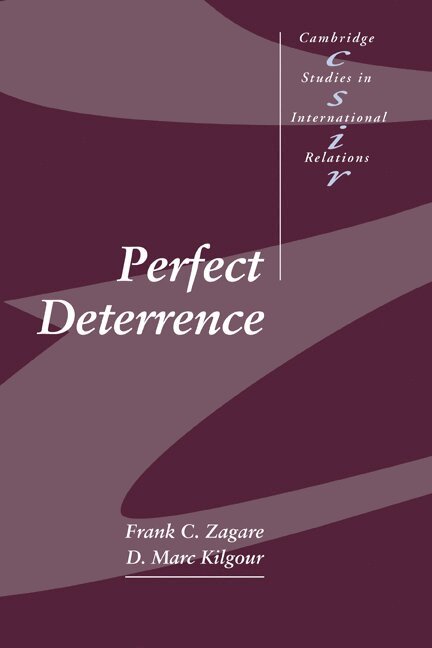
An important and timely contribution to International Relations and political science, this is the first general analysis of deterrence since the end of the Cold War. Using non-cooperative game theory, the authors develop a new approach to deterrence (Perfect Deterrence Theory), which they apply to unilateral and mutual direct-deterrence relationships, and to extended-deterrence relationships supported by deployment policies such as Massive Retaliation and Flexible Response. The authors focus on the relationship among capabilities, preferences, credibility, and outcomes to achieve a new understanding of threats and responses. Some surprising conclusions emerge, indicating that credible threats to respond to attack can sometimes make an attack more likely, and that incredible response threats can sometimes promote peace. With the application of deterrence theory in diverse social settings, and historical examples from before, during, and after the Cold War, this book provides a welcome new examination of the subject.
613 kr
Skickas inom 7-10 vardagar
An important and timely contribution to International Relations and political science, this is the first general analysis of deterrence since the end of the Cold War. Using non-cooperative game theory, the authors develop a new approach to deterrence (Perfect Deterrence Theory), which they apply to unilateral and mutual direct-deterrence relationships, and to extended-deterrence relationships supported by deployment policies such as Massive Retaliation and Flexible Response. The authors focus on the relationship among capabilities, preferences, credibility, and outcomes to achieve a new understanding of threats and responses. Some surprising conclusions emerge, indicating that credible threats to respond to attack can sometimes make an attack more likely, and that incredible response threats can sometimes promote peace. With the application of deterrence theory in diverse social settings, and historical examples from before, during, and after the Cold War, this book provides a welcome new examination of the subject.
Del 41 - Quantitative Applications in the Social Sciences
Game Theory
Concepts and Applications
Häftad, Engelska, 1984
804 kr
Skickas inom 3-6 vardagar
This volume demonstrates the applicability of game-theoretic models and explores zero-sum games, the fundamental Minimax Theory, nonzero-sum games, and n-person games.