

The brightest star at the court of King Charles II, John Wilmot, Earl of Rochester (1647-80), lived a life of reckless debauchery and sexual adventuring that led to his death at the age of thirty-three - described by Samuel Johnson as having 'blazed out his youth and health in lavish voluptuousness'. Rochester was also one of the wittiest and most complex poets of the seventeenth century, writing comic verse, scurrilous satires and highly explicit erotica - from the bawdy self-portrait in 'The Maimed Debauchee' and the tender passion of 'Absent from thee I languish still' to the comic world-weariness of 'Upon Nothing' and 'A Satyr against Mankind', which mocks human follies. With endless literary disguises, rhymes and alliteration, humour and humanity, Rochester's poems hold up a mirror to the extravagances and absurdities of his age.
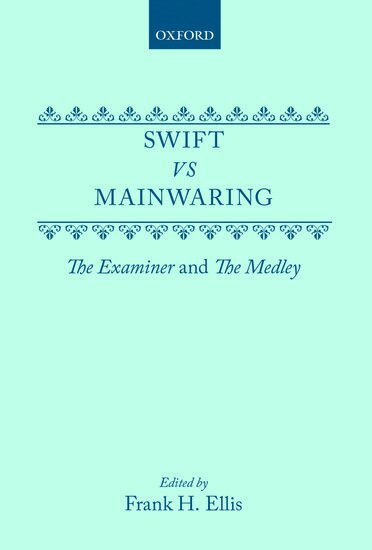
In this edition the text of The Examiner is presented as Swift wrote it, not as it was revised for publication by George Faulkner in 1738. And for the first time Swift's Examiners are juxtaposed with the Medleys of Arthur Mainwaring that replied to them every week. They bring the reader close to the actualités of London between November 1710 and June 1711. From the literary point of view The Examiner is important because it contains some of Swift's best work. Even under the pressure of weekly publication he was still able to achieve, in Herbert Davis's words, 'an aloofness as if beyond bias and passion'.
Samuel Johnson, who did not like Swift, said that A Tale of a Tub «exhibits a vehemence and rapidity of mind, a copiousness of images, and vivacity of diction such as he afterwards never possessed or never exerted.» And in his old age «looking over the Tale,» Swift called out to Mrs. Whiteway, «Good God! What a genius I had when I wrote that book!»Harold Bloom says that A Tale of a Tub «is one of the handful of totally original works in the language.» This new edition presents the work as «an amazing comic book» which puts it in a class with Rabelais’ Pantagruel. Both of these works became banned books, greatly increasing the sales. In this edition for the first time the Narrator of the text is discovered to be an authentic comic-pathetic character, with cropped ears, ill-cured syphilis, and suicidal impulses, waiting to be admitted to Bedlam, the new insane asylum, as a terminal patient. This edition is also the first to recognize that the text of A Tale of a Tub is a mosaic, composed of quotations from other texts, which incidentally accounts for the necessity of many end notes.
The brightest star at the court of King Charles II, John Wilmot, Earl of Rochester (1647-80), lived a life of reckless debauchery and sexual adventuring that led to his death at the age of thirty-three - described by Samuel Johnson as having 'blazed out his youth and health in lavish voluptuousness'. Rochester was also one of the wittiest and most complex poets of the seventeenth century, writing comic verse, scurrilous satires and highly explicit erotica - from the bawdy self-portrait in 'The Maimed Debauchee' and the tender passion of 'Absent from thee I languish still' to the comic world-weariness of 'Upon Nothing' and 'A Satyr against Mankind', which mocks human follies. With endless literary disguises, rhymes and alliteration, humour and humanity, Rochester's poems hold up a mirror to the extravagances and absurdities of his age.

In this edition the text of The Examiner is presented as Swift wrote it, not as it was revised for publication by George Faulkner in 1738. And for the first time Swift's Examiners are juxtaposed with the Medleys of Arthur Mainwaring that replied to them every week. They bring the reader close to the actualités of London between November 1710 and June 1711. From the literary point of view The Examiner is important because it contains some of Swift's best work. Even under the pressure of weekly publication he was still able to achieve, in Herbert Davis's words, 'an aloofness as if beyond bias and passion'.
Samuel Johnson, who did not like Swift, said that A Tale of a Tub «exhibits a vehemence and rapidity of mind, a copiousness of images, and vivacity of diction such as he afterwards never possessed or never exerted.» And in his old age «looking over the Tale,» Swift called out to Mrs. Whiteway, «Good God! What a genius I had when I wrote that book!»Harold Bloom says that A Tale of a Tub «is one of the handful of totally original works in the language.» This new edition presents the work as «an amazing comic book» which puts it in a class with Rabelais’ Pantagruel. Both of these works became banned books, greatly increasing the sales. In this edition for the first time the Narrator of the text is discovered to be an authentic comic-pathetic character, with cropped ears, ill-cured syphilis, and suicidal impulses, waiting to be admitted to Bedlam, the new insane asylum, as a terminal patient. This edition is also the first to recognize that the text of A Tale of a Tub is a mosaic, composed of quotations from other texts, which incidentally accounts for the necessity of many end notes.