Frans B. M. de Waal – författare
Visar alla böcker från författaren Frans B. M. de Waal. Handla med fri frakt och snabb leverans.
8 produkter
8 produkter
Inbunden, Engelska, 2002
1 114 kr
Skickas inom 5-8 vardagar
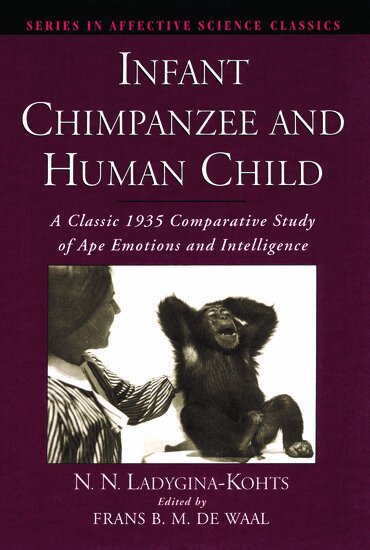
N.N. Ladygina-Kohts earned her degree in comparative psychology at Moscow University in 1917, then became the first curator of the Darwin Museum in Moscow. Her pioneering work with the chimpanzee, Joni, was reported throughout the continent during her lifetime, earning her a series of honors in the Soviet Union. Unfortunately, Infant Chimpanzee and Human Child, her diary comparing Joni's development with that of her son, Rudy, had never been translated completely. This volume presents the first, complete English translation with 120 photographs, an introduction by Allen and Beatrix Gardner of the Center for Advanced Study at the University of Nevada and an Afterword by Lisa A. Parr, Signe Preuschoft, and Frans B. M. de Waal of the Living Links Center.
E-bok
Engelska, 2023568 kr
Läs direkt efter köp
This remarkable primate with the curious name is challenging established views on human evolution. The bonobo, least known of the great apes, is a female-centered, egalitarian species that has been dubbed the "make-love-not-war" primate by specialists. In bonobo society, females form alliances to intimidate males, sexual behavior (in virtually every partner combination) replaces aggression and serves many social functions, and unrelated groups mingle instead of fighting. The species''s most striking achievement is not tool use or warfare but sensitivity to others.In the first book to combine and compare data from captivity and the field, Frans de Waal, a world-renowned primatologist, and Frans Lanting, an internationally acclaimed wildlife photographer, present the most up-to-date perspective available on the bonobo. Focusing on social organization, de Waal compares the bonobo with its better-known relative, the chimpanzee. The bonobo''s relatively nonviolent behavior and the tendency for females to dominate males confront the evolutionary models derived from observing the chimpanzee''s male power politics, cooperative hunting, and intergroup warfare. Further, the bonobo''s frequent, imaginative sexual contacts, along with its low reproduction rate, belie any notion that the sole natural purpose of sex is procreation. Humans share over 98 percent of their genetic material with the bonobo and the chimpanzee. Is it possible that the peaceable bonobo has retained traits of our common ancestor that we find hard to recognize in ourselves?Eight superb full-color photo essays offer a rare view of the bonobo in its native habitat in the rain forests of Zaire as well as in zoos and research facilities. Additional photographs and highlighted interviews with leading bonobo experts complement the text. This book points the way to viable alternatives to male-based models of human evolution and will add considerably to debates on the origin of our species. Anyone interested in primates, gender issues, evolutionary psychology, and exceptional wildlife photography will find a fascinating companion in Bonobo: The Forgotten Ape.This remarkable primate with the curious name is challenging established views on human evolution. The bonobo, least known of the great apes, is a female-centered, egalitarian species that has been dubbed the "make-love-not-war" primate by specialists. In
Häftad, Engelska, 2002
352 kr
Skickas inom 10-15 vardagar
How did we become the linguistic, cultured, and hugely successful apes that we are? Our closest relatives--the other mentally complex and socially skilled primates--offer tantalizing clues. In Tree of Origin nine of the world's top primate experts read these clues and compose the most extensive picture to date of what the behavior of monkeys and apes can tell us about our own evolution as a species.It has been nearly fifteen years since a single volume addressed the issue of human evolution from a primate perspective, and in that time we have witnessed explosive growth in research on the subject. Tree of Origin gives us the latest news about bonobos, the "make love not war" apes who behave so dramatically unlike chimpanzees. We learn about the tool traditions and social customs that set each ape community apart. We see how DNA analysis is revolutionizing our understanding of paternity, intergroup migration, and reproductive success. And we confront intriguing discoveries about primate hunting behavior, politics, cognition, diet, and the evolution of language and intelligence that challenge claims of human uniqueness in new and subtle ways.Tree of Origin provides the clearest glimpse yet of the apelike ancestor who left the forest and began the long journey toward modern humanity.
Inbunden, Engelska, 2012
586 kr
Skickas inom 10-15 vardagar
“Monkey see, monkey do” may sound simple, but how an individual perceives and processes the behavior of another is one of the most complex and fascinating questions related to the social life of humans and other primates. In The Primate Mind, experts from around the world take a bottom-up approach to primate social behavior by investigating how the primate mind connects with other minds and exploring the shared neurological basis for imitation, joint action, cooperative behavior, and empathy.In the past, there has been a tendency to ask all-or-nothing questions, such as whether primates possess a theory of mind, have self-awareness, or have culture. A bottom-up approach asks, rather, what are the underlying cognitive processes of such capacities, some of which may be rather basic and widespread. Prominent neuroscientists, psychologists, ethologists, and primatologists use methods ranging from developmental psychology to neurophysiology and neuroimaging to explore these evolutionary foundations.A good example is mirror neurons, first discovered in monkeys but also assumed to be present in humans, that enable a fusing between one’s own motor system and the perceived actions of others. This allows individuals to read body language and respond to the emotions of others, interpret their actions and intentions, synchronize and coordinate activities, anticipate the behavior of others, and learn from them. The remarkable social sophistication of primates rests on these basic processes, which are extensively discussed in the pages of this volume.
Häftad, Engelska, 1996
497 kr
Skickas inom 10-15 vardagar
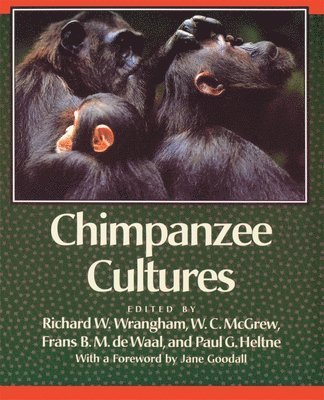
Do chimpanzees have something akin to culture? Bringing together studies of behavioral variation within and among chimpanzees and bonobos --the sibling species of the genus Pan--this book provides the basis for answering this question. In Chimpanzee Cultures, the world's leading authorities on chimpanzees and bonobos chronicle the animals' behaviors from one study site to the next, in both captive and wild groups, in laboratory and field settings.
Häftad, Engelska, 1997
299 kr
Skickas inom 5-8 vardagar
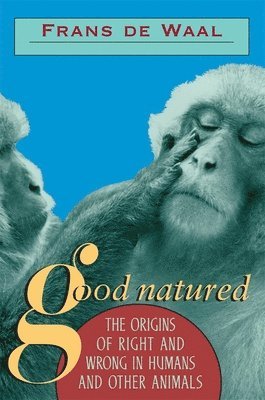
To observe a dog's guilty look.to witness a gorilla's self-sacrifice for a wounded mate, to watch an elephant herd's communal effort on behalf of a stranded calf--to catch animals in certain acts is to wonder what moves them. Might there he a code of ethics in the animal kingdom? Must an animal be human to he humane? In this provocative book, a renowned scientist takes on those who have declared ethics uniquely human Making a compelling case for a morality grounded in biology, he shows how ethical behavior is as much a matter of evolution as any other trait, in humans and animals alike.World famous for his brilliant descriptions of Machiavellian power plays among chimpanzees-the nastier side of animal life--Frans de Waal here contends that animals have a nice side as well. Making his case through vivid anecdotes drawn from his work with apes and monkeys and holstered by the intriguing, voluminous data from his and others' ongoing research, de Waal shows us that many of the building blocks of morality are natural: they can he observed in other animals. Through his eyes, we see how not just primates but all kinds of animals, from marine mammals to dogs, respond to social rules, help each other, share food, resolve conflict to mutual satisfaction, even develop a crude sense of justice and fairness.Natural selection may be harsh, but it has produced highly successful species that survive through cooperation and mutual assistance. De Waal identifies this paradox as the key to an evolutionary account of morality, and demonstrates that human morality could never have developed without the foundation of fellow feeling our species shares with other animals. As his work makes clear, a morality grounded in biology leads to an entirely different conception of what it means to he human--and humane.
Häftad, Engelska, 1990
385 kr
Skickas inom 10-15 vardagar
Does biology condemn the human species to violence and war? Previous studies of animal behavior incline us to answer yes, but the message of this book is considerably more optimistic. Without denying our heritage of aggressive behavior, Frans de Waal describes powerful checks and balances in the makeup of our closest animal relatives, and in so doing he shows that to humans making peace is as natural as making war.In this meticulously researched and absorbing account, we learn in detail how different types of simians cope with aggression, and how they make peace after fights. Chimpanzees, for instance, reconcile with a hug and a kiss, whereas rhesus monkeys groom the fur of former adversaries. By objectively examining the dynamics of primate social interactions, de Waal makes a convincing case that confrontation should not be viewed as a barrier to sociality but rather as an unavoidable element upon which social relationships can be built and strengthened through reconciliation.The author examines five different species—chimpanzees, rhesus monkeys, stump-tailed monkeys, bonobos, and humans—and relates anecdotes, culled from exhaustive observations, that convey the intricacies and refinements of simian behavior. Each species utilizes its own unique peacemaking strategies. The bonobo, for example, is little known to science, and even less to the general public, but this rare ape maintains peace by means of sexual behavior divorced from reproductive functions; sex occurs in all possible combinations and positions whenever social tensions need to be resolved. “Make love, not war” could be the bonobo slogan.De Waal’s demonstration of reconciliation in both monkeys and apes strongly supports his thesis that forgiveness and peacemaking are widespread among nonhuman primates—an aspect of primate societies that should stimulate much needed work on human conflict resolution.
Inbunden, Engelska, 2003
854 kr
Tillfälligt slut
For over 25 years, primatologists have speculated that intelligence, at least in monkeys and apes, evolved as an adaptation to the complicated social milieu of hard-won friendships and bitterly contested rivalries. Yet the Balkanization of animal research has prevented us from studying the same problem in other large-brained, long-lived animals, such as hyenas and elephants, bats and sperm whales. Social complexity turns out to be widespread indeed. For example, in many animal societies one individual's innovation, such as tool use or a hunting technique, may spread within the group, thus creating a distinct culture. As this collection of studies on a wide range of species shows, animals develop a great variety of traditions, which in turn affect fitness and survival. The editors argue that future research into complex animal societies and intelligence will change the perception of animals as gene machines, programmed to act in particular ways and perhaps elevate them to a status much closer to our own. At a time when humans are perceived more biologically than ever before, and animals as more cultural, are we about to witness the dawn of a truly unified social science, one with a distinctly cross-specific perspective?