E-bok
PDF, Engelska, 19941 511 kr
Läs direkt efter köp
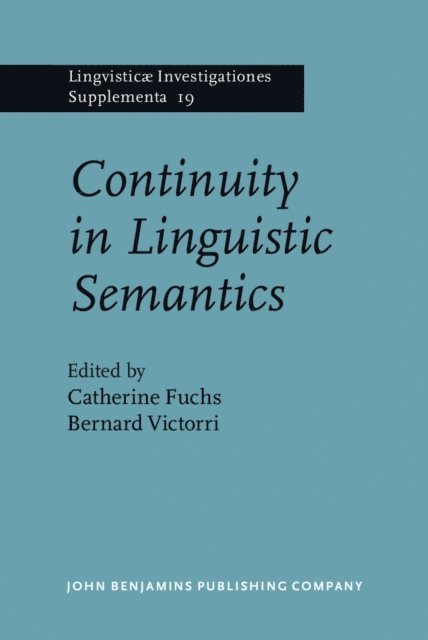
Until recently, most linguistic theories as well as theories of cognition have avoided use of the notion of continuity. At the moment, however, several linguistic trends, sharing a preoccupation with semantico-cognitive problems (e.g. cognitive grammars, ''psychomechanics'', ''enunciative theories''), are trying to go beyond the constraints imposed by discrete approaches. At the same time, mathematical (e.g. differential geometry and dynamical systems) and computer science tools (e.g. connectionism) have been proposed that can be used for modelling of continuous linguistic phenomena.In this volume, linguists, philosophers, mathematicians and computer scientists discuss which semantic phenomena (linked to the lexicon, to grammatical theories or to syntactic structures) call for continuous models and which formalisation tools can contribute to the development of such models. The first part of the book is devoted to linguistic issues, the second part deals with modelling issues.Many important questions are raised in the discussion, for instance: Is continuity just a convenient representation of gradual yet discrete facts, or is it an intrinsic characteristic of semantic phenomena? How can the introduction of continuity be reconciled with a methodology based on the falsifiability of theories? What is the link between continuity and Gestalt theory? Can linguistic continuity be accounted for by mathematical models? What about statistical models? How can continuity be implemented on a digital and therefore discrete machine?