G. A. Ekama – författare
Visar alla böcker från författaren G. A. Ekama. Handla med fri frakt och snabb leverans.
4 produkter
4 produkter
1 822 kr
Tillfälligt slut
Advances in Wastewater Treatment presents a compendium of the key topics surrounding wastewater treatment, assembled by looking at the future technologies, and provides future perspectives in wastewater treatment and modelling. It covers the fundamentals and innovative wastewater treatment processes (such as membrane bioreactors and granular process). Furthermore, it focuses attention on mathematical modelling aspects in the field of wastewater treatments by highlighting the key role of models in process design, operation and control.Other topics include:• Anaerobic digestion• Biological nutrient removal• Instrumentation, control and automation• Computational fluid dynamics in wastewater• IFAS systems• New frontiers in wastewater treatment• Greenhouse gas emissions from wastewater treatmentEach topic is addressed by discussing past, present and future trends. Advances in Wastewater Treatment is a valid support for researchers, practitioners and also students to have a frame of the frontiers in wastewater treatment and modelling.
2 134 kr
Tillfälligt slut
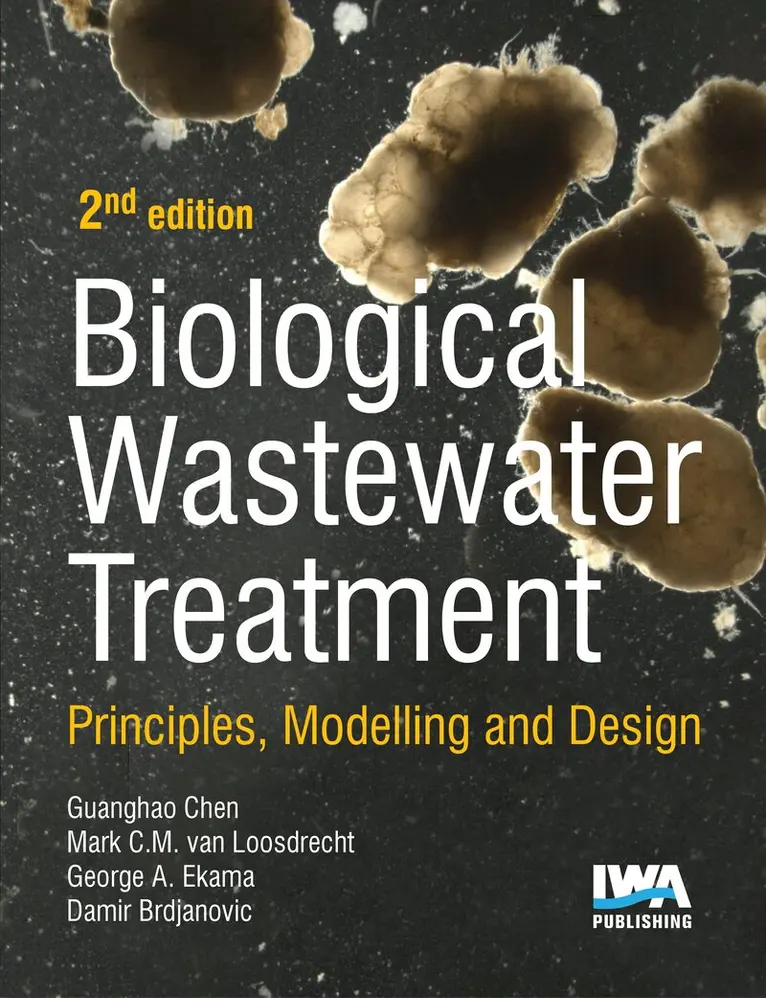
The first edition of this book was published in 2008 and it went on to become IWA Publishing’s bestseller. Clearly there was a need for it because over the twenty years prior to 2008, the knowledge and understanding of wastewater treatment had advanced extensively and moved away from empirically-based approaches to a fundamental first-principles approach based on chemistry, microbiology, physical and bioprocess engineering, mathematics and modelling. However the quantity, complexity and diversity of these new developments was overwhelming for young water professionals, particularly in developing countries without readily available access to advanced-level tertiary education courses in wastewater treatment. For a whole new generation of young scientists and engineers entering the wastewater treatment profession, this book assembled and integrated the postgraduate course material of a dozen or so professors from research groups around the world who have made significant contributions to the advances in wastewater treatment. This material had matured to the degree that it had been codified into mathematical models for simulation with computers. The first edition of the book offered, that upon completion of an in-depth study of its contents, the modern approach of modelling and simulation in wastewater treatment plant design and operation could be embraced with deeper insight, advanced knowledge and greater confidence, be it activated sludge, biological nitrogen and phosphorus removal, secondary settling tanks, or biofilm systems.However, the advances and developments in wastewater treatment have accelerated over the past 12 years since publication of the first edition. While all the chapters of the first edition have been updated to accommodate these advances and developments, some, such as granular sludge, membrane bioreactors, sulphur conversion-based bioprocesses and biofilm reactors which were new in 2008, have matured into new industry approaches and are also now included in this second edition. The target readership of this second edition remains the young water professionals, who will still be active in the field of protecting our precious water resources long after the aging professors who are leading some of these advances have retired. The authors, all still active in the field, are aware that cleaning dirty water has become more complex but that it is even more urgent now than 12 years ago, and offer this second edition to help the young water professionals engage with the scientific and bioprocess engineering principles of wastewater treatment science and technology with deeper insight, advanced knowledge and greater confidence built on stronger competence.
1 355 kr
Tillfälligt slut
The first edition of this book was published in 2008 and it went on to become IWA Publishing’s bestseller. Clearly there was a need for it because over the twenty years prior to 2008, the knowledge and understanding of wastewater treatment had advanced extensively and moved away from empirically-based approaches to a fundamental first-principles approach based on chemistry, microbiology, physical and bioprocess engineering, mathematics and modelling. However the quantity, complexity and diversity of these new developments was overwhelming for young water professionals, particularly in developing countries without readily available access to advanced-level tertiary education courses in wastewater treatment. For a whole new generation of young scientists and engineers entering the wastewater treatment profession, this book assembled and integrated the postgraduate course material of a dozen or so professors from research groups around the world who have made significant contributions to the advances in wastewater treatment. This material had matured to the degree that it had been codified into mathematical models for simulation with computers. The first edition of the book offered, that upon completion of an in-depth study of its contents, the modern approach of modelling and simulation in wastewater treatment plant design and operation could be embraced with deeper insight, advanced knowledge and greater confidence, be it activated sludge, biological nitrogen and phosphorus removal, secondary settling tanks, or biofilm systems. However, the advances and developments in wastewater treatment have accelerated over the past 12 years since publication of the first edition. While all the chapters of the first edition have been updated to accommodate these advances and developments, some, such as granular sludge, membrane bioreactors, sulphur conversion-based bioprocesses and biofilm reactors which were new in 2008, have matured into new industry approaches and are also now included in this second edition. The target readership of this second edition remains the young water professionals, who will still be active in the field of protecting our precious water resources long after the aging professors who are leading some of these advances have retired. The authors, all still active in the field, are aware that cleaning dirty water has become more complex but that it is even more urgent now than 12 years ago, and offer this second edition to help the young water professionals engage with the scientific and bioprocess engineering principles of wastewater treatment science and technology with deeper insight, advanced knowledge and greater confidence built on stronger competence.
1 822 kr
Tillfälligt slut
Although developments in wastewater treatment over recent decades have focused on the biological reactor, the secondary settling tank (SST) also plays a major role in achieving increasingly stringent effluent quality standards. This report collates many of the significant developments that have taken place in SST theory, design, modelling and operation. Earlier SSTs were designed only by empirical hydraulic criteria such as overflow rate, which do not recognize sludge concentration and settleability. Today, there are available not only much improved design procedures but also hydrodynamic models for simulating water and solids distribution and flows in full-scale SSTs. Nine chapters cover a wide range of subjects including: Flocculation and settling behaviour of biological sludges SST performance evaluation protocols Development and evaluation of the different design procedures such as the flux theory and the ATV design rules Developments in and application of one- two- and three-dimensional modelling Experience-based aspects of design and operation of circular, rectangular and vertical SSTs. Reprinted for 2006 Scientific and Technical Report No.6