G. M. Hamburg – författare
Visar alla böcker från författaren G. M. Hamburg. Handla med fri frakt och snabb leverans.
3 produkter
3 produkter
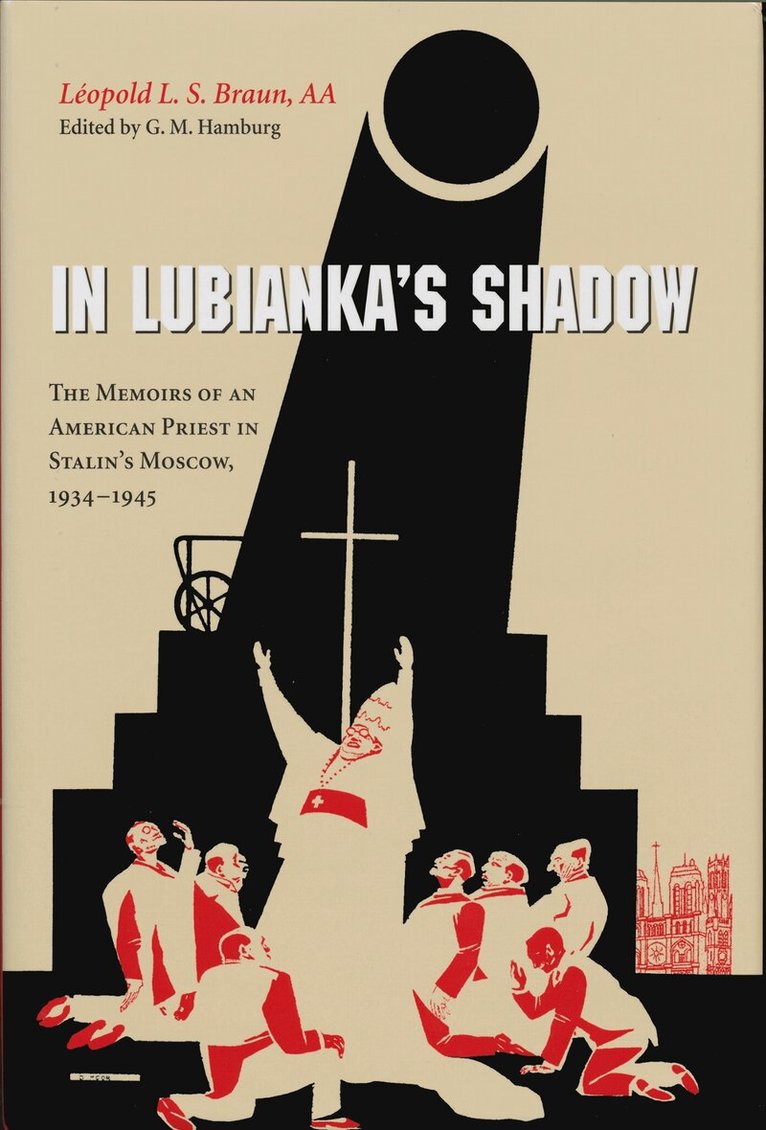
In Lubianka's Shadow
The Memoirs of an American Priest in Stalin's Moscow, 1934-1945
Inbunden, Engelska, 2006
405 kr
Skickas inom 10-15 vardagar
In Lubianka's Shadow chronicles the extraordinary life of a young American Catholic priest, Father Léopold Braun, who, as pastor of a small Catholic church near the Lubianka political prison in the heart of Moscow, witnessed Stalin's purges, the Soviet government's campaign against organized religion, and the destruction of World War II. These memoirs, recently discovered in the archive of Fr. Bruan's Assumptionist order by Soviet scholar Gary Hamburg, offer an intimate account of Fr. Braun's valiant effort to uphold Christian worship in the only Catholic church allowed to operate in Stalin's Moscow. Posted to Moscow in 1934 as chaplain of the United States embassy, Father Braun served the embassy staff and local parishioners in the Saint Louis des Français Church at a moment when Stalin's anti-religious campaign was reaching a crescendo. He describes the Soviet government's intimidation and arrest of his parishioners, police surveillance of the church building, and personal harassment designed to force him out of the country. Father Braun's responses to these pressures—sometimes amusing, sometimes heart-rending, but always intelligent and soulful—tell us much about the capacity of ordinary people to respond to extraordinary circumstances. Under his pen, Soviet society comes alive, with its citizens' poverty, cynicism, humor, and courage on full display.Accompanying the memoirs is an introductory, historical essay by G. M. Hamburg. In Lubianka's Shadow is required reading for anyone interested in modern Russian history and for those concerned about the survival of religious faith under political assault.
A History of Russian Philosophy 1830-1930
Faith, Reason, and the Defense of Human Dignity
Inbunden, Engelska, 2010
1 552 kr
Skickas inom 7-10 vardagar
The great age of Russian philosophy spans the century between 1830 and 1930 - from the famous Slavophile-Westernizer controversy of the 1830s and 1840s, through the 'Silver Age' of Russian culture at the beginning of the twentieth century, to the formation of a Russian 'philosophical emigration' in the wake of the Russian Revolution. This volume is a major history and interpretation of Russian philosophy in this period. Eighteen chapters (plus a substantial introduction and afterword) discuss Russian philosophy's main figures, schools and controversies, while simultaneously pursuing a common central theme: the development of a distinctive Russian tradition of philosophical humanism focused on the defence of human dignity. As this volume shows, the century-long debate over the meaning and grounds of human dignity, freedom and the just society involved thinkers of all backgrounds and positions, transcending easy classification as 'religious' or 'secular'. The debate still resonates strongly today.
A History of Russian Philosophy 1830-1930
Faith, Reason, and the Defense of Human Dignity
Häftad, Engelska, 2013
482 kr
Skickas inom 7-10 vardagar
The great age of Russian philosophy spans the century between 1830 and 1930 - from the famous Slavophile-Westernizer controversy of the 1830s and 1840s, through the 'Silver Age' of Russian culture at the beginning of the twentieth century, to the formation of a Russian 'philosophical emigration' in the wake of the Russian Revolution. This volume is a major history and interpretation of Russian philosophy in this period. Eighteen chapters (plus a substantial introduction and afterword) discuss Russian philosophy's main figures, schools and controversies, while simultaneously pursuing a common central theme: the development of a distinctive Russian tradition of philosophical humanism focused on the defence of human dignity. As this volume shows, the century-long debate over the meaning and grounds of human dignity, freedom and the just society involved thinkers of all backgrounds and positions, transcending easy classification as 'religious' or 'secular'. The debate still resonates strongly today.