Randall A. Poole – författare
Visar alla böcker från författaren Randall A. Poole. Handla med fri frakt och snabb leverans.
8 produkter
8 produkter
E-bok
PDF, Engelska, 20201 769 kr
Läs direkt efter köp
The Oxford Handbook of Russian Religious Thought is an authoritative new reference and interpretive volume detailing the origins, development, and influence of one of the richest aspects of Russian cultural and intellectual life - its religious ideas. After setting the historical background and context, the Handbook follows the leading figures and movements in modern Russian religious thought through a period of immense historical upheavals, including seventy years of officially atheist communist rule and the growth of an exiled diaspora with, e.g., its journal The Way. Therefore the shape of Russian religious thought cannot be separated from long-running debates with nihilism and atheism. Important thinkers such as Losev and Bakhtin had to guard their words in an environment of religious persecution, whilst some views were shaped by prison experiences. Before the Soviet period, Russian national identity was closely linked with religion - linkages which again are being forged in the new Russia. Relevant in this connection are complex relationships with Judaism. In addition to religious thinkers such as Philaret, Chaadaev, Khomiakov, Kireevsky, Soloviev, Florensky, Bulgakov, Berdyaev, Shestov, Frank, Karsavin, and Alexander Men, the Handbook also looks at the role of religion in aesthetics, music, poetry, art, film, and the novelists Dostoevsky and Tolstoy. Ideas, institutions, and movements discussed include the Church academies, Slavophilism and Westernism, theosis, the name-glorifying (imiaslavie) controversy, the God-seekers and God-builders, Russian religious idealism and liberalism, and the Neopatristic school. Occultism is considered, as is the role of tradition and the influence of Russian religious thought in the West.
E-bok
Engelska, 20201 769 kr
Läs direkt efter köp
The Oxford Handbook of Russian Religious Thought is an authoritative new reference and interpretive volume detailing the origins, development, and influence of one of the richest aspects of Russian cultural and intellectual life - its religious ideas. After setting the historical background and context, the Handbook follows the leading figures and movements in modern Russian religious thought through a period of immense historical upheavals, including seventy years of officially atheist communist rule and the growth of an exiled diaspora with, e.g., its journal The Way. Therefore the shape of Russian religious thought cannot be separated from long-running debates with nihilism and atheism. Important thinkers such as Losev and Bakhtin had to guard their words in an environment of religious persecution, whilst some views were shaped by prison experiences. Before the Soviet period, Russian national identity was closely linked with religion - linkages which again are being forged in the new Russia. Relevant in this connection are complex relationships with Judaism. In addition to religious thinkers such as Philaret, Chaadaev, Khomiakov, Kireevsky, Soloviev, Florensky, Bulgakov, Berdyaev, Shestov, Frank, Karsavin, and Alexander Men, the Handbook also looks at the role of religion in aesthetics, music, poetry, art, film, and the novelists Dostoevsky and Tolstoy. Ideas, institutions, and movements discussed include the Church academies, Slavophilism and Westernism, theosis, the name-glorifying (imiaslavie) controversy, the God-seekers and God-builders, Russian religious idealism and liberalism, and the Neopatristic school. Occultism is considered, as is the role of tradition and the influence of Russian religious thought in the West.
Inbunden, Engelska, 2020
2 412 kr
Skickas inom 7-10 vardagar
The Oxford Handbook of Russian Religious Thought is an authoritative new reference and interpretive volume detailing the origins, development, and influence of one of the richest aspects of Russian cultural and intellectual life - its religious ideas. After setting the historical background and context, the Handbook follows the leading figures and movements in modern Russian religious thought through a period of immense historical upheavals, including seventy years of officially atheist communist rule and the growth of an exiled diaspora with, e.g., its journal The Way. Therefore the shape of Russian religious thought cannot be separated from long-running debates with nihilism and atheism. Important thinkers such as Losev and Bakhtin had to guard their words in an environment of religious persecution, whilst some views were shaped by prison experiences. Before the Soviet period, Russian national identity was closely linked with religion - linkages which again are being forged in the new Russia. Relevant in this connection are complex relationships with Judaism. In addition to religious thinkers such as Philaret, Chaadaev, Khomiakov, Kireevsky, Soloviev, Florensky, Bulgakov, Berdyaev, Shestov, Frank, Karsavin, and Alexander Men, the Handbook also looks at the role of religion in aesthetics, music, poetry, art, film, and the novelists Dostoevsky and Tolstoy. Ideas, institutions, and movements discussed include the Church academies, Slavophilism and Westernism, theosis, the name-glorifying (imiaslavie) controversy, the God-seekers and God-builders, Russian religious idealism and liberalism, and the Neopatristic school. Occultism is considered, as is the role of tradition and the influence of Russian religious thought in the West.
Inbunden, Engelska, 2010
1 610 kr
Skickas inom 7-10 vardagar
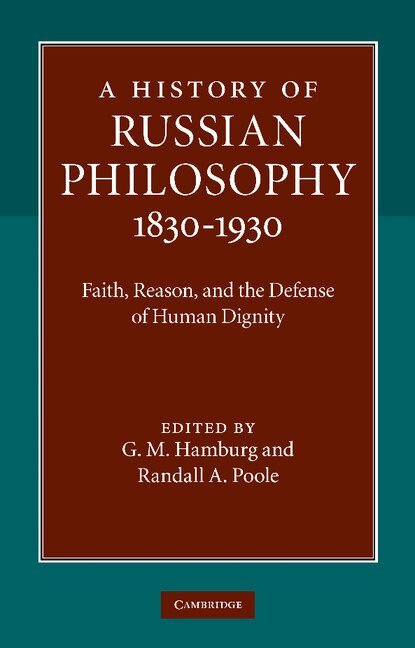
The great age of Russian philosophy spans the century between 1830 and 1930 - from the famous Slavophile-Westernizer controversy of the 1830s and 1840s, through the 'Silver Age' of Russian culture at the beginning of the twentieth century, to the formation of a Russian 'philosophical emigration' in the wake of the Russian Revolution. This volume is a major history and interpretation of Russian philosophy in this period. Eighteen chapters (plus a substantial introduction and afterword) discuss Russian philosophy's main figures, schools and controversies, while simultaneously pursuing a common central theme: the development of a distinctive Russian tradition of philosophical humanism focused on the defence of human dignity. As this volume shows, the century-long debate over the meaning and grounds of human dignity, freedom and the just society involved thinkers of all backgrounds and positions, transcending easy classification as 'religious' or 'secular'. The debate still resonates strongly today.
Häftad, Engelska, 2013
501 kr
Skickas inom 7-10 vardagar
The great age of Russian philosophy spans the century between 1830 and 1930 - from the famous Slavophile-Westernizer controversy of the 1830s and 1840s, through the 'Silver Age' of Russian culture at the beginning of the twentieth century, to the formation of a Russian 'philosophical emigration' in the wake of the Russian Revolution. This volume is a major history and interpretation of Russian philosophy in this period. Eighteen chapters (plus a substantial introduction and afterword) discuss Russian philosophy's main figures, schools and controversies, while simultaneously pursuing a common central theme: the development of a distinctive Russian tradition of philosophical humanism focused on the defence of human dignity. As this volume shows, the century-long debate over the meaning and grounds of human dignity, freedom and the just society involved thinkers of all backgrounds and positions, transcending easy classification as 'religious' or 'secular'. The debate still resonates strongly today.
Del 4 - Ex Oriente Lux
Evgenii Trubetskoi
Icon and Philosophy
Häftad, Engelska, 2021
309 kr
Skickas inom 5-8 vardagar
Del 4 - Ex Oriente Lux
Evgenii Trubetskoi
Icon and Philosophy
Inbunden, Engelska, 2021
439 kr
Skickas inom 5-8 vardagar
E-bok
Engelska, 2021471 kr
Läs direkt efter köp
Prince Evgenii Trubetskoi (1863-1920), one of Russia's great philosophers, exemplified what was best in the Russian religious-philosophical tradition. His lifelong pursuit was "e;integral knowledge."e; This ideal affirmed that faith was integral to reason and that inner experience (moral, religious, aesthetic), and not just external sensory experience, offered truthful testimony to the nature of reality--precisely contrary to the reductive positivism and scientism of Trubetskoi's day and ours. Following Vladimir Soloviev he developed the concept of Bogochelovechestvo (divine humanity)--the free human realization of the divine principle in ourselves and in the world (deification)--and found in it the very meaning of life. Trubetskoi strikingly combined religious philosophy with an unwavering commitment to the main principles of liberalism: human dignity, freedom of conscience, the rule of law (based ultimately on natural law), and human perfectibility (progress). He worked tirelessly for a liberal, constitutional Russia. This is the first book in English devoted to Evgenii Trubetskoi's life and thought. It includes a comprehensive introduction, six chapters on his religious-philosophical worldview, and six chapters on an area of religious studies that he inspired--the philosophy of the icon.