Gareth R. Eaton – författare
Visar alla böcker från författaren Gareth R. Eaton. Handla med fri frakt och snabb leverans.
16 produkter
Distance Measurements in Biological Systems by EPR
Av Lawrence J. Berliner, Sandra S. Eaton m. fl.
Inbunden, 2001
2254 kr
Lägg i varukorg
Distance measurements in biological systems by EPR The foundation for understanding function and dynamics of biological systems is knowledge of their structure. Many experimental methodologies are used for determination of structure, each with special utility. Volumes in this series on Biological …
Distance Measurements in Biological Systems by EPR
Av Gareth R. Eaton, Sandra S. Eaton m. fl.
E-bok, 2006
3013 kr
Lägg i varukorg
Distance measurements in biological systems by EPR The foundation for understanding function and dynamics of biological systems is knowledge of their structure. Many experimental methodologies are used for determination of structure, each with special utility. Volumes in this series on Biological …
Biomedical EPR - Part A: Free Radicals, Metals, Medicine and Physiology
Av Sandra S. Eaton, Gareth R. Eaton m. fl.
Inbunden, 2004
3377 kr
Lägg i varukorg
Biomedical EPR – Part A focuses on applications of EPR spectroscopy in the areas of free radicals, metals, medicine, and physiology. The book celebrates the 70th birthday of Prof. James S. Hyde, Medical College of Wisconsin, and his contributions to this field. Chapters are written to provide …
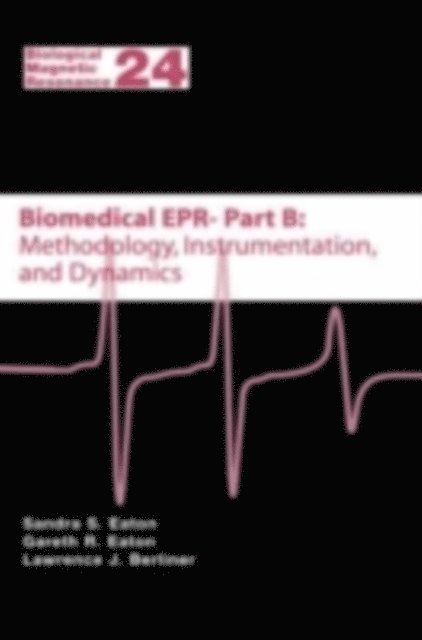
Biomedical EPR - Part B: Methodology, Instrumentation, and Dynamics
Av Sandra S. Eaton, Gareth R. Eaton m. fl.
Inbunden, 2004
2188 kr
Lägg i varukorg
Biomedical EPR – Part B focuses on applications of EPR techniques and instrumentation, with applications to dynamics. The book celebrates the 70th birthday of Prof. James S. Hyde, Medical College of Wisconsin, and his contributions to this field. Chapters are written to provide introductory …
Biomedical EPR - Part B: Methodology, Instrumentation, and Dynamics
Av Lawrence Berliner, Gareth R. Eaton m. fl.
E-bok, 2006
2925 kr
Lägg i varukorg
Biomedical EPR – Part B focuses on applications of EPR techniques and instrumentation, with applications to dynamics. The book celebrates the 70 th birthday of Prof. James S. Hyde, Medical College of Wisconsin, and his contributions to this field. Chapters are written to provide introductory …
Biomedical EPR - Part A: Free Radicals, Metals, Medicine and Physiology
Av Lawrence J. Berliner, Gareth R. Eaton m. fl.
E-bok, 2006
4187 kr
Lägg i varukorg
Biomedical EPR – Part A focuses on applications of EPR spectroscopy in the areas of free radicals, metals, medicine, and physiology. The book celebrates the 70 th birthday of Prof. James S. Hyde, Medical College of Wisconsin, and his contributions to this field. Chapters are written to provide …
EPR IMAGING and IN VIVO EPR
Inbunden, 2017
3793 kr
Lägg i varukorg
This volume provides a detailed examination of the physical basis for EPR imaging and in vivo EPR spectroscopy, experimental arrangements, and data analysis. The EPR imaging methods described include continuous wave, spin-echo-detected and ENDOR-detected EPR with constant, stepped, modulated, and …
EPR IMAGING and IN VIVO EPR
E-bok, 2018
4274 kr
Lägg i varukorg
This volume provides a detailed examination of the physical basis for EPR imaging and in vivo EPR spectroscopy, experimental arrangements, and data analysis. The EPR imaging methods described include continuous wave, spin-echo-detected and ENDOR-detected EPR with constant, stepped, modulated, and …
EPR IMAGING and IN VIVO EPR
E-bok, 2018
4369 kr
Lägg i varukorg
This volume provides a detailed examination of the physical basis for EPR imaging and in vivo EPR spectroscopy, experimental arrangements, and data analysis. The EPR imaging methods described include continuous wave, spin-echo-detected and ENDOR-detected EPR with constant, stepped, modulated, and …
Biomedical EPR - Part A: Free Radicals, Metals, Medicine and Physiology
Av Sandra S. Eaton, Gareth R. Eaton m. fl.
Häftad, 2010
3386 kr
Lägg i varukorg
Biomedical EPR -- Part A focuses on applications of EPR spectroscopy in the areas of free radicals, metals, medicine, and physiology. The book celebrates the 70th birthday of Prof. James S. Hyde, Medical College of Wisconsin, and his contributions to this field. Chapters are written to provide …
Biomedical EPR - Part B: Methodology, Instrumentation, and Dynamics
Av Sandra S. Eaton, Gareth R. Eaton m. fl.
Häftad, 2010
2260 kr
Lägg i varukorg
Biomedical EPR -- Part B focuses on applications of EPR techniques and instrumentation, with applications to dynamics. The book celebrates the 70th birthday of Prof. James S. Hyde, Medical College of Wisconsin, and his contributions to this field. Chapters are written to provide introductory …
Distance Measurements in Biological Systems by EPR
Av Lawrence J. Berliner, Sandra S. Eaton m. fl.
Häftad, 2012
2260 kr
Lägg i varukorg
Distance measurements in biological systems by EPR The foundation for understanding function and dynamics of biological systems is knowledge of their structure. Many experimental methodologies are used for determination of structure, each with special utility. Volumes in this series on Biological …
Quantitative EPR
Av Gareth R. Eaton, Sandra S. Eaton m. fl.
Inbunden, 2010
1538 kr
Lägg i varukorg
There is a growing need in both industrial and academic research to obtain accurate quantitative results from continuous wave (CW) electron paramagnetic resonance (EPR) experiments. This book describes various sample-related, instrument-related and software-related aspects of obtaining quantitative …
Quantitative EPR
Av Ralph T. Weber, David P. Barr m. fl.
E-bok, 2010
1948 kr
Lägg i varukorg
There is a growing need in both industrial and academic research to obtain accurate quantitative results from continuous wave (CW) electron paramagnetic resonance (EPR) experiments. This book describes various sample-related, instrument-related and software-related aspects of obtaining quantitative …
Quantitative EPR
Av Gareth R. Eaton, Sandra S. Eaton m. fl.
Häftad, 2014
1534 kr
Lägg i varukorg
There is a growing need in both industrial and academic research to obtain accurate quantitative results from continuous wave (CW) electron paramagnetic resonance (EPR) experiments. This book describes various sample-related, instrument-related and software-related aspects of obtaining quantitative …
FOUNDATIONS OF MODERN EPR
Av Gareth R Eaton, Sandra S Eaton m. fl.
Inbunden, 1998
2214 kr
Tillfälligt slut
Since its inception 50 years ago, electron paramagnetic resonance (EPR, also called ESR or EMR) has become a major tool in diverse fields ranging from biology and chemistry to solid state physics and materials science. This important book includes personal descriptions of early experiments by …