Geoffrey Webb – författare
Visar alla böcker från författaren Geoffrey Webb. Handla med fri frakt och snabb leverans.
8 produkter
Error and Fraud
The Dark Side of Biomedical Research
Häftad, 2021
562 kr
Lägg i varukorg
This fascinating book gives readers an appreciation of how biomedical research should work and how the reality is all too often seriously flawed. Explaining the logical basis of the different research approaches used by biomedical research scientists and their relative merits, it will help readers …
Error and Fraud
The Dark Side of Biomedical Research
Inbunden, 2021
1568 kr
Lägg i varukorg
This fascinating book gives readers an appreciation of how biomedical research should work and how the reality is all too often seriously flawed. Explaining the logical basis of the different research approaches used by biomedical research scientists and their relative merits, it will help readers …
Error and Fraud
The Dark Side of Biomedical Research
E-bok, 2021
639 kr
Lägg i varukorg
This fascinating book gives readers an appreciation of how biomedical research should work and how the reality is all too often seriously flawed. Explaining the logical basis of the different research approaches used by biomedical research scientists and their relative merits, it will help readers …
Error and Fraud
The Dark Side of Biomedical Research
E-bok, 2021
660 kr
Lägg i varukorg
This fascinating book gives readers an appreciation of how biomedical research should work and how the reality is all too often seriously flawed. Explaining the logical basis of the different research approaches used by biomedical research scientists and their relative merits, it will help readers …
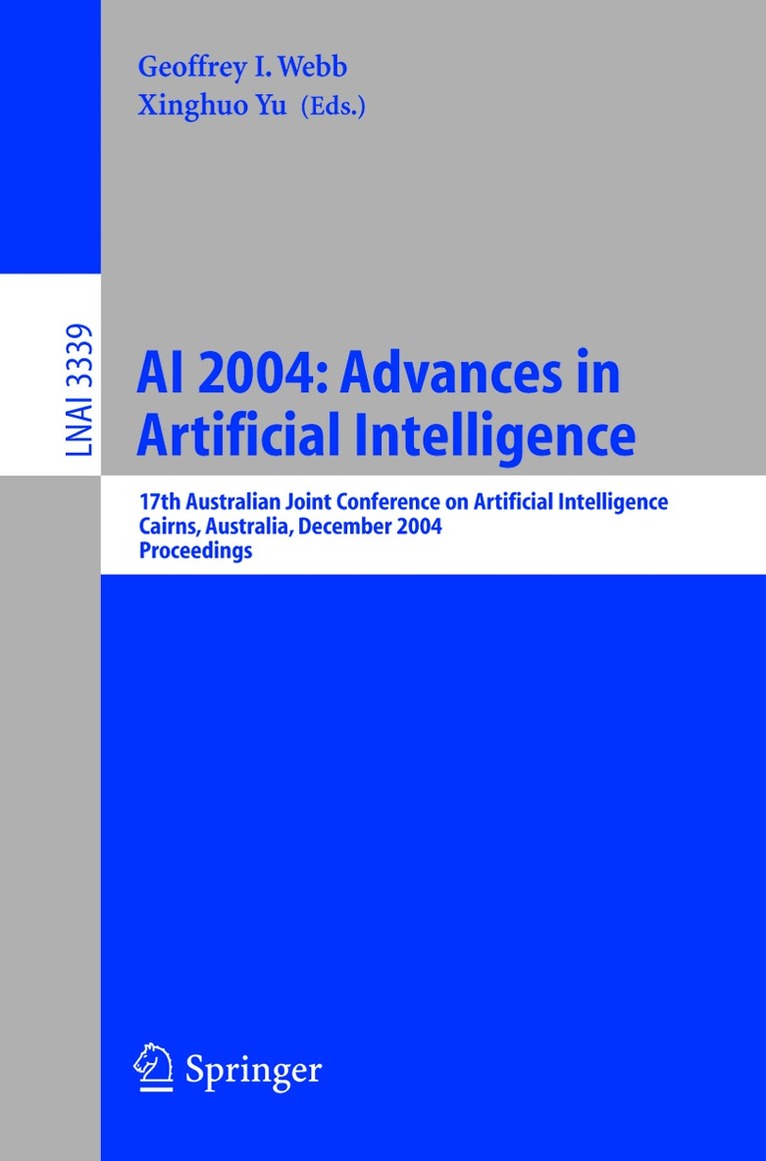
AI 2004: Advances in Artificial Intelligence
17th Australian Joint Conference on Artificial Intelligence, Cairns, Australia, December 4-6, 2004, Proceedings
Häftad, 2004
1636 kr
Lägg i varukorg
This book constitutes the refereed proceedings of the 17th Australian Conference on Artificial Intelligence, AI 2004, held in Cairns, Australia, in December 2004.The 78 revised full papers and 62 revised short papers presented were carefully reviewed and selected from 340 submissions. The papers …
AI 2004: Advances in Artificial Intelligence
17th Australian Joint Conference on Artificial Intelligence, Cairns, Australia, December 4-6, 2004, Proceedings
E-bok, 2004
2190 kr
Lägg i varukorg