George Wypych - Böcker
2 995 kr
Skickas inom 7-10 vardagar
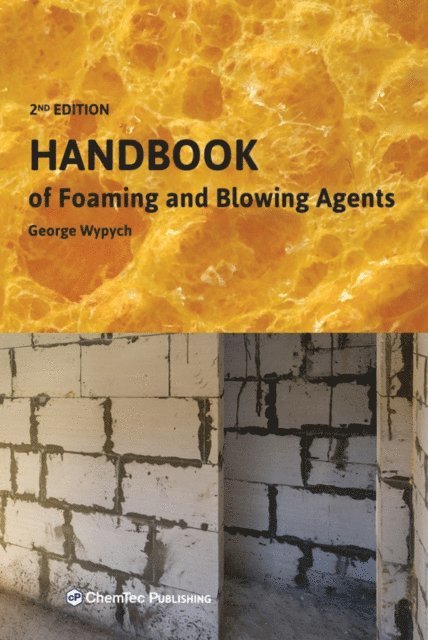
Handbook of Foaming and Blowing Agents, Second Edition includes the most current information on foaming technology, guiding users on the proper selection of formulation, which is highly dependent on the mechanisms of action of blowing agents and foaming agents, as well as dispersion and solubility. The book includes properties of 23 groups of blowing agents and the typical range of technical performance for each group, including general properties, physical-chemical properties, health and safety, environmental impact, and applications in different products and polymers. All information is illustrated by chemical reactions and diagrams.
Chapters in the book look at foaming mechanisms with the use of solid blowing agents, which are decomposed to the gaseous products by application of heat, production of gaseous products by chemical reaction, and foaming by gases and evaporating liquids.
Introduces the fundamental mechanisms of action of blowing agents and foaming Includes best practice guidance to help engineers and technicians improve the efficiency of their existing foaming processes Enables practitioners to select blowing agents and foaming methods more effectively, thus reducing the risk of poor specification Introduces useful analytical techniques for foaming Discusses the environmental impact of foaming processes3 056 kr
Skickas inom 7-10 vardagar
Self-Healing Materials: Principles and Technology, Second Edition provides engineers and researchers in both industry and academia the information they need to deploy self-healing technology in a range of potential applications, from adhesives to the automotive industry, and from electronics to biomedical implants. Sections discuss the principal mechanisms of self-healing and how these are applied to the development of materials that have the ability to repair themselves, either with minimal or no human intervention. In addition, the book provides a theoretical background and a review of the major research undertaken to date, providing a thorough grounding in this concept and related technology.
Other sections compare the parameters of different self-healing technological processes, such as fault detection mechanisms, methods of triggering and turning off the healing processes, the activation energy of self-healing processes, the means and methods of delivery of the healing substances to the defect locations, self-healing timescale (rate of self-healing), and the extent of self-healing (healing efficiency, recovery of properties, etc.). In addition, mathematical modeling of the processes of self-healing (molecular dynamics simulation), the morphology of healed areas, and other important topics are thoroughly discussed.
Helps materials scientists and engineers reduce risk of degradation and materials failure by using self-healing materials in a range of applications Provides real-world application examples so practitioners can assess the applicability and usefulness of self-healing materials in their work Includes guidance on the efficiency and efficacy of self-healing mechanisms, with coverage of different parameters considered and methodologies used Discusses typical aids and additives in self-healing materials, including plasticizers, catalysts, shape-memory components, and more2 691 kr
Skickas inom 7-10 vardagar
Handbook of Impact Modifiers provides key information on how to modify structure and morphology, improve mechanical performance, and prevent changes during the use of polymeric products through proper selection of impact modifiers. The book brings analyses of important publications found in open and patent literature, with special attention given to recent findings that have brought many new essential developments. Sections cover an analysis of chemical origin and related properties of impact modifiers, which are analyzed in general terms to highlight the differences in their properties.
This handbook contains the essential theoretical knowledge required for proper selection and use of impact modifiers, including their morphological structure and distribution in a polymer matrix, the effect of polymer crystallization in the presence of and without impact modifiers, important influences on impact modification, mechanisms of modification, and effective methods of incorporation of impact modifiers.
Outlines strategies for modifying the structure and improving the mechanical properties of polymeric products through proper application of impact modifiers Provides detailed information on impact modifiers, including their morphological structure and distribution in a polymer matrix, the effects of polymer crystallization with and without impact modifiers, influences on impact modification, the mechanisms of modification, and more Includes analytical techniques, heath and safety and environmental considerations, and processing methods2 812 kr
Skickas inom 7-10 vardagar
Handbook of Polymer Processing Additives provides insights on the selection of additives, their performance mechanisms, essential application properties, and a complete analysis of related literature and patents. Acid scavengers, air release, anticaking, antigassing, anti-gelling, anti-settling, hydrolysis stabilizers, and moisture scavengers are each covered. Information on the use of additives in various products is divided into sections on types, concentrations, usage, advantages and disadvantages, effects on product properties, and examples of formulation. Processing methods are similarly divided into sections on types and concentrations, effects on the process, effect on product properties, advantages and disadvantages, and examples of formulation.
All essential aspects of chemistry, physical properties, influence on properties of final products, formulations, methods of incorporation, analysis and effects on health and environment are considered. The book is an excellent companion to the Databook of Polymer Processing Additives.
Covers the applications, manufacturing, selection and performance mechanisms of polymer processing additives Provides a complete analysis of the current literature and patents of these additives Discusses reasons for use, advantages and disadvantages, effects on product properties, methods of incorporation, and effects on health and the environment Includes discussions on antiblocking agents, antioxidants, biocides, flame retardants, nucleating agents, solvents, plasticizers, and more3 300 kr
Skickas inom 7-10 vardagar
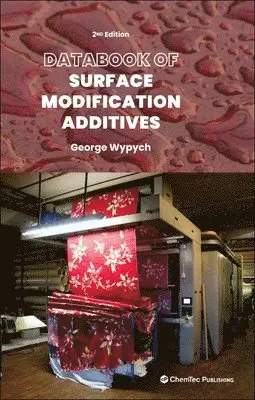
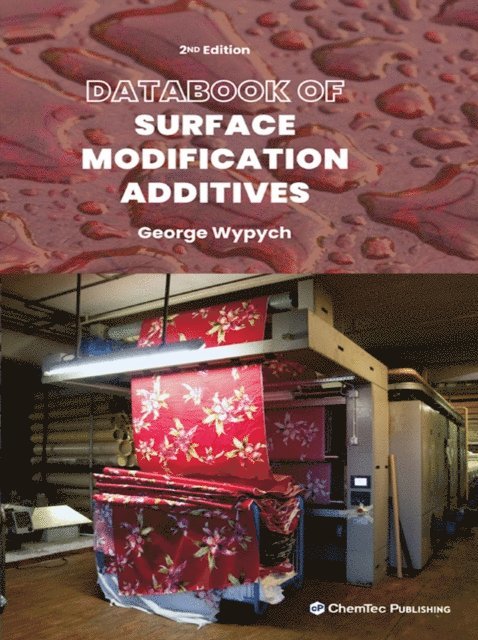
Databook of Surface Modification Additives, Second Edition contains data on 10 groups of additives, including anti-scratch and mar-preventing additives, additives for surface tension reduction and wetting, hydrophobization additives, gloss enhancement and surface matting additives, additives for formation of tack-free surface and tackifiers, and stain inhibiting additives. The information on each is divided into five sections, including General Information, Physical- chemical Properties, Health and Safety, Ecological Properties and Use and Performance. This data is provided for approximately 360 of the most important surface modification additives produced and used today.
This databook will be an extremely useful resource for engineers, researchers and technicians interested in using additives to modify and improve the surface properties of materials.
Provides detailed, up-to-date, essential data on 10 groups of additives Covers general information, physical-chemical properties, health and safety, ecological properties, and use and performance Includes recommendations for specific products, applications, processing methods and the concentrations usedFunctional Fillers
Chemical Composition, Morphology, Performance, Applications
3 300 kr
Skickas inom 7-10 vardagar
3 178 kr
Skickas inom 7-10 vardagar
Handbook of Adhesion Promoters, Second Edition outlines known mechanisms, principles of use, and the applications of different groups of adhesion promoters, along with a discussion of the mechanisms that cause adhesion loss, such as corrosion, delamination, detachment, liquid penetration and peeling. Surface condition and treatment are also discussed, including different methods (cleaning, mechanical, plasma, microwave, flame, corona discharge, laser, UV, and chemical modification) for practical applications. Formulation of typical primers used in the application of adhesives, sealants, coatings, coil coatings, cosmetics, metal, optical devices, polymers and plastics are covered, with over 50 primer formulations provided.
In addition, a full chapter is dedicated to the subject of polymer modification for improved adhesion, a method frequently used instead of the addition of adhesion promoters. The book's final chapters contain information on available evaluation and selection of adhesion promoters that work with different polymers (29), products (28), and those that help to prevent corrosion.
Provides detailed, essential data on adhesion promoters, including additives that are both widely used and recently introduced Covers critical aspects involved in the application of adhesion promoters Discusses mechanisms that result in adhesion loss, primer formulation, polymer modification for improved adhesion, and surface treatment methods Supports readers in the selection of adhesion promoters, including detailed information on adhesion promoter properties, applications and their potential3 300 kr
Skickas inom 7-10 vardagar
Handbook of Odors in Plastic Materials, Third Edition analyzes the reasons behind unwanted odor formation and outlines methods for prevention. This new edition contains a thorough review of the most recent data, achievements and information in this less known but very significant field of polymer modification. The book covers the fundamentals of odor formation and its transport within a material, the relationship between odor and toxicity, and various methods of odor removal and unwanted odor formation. Three chapters are devoted to the analysis of odor-related matters in different polymers, products and methods of processing.
Dozens of polymers and product groups are analyzed, and the book also discusses regulations related to odor in products, effects of odor on health and safety, the effect of odors from plastic materials on indoor air quality, information on testing of odor changes, as well as a selection of raw materials for fog-free products.
Analyzes the reasons behind odor formation Provides the best methods to prevent odors in various plastic materials Contains information on testing odor changes and the relationship between odor and toxicity Includes a comprehensive list of methods for removal of unwanted odors from plastic materials3 666 kr
Skickas inom 7-10 vardagar
Handbook of Plasticizers, Fourth Edition provides a comprehensive review of the current literature as well as cutting-edge details on plasticizers obtained from renewable resources. The book specifies the typical properties of plasticizers belonging to one of thirty-one groups, including expected properties in a given group. The mechanisms of plasticizers, plasticization production steps, and their material behavior in plasticized systems are outlined, along with theoretical background to help readers understand practical observations and methods of material improvement. Other chapters cover the effects on the physical and mechanical properties of plasticized materials, their use in polymers, processing defects formation, and more.
This is an essential professional reference, providing R&D scientists, production chemists, and engineers the information they need to avoid certain plasticizers in applications where they may cause health or material durability problems. In addition, the book shows readers how and where to use plasticizers more effectively.
Provides detailed coverage of thirty-one groups of plasticizers, covering their properties, production, processing, applications, health and environmental aspects Contains new material on odors in plastic materials and their removal Includes expanded coverage of plasticizers from renewable resources3 056 kr
Skickas inom 7-10 vardagar
4 313 kr
Skickas inom 7-10 vardagar
Encyclopedia of Polymer and Rubber Additives documents how polymer properties and performance can be improved through the use of additives, resulting in enhanced physical properties, stability, improved process and assembly, extended shelf life, enhanced purity, and minimized environmental impact. 88 groups of additives used by all segments of the polymer and rubber industries are included, with each group discussed in a systematic manner to facilitate easy information retrieval and comparison. Typical chemical structures, mechanisms of action, influences and interferences in complex formulations, and evidence of performance from experimental studies are each featured, with frequent references to monographic sources.The companion volume, Databook of the Most Important Polymer and Rubber Additives, is also available. It contains robust technical data on the most essential additives currently in use, and the two books are must-have references for anyone working with rubbers and plastics.
Provides a complete set of tables, classifications, and information related to a wide variety of commercially used additives for polymers and rubbersDetails the characteristics of hundreds of additives that can improve performance of physical properties, stability, and storage life, provide colorants, reduce costs, enhance purity, and minimize environmental impactFacilitates information retrieval and comparison, discussing mechanisms of action, suitable features, modifications, evidence of performance from experimental studies, and more3 837 kr
Skickas inom 7-10 vardagar
Databook of the Most Important Polymer and Rubber Additives is a vital reference for anyone working with polymers and rubbers. It provides key information on the properties of the most widely used additives that can be used to alter the physical, chemical, and mechanical properties of rubbers and plastics. Additives are presented by their main chemical component, with information for each additive provided in the form of a table divided into 5 sections, covering General Information, Physical Properties, Health and Safety Considerations, Ecological Impact, and Use and Applications. Data provided includes CAS#, acid/base properties, odor, various cloud points, volatility data, surface tension, thermal conductivity, explosion limits, carcinogenicity, oxygen demands, biodegradation probability, air pollution data, applications in different polymers and products, processing requirements and doses, food approvals, substitutes, and more.The companion book, The Encyclopedia of Polymer and Rubber Additives, contains information on the mechanisms of action of each group of additives, their suitable features and modifications, their effect and interferences in complex formulations, and it is illustrated with numerous experimental examples highlighting their performance.
Provides information on the properties of key additives that can be used to alter the physical, chemical, and mechanical properties of rubbers and plasticsCovers general information, physical properties, health and safety considerations, ecological impact, and use and applicationsPresents additives by their main chemical component, discussing anticaking agents, antidegradants, antifogging agents, curatives, crosslinkers, defoaming agents, fillers, nucleating agents, pigments, solvents, stabilizers, vulcanizing agents, and more3 117 kr
Skickas inom 7-10 vardagar
3 593 kr
Skickas inom 7-10 vardagar
3 483 kr
Skickas inom 7-10 vardagar
Handbook of Curatives and Crosslinkers, Second Edition presents the mechanisms of action of these additives, methods of their use, their effects on the properties of transformed products, as well as their applications. The book outlines the most-recent information on additives that convert soluble monomers, prepolymers, or polymers to insoluble polymer networks commonly known as thermosetting polymers. Chapters cover the common use of curatives in many industrial products manufactured in large scale, such as adhesives, sealants, coatings, inks, explosives, propellants and foams, and in emerging products such as optoelectronics, light-emitting diodes, shape memory polymers, and more.In addition, crosslinkers used in typical industrial processing methods, such as solar cells, vulcanization, adhesives, foams, and roofing are covered. Each section presents the effect of the additive, including an evaluation of its chemical and physical properties. Also available is the complementary Databook of Curatives and Crosslinkers, Second Edition, which provides information on both the commercial and generic chemical products used as curatives and crosslinkers.
Covers the use of curatives in emerging products such as optoelectronics, light-emitting diodes, liquid crystal displays, self-healing materials, and in shape-memory materialsPresents emerging applications, such as drug release, artificial muscles in microdevices, autonomous shape-memory actuators, hygienic textiles, membranes, scaffolds, recycling, sensors, tissue adhesives, wound dressing, and moreDiscusses the selection, chemical and physical properties, mechanics, and the effects of crosslinkers and curatives3 239 kr
Skickas inom 7-10 vardagar
Handbook of Solvents, Fourth Edition, Volume One provides a comprehensive survey of the science of solvents and their properties, covering all aspects of solvent behavior relevant to chemical and related industries, including agricultural and technical processes, inorganic synthesis, materials chemistry, and more. Divided into two volumes that cover high-level information on the physical chemical properties of the most relevant solvent systems, sections focus on a specific aspect of solvent properties that determine selection, such as the effect on properties of solutes and solutions, properties of different groups of solvents, and the summary of their applications' effect on health and the environment.With insights from specialists in a broad array of different areas and written with an interdisciplinary audience in mind, this thoroughly revised edition provides readers with a complete overview of all the organic solvents available for industrial applications today.
Provides key insights that will help engineers and scientists select the best solvent for the jobIncludes practical information and ideas on how to improve existing processes involving solventsPresents the latest advances in solvent technology and their applications3 117 kr
Skickas inom 7-10 vardagar
This Fourth Edition of Handbook of Solvents, Volume 2, contains the most comprehensive information ever published on solvents as well as an extensive analysis of the principles of solvent selection and use. The book begins with a discussion of solvents used in over 30 industries which are the main consumers of solvents. The analysis is conducted based on the available data and contains information on the types (and frequently amounts) of solvents used and potential problems and solutions. Picking up where Handbook of Solvents, Volume 1 leaves off, Handbook of Solvents Volume 2 provides information on the methods of analysis of solvents and materials containing solvents, with 2 sections containing standard and special methods of solvent analysis, followed by a discussion of residual solvents left in the final products. The environmental impact of solvents, such as their fate and movement in the water, soil, and air, fate-based management of solvent-containing wastes, and ecotoxicological effects are discussed as are solvents' impact on tropospheric air pollution. The next 2 chapters are devoted to the toxicology of solvents and regulations aiming to keep solvent toxicity under control. The analysis of the concentration of solvents in more than 15 industries, specific issues related to the paint industry, and characteristics of the environment in automotive collision repair shops are followed by a thorough discussion of regulations in the USA and Europe. Following chapters show examples of solvent substitution by safer materials, with an emphasis on supercritical solvents, ionic liquids, deep eutectic solvents, and agriculture-based products, such as ethyl lactate. Discussion of solvent recycling, removal, and degradation includes absorptive solvent recovery, comparison of results of recovery and incineration, and application of solar photocatalytic oxidation. The book concludes with an evaluation of methods of natural attenuation of various solvents in soils and modern methods of cleaning contaminated soils.
Assists in solvent selection by providing key information and insight on environmental and safety issuesProvides essential best practice guidance for human health considerationDiscusses the latest advances and trends in solvent technology, including modern methods of cleaning contaminated soils, selection of gloves, suits, and respirators3 483 kr
Skickas inom 7-10 vardagar
Databook of Solvents, Third Edition covers high-production solvents, including a large dataset for each, with information divided into General; Physical; Health; Environmental; and Use. The General section covers data such as name, CAS number, empirical formula, mixture, moisture contents, properties, EC number, and more. The Physical section includes data dielectric constant, boiling temperature, color, corrosivity, electrical conductivity, heat of combustion, odor, surface tension, and more. The Health section covers carcinogenicity, packaging group, explosion limits, flammability, reactivity, ingestion, skin and eye irritation, and more. The Environmental section covers biodegradation probability, chemical oxygen demand, global warming potential, soil absorption constant, UV absorption, and more.Finally, the Use section features data on manufacturer, outstanding properties, potential substitutes, processing methods, and more. Further information which may help in the replacement of these solvents can be found in the complementary Databook of Green Solvents, and readers interested in the subject should note that two volumes of fundamental treatment of all essential areas of solvent use have also been published, Handbook of Solvents Volume 1: Properties, and Handbook of Solvents Volume 2: Use, Health, and Environment. Together these four books provide the most wide-ranging and authoritative information on the subject of solvents.
Covers more than 280 of the most essential solventsProvides practical information for use in the lab and the field, including recommended processing methods, dosages, and potential substitutesPresents environmental considerations, thus enabling practitioners to find more efficient replacements for toxic solvents3 361 kr
Skickas inom 7-10 vardagar
Chain Mobility and Progress in Medicine, Pharmaceuticals, and Polymer Science and Technology
3 361 kr
Skickas inom 7-10 vardagar
3 361 kr
Skickas inom 7-10 vardagar
3 361 kr
Skickas inom 7-10 vardagar
3 361 kr
Skickas inom 7-10 vardagar
3 837 kr
Skickas inom 7-10 vardagar
3 361 kr
Skickas inom 7-10 vardagar
3 361 kr
Skickas inom 7-10 vardagar
3 361 kr
Skickas inom 7-10 vardagar
3 739 kr
Skickas inom 7-10 vardagar
2 886 kr
Skickas inom 7-10 vardagar
2 642 kr
Skickas inom 7-10 vardagar