Georgia Mason - Böcker
Visar alla böcker från författaren Georgia Mason. Handla med fri frakt och snabb leverans.
4 produkter
4 produkter
1 499 kr
Skickas inom 11-20 vardagar
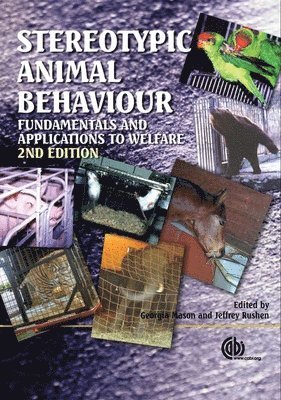
This 2nd edition is a complete re-write of the 1st edition in 1993. It reflects developments in knowledge since the 1st edition and includes many new chapters and contributors. Concern over the welfare of confined animals is continuing to increase and extends not only to farm and zoo animals, but also to laboratory and companion animals. This book focuses on environmentally induced stereotypes, rather than drug induced or neurologically based stereotypes and discusses why captive animals perform these stereotypes. It also examines what this behaviour can tell us about animal welfare, options for prevention and cure and assesses future research directions and implications for animal welfare.
Assessing Animal Welfare
A Guide to the Valid Use of Indicators of Affective States
Häftad, Engelska, 2026
775 kr
Kommande
A clear, practical guide on how to use validated indicators of affective states. Assessing Animal Welfare is a guide on how to use accurate indicators to assess the welfare of animals. The basis for this book is construct validity: how we can validate different indicators that are commonly used to assess animal welfare, and apply this knowledge when using these indicators. Starting with two chapters on the challenges of assessing emotions and moods in animals, and the importance and basis of construct validation, the following chapters evaluate the validity of 11 indicators that range from being suitable to assessing short-term emotions to assessing cumulative negative affect over a lifetime. Each chapter further highlights the limitations of each indicator and provides clear, useful guidance on its interpretation to avoid associated pitfalls. The book also shows how different indicators can complement each other, with real-life examples showing how to put theory into practice. The final chapter concludes by discussing some of the remaining challenges. Written by leading experts in their respective fields, Assessing Animal Welfare presents: Five key approaches to assessing the construct validity of a welfare indicator: using humans as models; observing how indicators change in rewarding or punishing situations, or when in the presence of threats to/promoters of ancestral fitness; taking a pharmacological approach; and assessing co-variance with already validated indicatorsIndicators of emotion, focusing on preference/avoidance, vocal signals, acute corticosteroid responses, body temperature and heart rate, ideal for assessing acute manipulations like handling, transport etc.Indicators of mood, focusing on judgement biases, play, the hormone DHEA, and measures of reward responsiveness, ideal for assessing long-term treatments like housing qualityIndicators of cumulative welfare focusing on abnormal repetitive behaviour, cellular aging, and hippocampal plasticityHow each valid indicator may sometimes yield false leads (suggesting affective states that are absent) or false null results (overlooking affective states that are present), and ways to avoid these pitfallsAssessing Animal Welfare serves as a clear and practical guide for animal welfare researchers, veterinarians, and students of animal welfare science, helping them evaluate and use the most accurate affective state indicators for a given situation.
676 kr
Skickas inom 7-10 vardagar
This second edition is a complete re-write of the 1st edition published in 1993 (editors Lawrence and Rushen). It reflects many recent advances, bringing together all new chapters and over 30 contributors. Abnormal behaviour patterns, from the jumping and somersaulting of caged laboratory mice to the pacing of enclosed 'big cats', are displayed by many millions of farm, zoo, research and companion animals. This book focuses on the causation and treatment of these environment-induced stereotypic behaviours, and their implications for animal welfare and normalcy of brain functioning. The first section takes an ethological perspective, focusing on the constraints captivity places on animals' normal behavioural repertoires, and the effects these have on specific motivational systems. The second section addresses the role of dysfunction, particularly the impact of chronic stress and impoverished environments on brain functioning. The third section looks at how stereotypic behaviours can be tackled, once they have emerged, using diverse techniques from environmental enrichment to pharmaceutical intervention. The volume ends with a synthesis, a suggested new definition for 'stereotypic behaviour', and a discussion of future research directions. This book will be of significant interest to researchers and advanced students in animal behaviour and welfare, animal and veterinary science, comparative psychology, and neuroscience.
325 kr
Skickas inom 5-8 vardagar