Gerald Sommer – författare
Visar alla böcker från författaren Gerald Sommer. Handla med fri frakt och snabb leverans.
17 produkter
17 produkter
Inbunden, Engelska, 1990
1 773 kr
Skickas inom 5-8 vardagar
No detailed description available for "Computer Analysis of Images and Patterns".
E-bok
PDF, Engelska, 20221 376 kr
Läs direkt efter köp
No detailed description available for "e;Computer Analysis of Images and Patterns"e;.
561 kr
Skickas inom 10-15 vardagar
MathematicsMechanization consistsoftheory,softwareandapplicationofc- puterized mathematical activities such as computing, reasoning and discovering. ItsuniquefeaturecanbesuccinctlydescribedasAAA(Algebraization,Algori- mization, Application). The name “Mathematics Mechanization” has its origin in the work of Hao Wang (1960s), one of the pioneers in using computers to do research in mathematics, particularly in automated theorem proving. Since the 1970s, this research direction has been actively pursued and extensively dev- oped by Prof. Wen-tsun Wu and his followers. It di?ers from the closely related disciplines like Computer Mathematics, Symbolic Computation and Automated Reasoning in that its goal is to make algorithmic studies and applications of mathematics the major trend of mathematics development in the information age. The International Workshop on Mathematics Mechanization (IWMM) was initiated by Prof. Wu in 1992, and has ever since been held by the Key L- oratory of Mathematics Mechanization (KLMM) of the Chinese Academy of Sciences. There have been seven workshops of the series up to now. At each workshop, several experts are invited to deliver plenary lectures on cutting-edge methods and algorithms of the selected theme. The workshop is also a forum for people working on related subjects to meet, collaborate and exchange ideas.
687 kr
Läs direkt efter köp
MathematicsMechanization consistsoftheory,softwareandapplicationofc- puterized mathematical activities such as computing, reasoning and discovering. ItsuniquefeaturecanbesuccinctlydescribedasAAA(Algebraization,Algori- mization, Application). The name “Mathematics Mechanization” has its origin in the work of Hao Wang (1960s), one of the pioneers in using computers to do research in mathematics, particularly in automated theorem proving. Since the 1970s, this research direction has been actively pursued and extensively dev- oped by Prof. Wen-tsun Wu and his followers. It di?ers from the closely related disciplines like Computer Mathematics, Symbolic Computation and Automated Reasoning in that its goal is to make algorithmic studies and applications of mathematics the major trend of mathematics development in the information age. The International Workshop on Mathematics Mechanization (IWMM) was initiated by Prof. Wu in 1992, and has ever since been held by the Key L- oratory of Mathematics Mechanization (KLMM) of the Chinese Academy of Sciences. There have been seven workshops of the series up to now. At each workshop, several experts are invited to deliver plenary lectures on cutting-edge methods and algorithms of the selected theme. The workshop is also a forum for people working on related subjects to meet, collaborate and exchange ideas.
Häftad, Engelska, 2000
561 kr
Skickas inom 10-15 vardagar
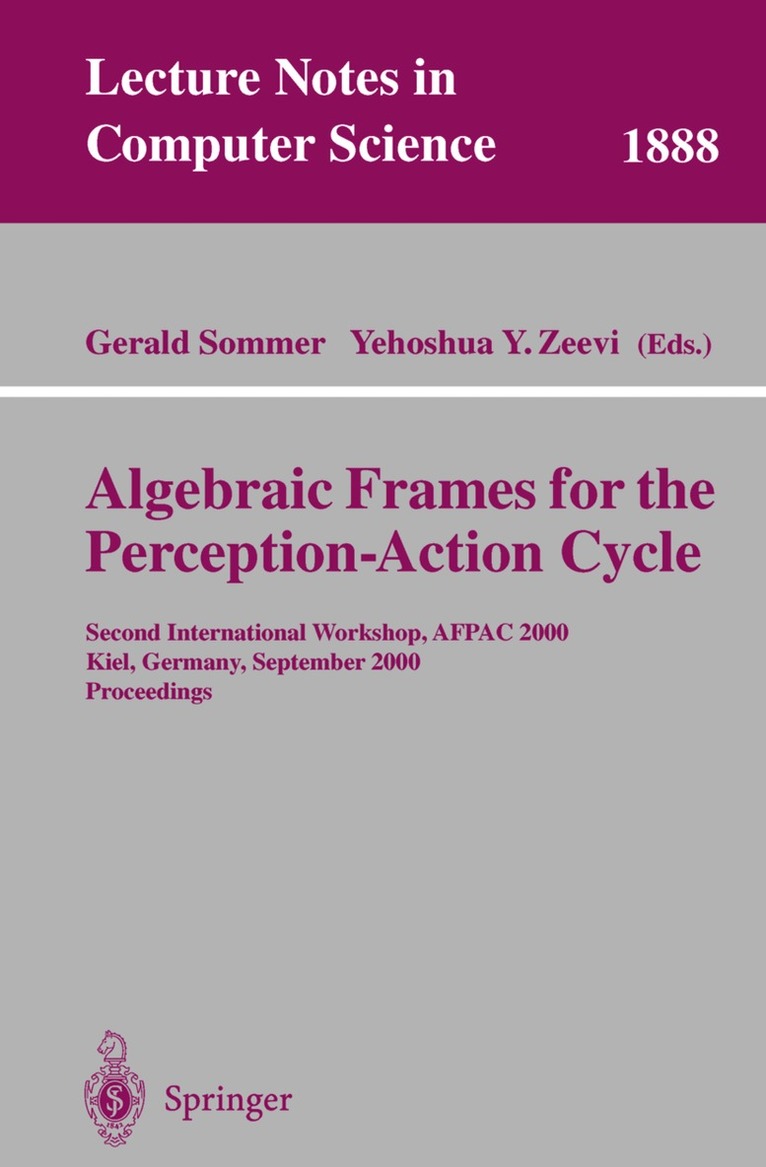
This book constitutes the refereed proceedings of the Second International Workshop on Algebraic Frames for the Perception-Action Cycle, AFPAC 2000, held in Kiel, Germany in September 2000.The 20 regular papers presented together with seven invited papers were carefully reviewed and selected for inclusion in the book. Among the topics addressed are action representation analysis, perception-action structure, colorimetry, motion modeling, spatio-temporal structures, geometric transformations, Clifford algebras, geometric algebra, illumination changes, contact modeling, wavelets, adaptive system behaviour, kinematics, hyperharmonic signal analysis, motion estimation, geodesic conturs, etc.
Inbunden, Engelska, 2001
1 834 kr
Skickas inom 10-15 vardagar
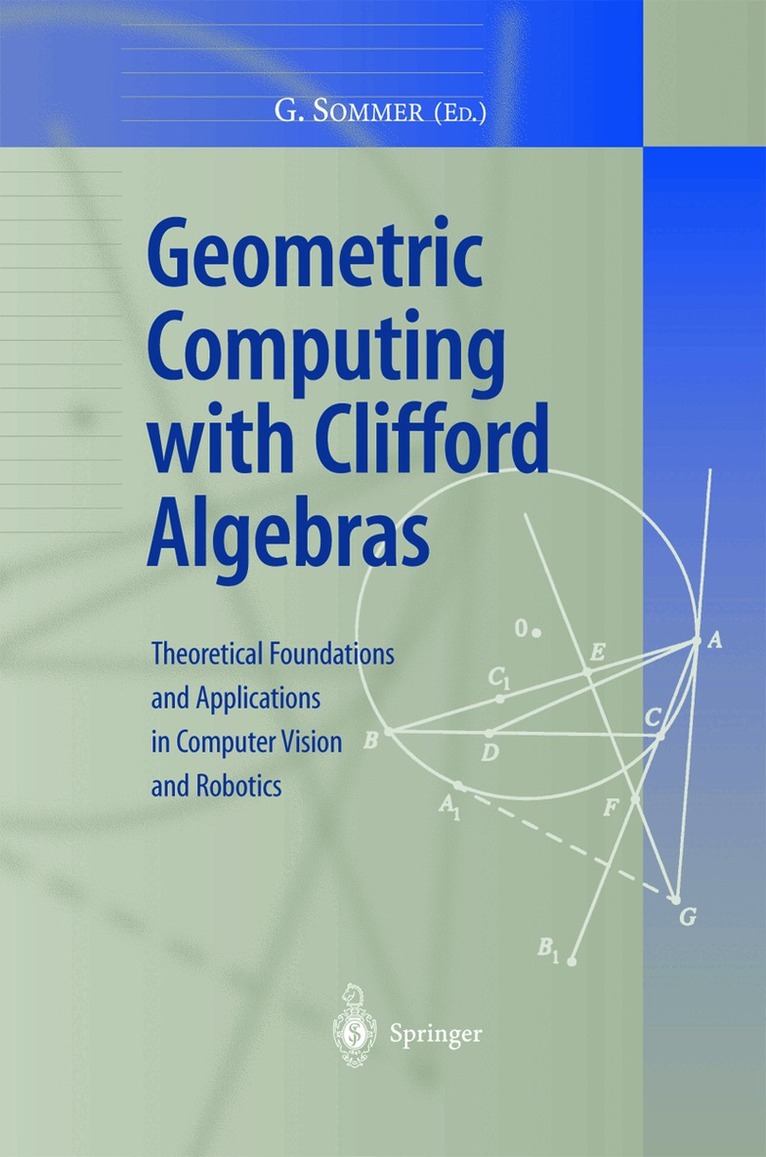
Clifford algebra, then called geometric algebra, was introduced more than a cenetury ago by William K. Clifford, building on work by Grassmann and Hamilton. Clifford or geometric algebra shows strong unifying aspects and turned out in the 1960s to be a most adequate formalism for describing different geometry-related algebraic systems as specializations of one "mother algebra" in various subfields of physics and engineering. Recent work outlines that Clifford algebra provides a universal and powerfull algebraic framework for an elegant and coherent representation of various problems occuring in computer science, signal processing, neural computing, image processing, pattern recognition, computer vision, and robotics. This monograph-like anthology introduces the concepts and framework of Clifford algebra and provides computer scientists, engineers, physicists, and mathematicians with a rich source of examples of how to work with this formalism.
Häftad, Engelska, 2001
544 kr
Skickas inom 10-15 vardagar
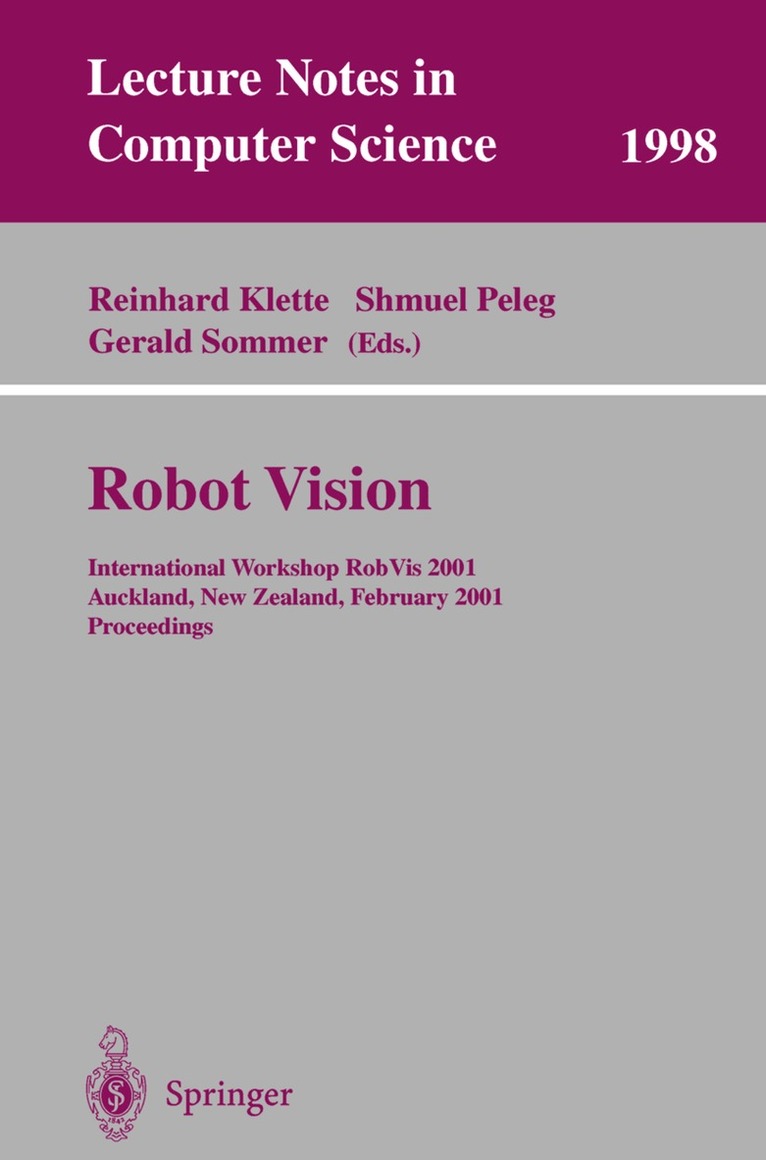
On behalf of the organizerswe would like to welcome all participants to the "Robot Vision 2001" workshop. Our objective has been to bring together - searchersinrobotvision,andtopromoteinteractionanddebate. Participants oftheworkshopcomefromEurope,US,theMiddleEast,theFarEast,andof coursefromNewZealand. Fifty-twopapersweresubmittedtotheworkshop,andeachpaperwasth- oughlyreviewedbyatleastthreereviewers. Seventeenpaperswereselectedfor oral presentation, and seventeen papers were selected for poster presentation. There were no invited technical papers, to give all participants the sense of equalopportunity. Thetechnicalscopeoftheworkshopisverywide,andincludespresentations onmotionanalysis,3Dmeasurements,calibration,navigation,objectrecog- tion,andmore. Thescheduleoftheworkshopwasthereforepreparedtoallow, inadditiontothetechnicalpresentation,ampletimefordiscussionsandint- action. Wehopethatinteractionamongresearchersofsuchdi?erentareas,yet allpartofrobotvision,willresultinbetterunderstandingandresearchofthe robotvisionarea.February2001 ReinhardKlette,ShmuelPeleg,andGeraldSommer Organization RobVis2001wasorganizedbytheCenterforImageTechnologyandRobotics (CITR),Tamakicampus,TheUniversityofAuckland. Co-chairs ReinhardKlette(Auckland,NewZealand) ShmuelPeleg(Jerusalem,Israel) GeraldSommer(Kiel,Germany) Program Committee JackyBaltes(Auckland, NZ), ThomasBr..aunl (Nedlands, AUS), Ross Clarke (Hamilton,NZ),GeorgyGimel'farb(Auckland,NZ),AtsusuhiImiya(Chiba,J), Reinhard Klette (Auckland, NZ), Claus-E. Liedtke (Hanover,D), Bruce Mac- Donald (Auckland, NZ), Takashi Matsuyama (Kyoto, Japan), Allan McIvor (Auckland,NZ),JosefPauli(Kiel,D),ShmuelPeleg(Jerusalem,IL),Moshe- rat(Haifa,IL),GeraldSommer(Kiel,D),BillTrigs(Grenoble,F),andFriedrich Wahl(Braunschweig,D). Local Organizing Committee JackyBaltes,GeorgyGimel'farb,UlrichGun .. ther,JamesHarper,ReinhardKlette, CeciliaLourdes,BruceMacDonald,S. Manoharan,SudhirReddy,andSharon Walker. Sponsors TheInternationalAssociationforPatternRecognition MORST/DFG InstituteofElectricalandElectronicEngineers(IEEE)-NZNorthSection TheUniversityofAuckland,Tamakicampus VisualImpactAucklandLtd. Table of Contents Active Perception VisualCuesforaFixatingActiveAgent ...1 M?artenBj..orkmanandJan-OlofEklundh TrackingwithaNovelPoseEstimationAlgorithm ...9 BodoRosenhahn,NorbertKru..ger,TorgeRabschandGeraldSommer Real-TimeTrackingofArticulatedHumanModels Usinga3DShape-from-SilhouetteMethod...19 JasonLuck,DanSmallandCharlesQ. Little Hierarchical3DPoseEstimationforArticulatedHumanBodyModels fromaSequenceofVolumeData...27 SebastianWeikandC. -E. Liedtke Vision-BasedRobotLocalizationUsingSporadicFeatures...35 StefanEnderle,HeikoFolkerts,MarcusRitter,StefanSablatn..og, GerhardKraetzschmarandGunth .. erPalm Poster Session1: Computer Vision AComparisonofFeatureMeasurementsforKineticStudies onHumanBodies...43 NikkiAustin,YenChen,ReinhardKlette,RobertMarshall, Yuan-shengTsaiandYongbaoZhang ObjectIdenti?cationandPoseEstimationforAutomaticManipulation ...52 BenjaminHohnhaeuserandGuenterHommel TowardSelf-calibrationofaStereoRigfromNoisyStereoscopicImages ...60 SlimaneLarabi AColorSegmentationAlgorithmforReal-TimeObjectLocalization onSmallEmbeddedSystems...69 PhilippeLeclercqandThomasBrau ..nl EYESCAN-AHighResolutionDigitalPanoramicCamera...77 KarstenScheibe,HartmutKorsitzky,RalfReulke,MartinScheele andMichaelSolbrig AWavelet-BasedAlgorithmforHeightfromGradients ...84 TiangongWeiandReinhardKlette EnhancedStereoVisionUsingFree-FormSurfaceMirrors...91 AlexanderWuerz,StefanK. GehrigandFridtjofJ. Stein VIII Table of Contents Poster Session2:Robotics& Video RoboCup-99:AStudent'sPerspective ...99 JackyBaltes Horus:ObjectOrientationandIdwithoutAdditionalMarkers ...107 JackyBaltes AnStereoscopicVisionSystemGuidinganAutonomousHelicopter forOverheadPowerCableInspection ...115 PascualCampoy,PedroJ. Garcia,AntonioBarrientos, JaimedelCerro,In"aquiAguirre,Andr'esRoa,RafaelGarcia andJos'eM. Muno"z 3DStereoVision-BasedNursingRobotforElderlyHealthCare ...125 Wee-SoonChing,EdwardHo,ChristopherOng,HsTayandSai-MuiLim E?cientComputationofIntensityPro?lesforReal-TimeVision ...131 ErnstDieterDickmanns SubpixelFlowDetectionbytheHoughTransform ...140 AtsushiImiyaandKeisukeIwawaki TrackingofMovingHeadsinClutteredScenesfromStereoVision ...148 RuijiangLuoandYanGuo ServoingMechanismsforPeg-In-HoleAssemblyOperations ...157 JosefPauli,ArneSchmidtandGeraldSommer RobotLocalizationUsingOmnidirectionalColorImages ...167 DavidC. K. YuenandBruceA. MacDonald TheBackgroundSubtractionProblemforVideoSurveillanceSystems ...176 AlanMcIvor,QiZangandReinhardKlette Computational Stereo StableMonotonicMatchingforStereoscopicVision ...184 ? RadimS'ara RandomSamplingandVotingMethod forThree-DimensionalReconstruction ...193 KazuhikoKawamotoandAtsushiImiya BinocularStereobyMaximizingtheLikelihoodRatioRelative toaRandomTerrain...201 GeorgyGimel'farb StereoReconstructionfromPolycentricPanoramas ...
E-bok
PDF, Engelska, 2003687 kr
Läs direkt efter köp
E-bok
PDF, Engelska, 2006697 kr
Läs direkt efter köp
This volume presents the proceedings of the 2nd International Workshop on - gebraic Frames for the Perception and Action Cycle. AFPAC 2000. held in Kiel, Germany, 10–11 September 2000. The presented topics cover new results in the conceptualization, design, and implementation of visual sensor-based robotics and autonomous systems. Special emphasis is placed on the role of algebraic modelling in the relevant disciplines, such as robotics, computer vision, theory of multidimensional signals, and neural computation. The aims of the workshop are twofold: ?rst, discussion of the impact of algebraic embedding of the task at hand on the emergence of new qualities of modelling and second, facing the strong relations between dominant geometric problems and algebraic modelling. The ?rst workshop in this series, AFPAC’97. inspired several groups to i- tiate new research programs, or to intensify ongoing research work in this ?eld, and the range of relevant topics was consequently broadened, The approach adopted by this workshop does not necessarily ?t the mainstream of worldwide research-granting policy. However, its search for fundamental problems in our ?eld may very well lead to new results in the relevant disciplines and contribute to their integration in studies of the perception–action cycle.
Häftad, Engelska, 1997
1 667 kr
Skickas inom 10-15 vardagar
This book constitutes the refereed proceedings of the 7th International Conference on Computer Analysis of Images and Patterns, CAIP '97, held in Kiel, Germany, in September 1997.The volume presents 92 revised papers selected during a double-blind reviewing process from a total of 150 high-quality submissions. The papers are organized in topical sections on pattern analysis, object recognition and tracking, invariants, applications, shape, texture analysis, motion calibration, low-level processing, structure from motion, stereo and correspondence, segmentation and grouping, mathematical morphology, pose estimation, and face analysis.
Häftad, Engelska, 1997
561 kr
Skickas inom 10-15 vardagar
The book constitutes the refereed proceedings of the International Workshop on Algebraic Frames for the Perception-Action Cycle, AFPAC '97, held in Kiel, Germany, in September 1997.The volume presents 12 revised full papers carefully reviewed and selected for inclusion in the book. Also included are 10 full invited papers by leading researchers in the area providing a representative state-of-the-art assessment of this rapidly growing field. The papers are organized in topical sections on PAC systems, low level and early vision, recognition of visual structure, processing of 3D visual space, representation and shape perception, inference and action, and visual and motor neurocomputation.
Häftad, Tyska, 2000
576 kr
Skickas inom 10-15 vardagar
Die Deutsche Arbeitsgemeinschaft für Mustererkennung veranstaltet seit 1978 jährlich an verschiedenen Orten ein wissenschaftliches Symposium mit dem Ziel, Aufgabenstellungen, Denkweisen und Forschungsergebnisse aus den Gebieten der Mustererkennung vorzustellen, den Erfahrungs- und Ideenaustausch zwischen den Fachleuten anzuregen und den Nachwuchs zu fördern.In dem dieses Jahr erstmals durchgeführten Kontaktforum unter dem Titel "Forum Industrie und Wissenschaft" findet der Austausch von Industrie und Wirtschaft besondere Beachtung.
Häftad, Engelska, 2008
544 kr
Skickas inom 10-15 vardagar
In 1986, B.K.P. Horn published a book entitled Robot Vision, which actually discussed a wider ?eld of subjects, basically addressing the ?eld of computer vision, but introducing “robot vision” as a technical term. Since then, the - teraction between computer vision and research on mobile systems (often called “robots”, e.g., in an industrial context, but also including vehicles, such as cars, wheelchairs, tower cranes, and so forth) established a diverse area of research, today known as robot vision. Robot vision (or, more general, robotics) is a fast-growing discipline, already taught as a dedicated teaching program at university level. The term “robot vision” addresses any autonomous behavior of a technical system supported by visual sensoric information. While robot vision focusses on the vision process, visual robotics is more directed toward control and automatization. In practice, however, both ?elds strongly interact. Robot Vision 2008 was the second international workshop, counting a 2001 workshop with identical name as the ?rst in this series. Both workshops were organized in close cooperation between researchers from New Zealand and Germany, and took place at The University of Auckland, New Zealand. Participants of the 2008 workshop came from Europe, USA, South America, the Middle East, the Far East, Australia, and of course from New Zealand.
E-bok
PDF, Engelska, 2008687 kr
Läs direkt efter köp
In 1986, B.K.P. Horn published a book entitled Robot Vision, which actually discussed a wider ?eld of subjects, basically addressing the ?eld of computer vision, but introducing “robot vision” as a technical term. Since then, the - teraction between computer vision and research on mobile systems (often called “robots”, e.g., in an industrial context, but also including vehicles, such as cars, wheelchairs, tower cranes, and so forth) established a diverse area of research, today known as robot vision. Robot vision (or, more general, robotics) is a fast-growing discipline, already taught as a dedicated teaching program at university level. The term “robot vision” addresses any autonomous behavior of a technical system supported by visual sensoric information. While robot vision focusses on the vision process, visual robotics is more directed toward control and automatization. In practice, however, both ?elds strongly interact. Robot Vision 2008 was the second international workshop, counting a 2001 workshop with identical name as the ?rst in this series. Both workshops were organized in close cooperation between researchers from New Zealand and Germany, and took place at The University of Auckland, New Zealand. Participants of the 2008 workshop came from Europe, USA, South America, the Middle East, the Far East, Australia, and of course from New Zealand.
Häftad, Engelska, 2010
1 889 kr
Skickas inom 10-15 vardagar
Clifford algebra, then called geometric algebra, was introduced more than a cenetury ago by William K. Clifford, building on work by Grassmann and Hamilton. Clifford or geometric algebra shows strong unifying aspects and turned out in the 1960s to be a most adequate formalism for describing different geometry-related algebraic systems as specializations of one "mother algebra" in various subfields of physics and engineering. Recent work outlines that Clifford algebra provides a universal and powerfull algebraic framework for an elegant and coherent representation of various problems occuring in computer science, signal processing, neural computing, image processing, pattern recognition, computer vision, and robotics. This monograph-like anthology introduces the concepts and framework of Clifford algebra and provides computer scientists, engineers, physicists, and mathematicians with a rich source of examples of how to work with this formalism.
E-bok
PDF, Tyska, 2013587 kr
Läs direkt efter köp
Die Deutsche Arbeitsgemeinschaft für Mustererkennung veranstaltet seit 1978 jährlich an verschiedenen Orten ein wissenschaftliches Symposium mit dem Ziel, Aufgabenstellungen, Denkweisen und Forschungsergebnisse aus den Gebieten der Mustererkennung vorzustellen, den Erfahrungs- und Ideenaustausch zwischen den Fachleuten anzuregen und den Nachwuchs zu fördern.In dem dieses Jahr erstmals durchgeführten Kontaktforum unter dem Titel "Forum Industrie und Wissenschaft" findet der Austausch von Industrie und Wirtschaft besondere Beachtung.
E-bok
PDF, Engelska, 20132 303 kr
Läs direkt efter köp
Clifford algebra, then called geometric algebra, was introduced more than a cenetury ago by William K. Clifford, building on work by Grassmann and Hamilton. Clifford or geometric algebra shows strong unifying aspects and turned out in the 1960s to be a most adequate formalism for describing different geometry-related algebraic systems as specializations of one "mother algebra" in various subfields of physics and engineering. Recent work outlines that Clifford algebra provides a universal and powerfull algebraic framework for an elegant and coherent representation of various problems occuring in computer science, signal processing, neural computing, image processing, pattern recognition, computer vision, and robotics. This monograph-like anthology introduces the concepts and framework of Clifford algebra and provides computer scientists, engineers, physicists, and mathematicians with a rich source of examples of how to work with this formalism.