Gerard Naddaf - Böcker
Visar alla böcker från författaren Gerard Naddaf. Handla med fri frakt och snabb leverans.
6 produkter
6 produkter
1 167 kr
Skickas inom 7-10 vardagar
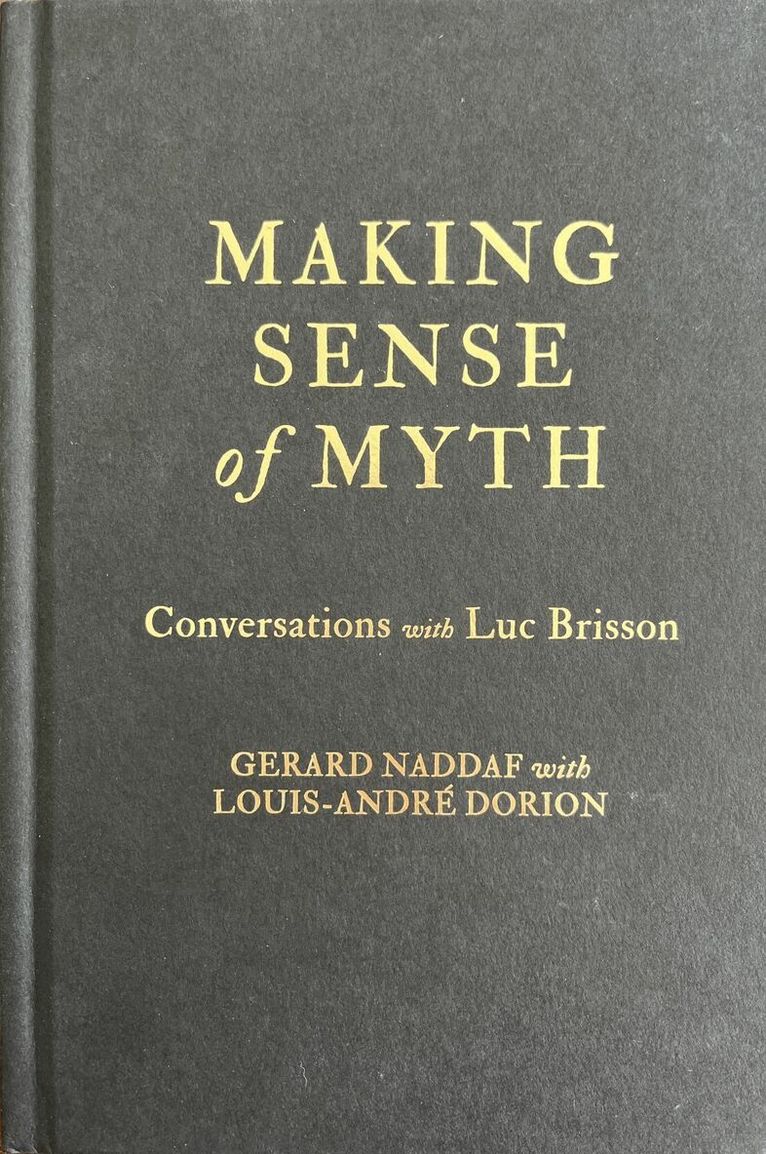
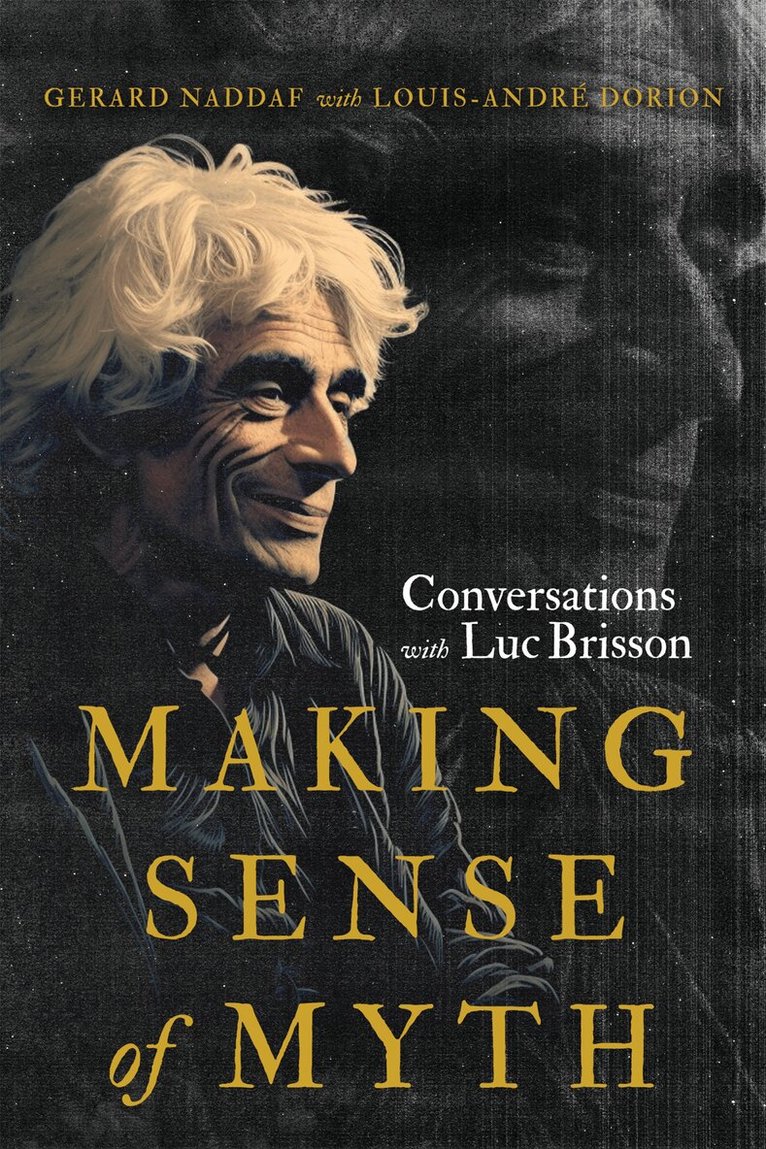
To most, myths are merely fantastic stories. But for Luc Brisson, one of the great living Plato scholars, myth is a key factor in what it means to be human – a condition of life for all. Essential and inescapable, myth offers a guide for living, forming the core of belonging and group identity.In 1999 Quebec classicist Louis-André Dorion published a series of French conversations with Brisson on the idea of myth. In Making Sense of Myth Gerard Naddaf offers an extended and updated English translation of these conversations, as well as a new set of discussions between himself and Brisson. Beginning with Brisson's childhood in the village of Saint-Esprit, Quebec, through his education as a gifted child in minor seminaries starting at age eleven, and continuing with his years in Paris, first as a graduate student and later at the Centre national de la recherche scientifique (CNRS), Brisson tells the story of his escape from an all-encompassing myth – the one promulgated by the Roman Catholic Church. The philosopher situates Quebec society as inseparable from the history of the Catholic Church in Quebec, and argues that this correlation offers a perfect paradigm of myth and mythmaking. Naddaf’s introduction and afterword contextualize the conversations by discussing Brisson’s and Plato’s understanding of the origin and meaning of myth, elaborating on the role of myth in anthropogeny, in the creation of selfhood, and in multiculturalism.Making Sense of Myth promises both a philosophy of myth and a philosophy of life, one inspired by Brisson’s lifelong engagement with the great Western philosopher Plato.
363 kr
Skickas inom 7-10 vardagar
To most, myths are merely fantastic stories. But for Luc Brisson, one of the great living Plato scholars, myth is a key factor in what it means to be human – a condition of life for all. Essential and inescapable, myth offers a guide for living, forming the core of belonging and group identity.In 1999 Quebec classicist Louis-André Dorion published a series of French conversations with Brisson on the idea of myth. In Making Sense of Myth Gerard Naddaf offers an extended and updated English translation of these conversations, as well as a new set of discussions between himself and Brisson. Beginning with Brisson's childhood in the village of Saint-Esprit, Quebec, through his education as a gifted child in minor seminaries starting at age eleven, and continuing with his years in Paris, first as a graduate student and later at the Centre national de la recherche scientifique (CNRS), Brisson tells the story of his escape from an all-encompassing myth – the one promulgated by the Roman Catholic Church. The philosopher situates Quebec society as inseparable from the history of the Catholic Church in Quebec, and argues that this correlation offers a perfect paradigm of myth and mythmaking. Naddaf’s introduction and afterword contextualize the conversations by discussing Brisson’s and Plato’s understanding of the origin and meaning of myth, elaborating on the role of myth in anthropogeny, in the creation of selfhood, and in multiculturalism.Making Sense of Myth promises both a philosophy of myth and a philosophy of life, one inspired by Brisson’s lifelong engagement with the great Western philosopher Plato.
1 223 kr
Skickas inom 5-8 vardagar
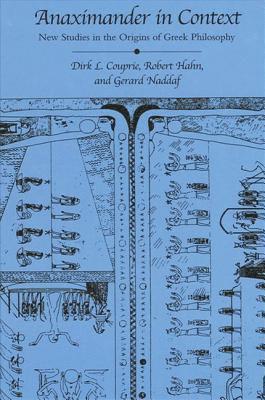
Places the development of Anaximander's thought within social, political, cosmological, astronomical, and technological contexts.Promoting a new, broadly interdisciplinary horizon for future studies in early Greek philosophy, Dirk L. Couprie, Robert Hahn, and Gerard Naddaf establish the cultural context in which Anaximander's thought developed and in which the origins of Greek philosophy unfolded in its earliest stages. In order to better understand Anaximander's achievement, the authors call our attention to the historical, social, political, technological, cosmological, astronomical, and observational contexts of his thought. Anaximander in Context brings to the forefront of modern debates the importance of cultural context, and the indispensability of images to clarify ancient ideologies.
594 kr
Skickas inom 3-6 vardagar
Places the development of Anaximander's thought within social, political, cosmological, astronomical, and technological contexts.Promoting a new, broadly interdisciplinary horizon for future studies in early Greek philosophy, Dirk L. Couprie, Robert Hahn, and Gerard Naddaf establish the cultural context in which Anaximander's thought developed and in which the origins of Greek philosophy unfolded in its earliest stages. In order to better understand Anaximander's achievement, the authors call our attention to the historical, social, political, technological, cosmological, astronomical, and observational contexts of his thought. Anaximander in Context brings to the forefront of modern debates the importance of cultural context, and the indispensability of images to clarify ancient ideologies.
1 057 kr
Tillfälligt slut
Explores the origin and evolution of the Greek concept of nature up until the time of Plato.In The Greek Concept of Nature, Gerard Naddaf utilizes historical, mythological, and linguistic perspectives to reconstruct the origin and evolution of the Greek concept of phusis. Usually translated as nature, phusis has been decisive both for the early history of philosophy and for its subsequent development. However, there is a considerable amount of controversy on what the earliest philosophers-Anaximander, Xenophanes, Pythagoras, Heraclitus, Parmenides, Empedocles, Anaxagoras, Leucippus, and Democritus-actually had in mind when they spoke of phusis or nature. Naddaf demonstrates that the fundamental and etymological meaning of the word refers to the whole process of birth to maturity. He argues that the use of phusis in the famous expression Peri phuseos or historia peri phuseos refers to the origin and the growth of the universe from beginning to end. Naddaf's bold and original theory for the genesis of Greek philosophy demonstrates that archaic and mythological schemes were at the origin of the philosophical representations, but also that cosmogony, anthropogony, and politogony were never totally separated in early Greek philosophy.
566 kr
Skickas inom 3-6 vardagar
Explores the origin and evolution of the Greek concept of nature up until the time of Plato.In The Greek Concept of Nature, Gerard Naddaf utilizes historical, mythological, and linguistic perspectives to reconstruct the origin and evolution of the Greek concept of phusis. Usually translated as nature, phusis has been decisive both for the early history of philosophy and for its subsequent development. However, there is a considerable amount of controversy on what the earliest philosophers-Anaximander, Xenophanes, Pythagoras, Heraclitus, Parmenides, Empedocles, Anaxagoras, Leucippus, and Democritus-actually had in mind when they spoke of phusis or nature. Naddaf demonstrates that the fundamental and etymological meaning of the word refers to the whole process of birth to maturity. He argues that the use of phusis in the famous expression Peri phuseos or historia peri phuseos refers to the origin and the growth of the universe from beginning to end. Naddaf's bold and original theory for the genesis of Greek philosophy demonstrates that archaic and mythological schemes were at the origin of the philosophical representations, but also that cosmogony, anthropogony, and politogony were never totally separated in early Greek philosophy.