Gerhard X. Ritter - Böcker
Visar alla böcker från författaren Gerhard X. Ritter. Handla med fri frakt och snabb leverans.
5 produkter
5 produkter
Introduction to Lattice Algebra
With Applications in AI, Pattern Recognition, Image Analysis, and Biomimetic Neural Networks
Inbunden, Engelska, 2021
1 631 kr
Skickas inom 10-15 vardagar
Lattice theory extends into virtually every branch of mathematics, ranging from measure theory and convex geometry to probability theory and topology. A more recent development has been the rapid escalation of employing lattice theory for various applications outside the domain of pure mathematics. These applications range from electronic communication theory and gate array devices that implement Boolean logic to artificial intelligence and computer science in general. Introduction to Lattice Algebra: With Applications in AI, Pattern Recognition, Image Analysis, and Biomimetic Neural Networks lays emphasis on two subjects, the first being lattice algebra and the second the practical applications of that algebra. This textbook is intended to be used for a special topics course in artificial intelligence with a focus on pattern recognition, multispectral image analysis, and biomimetic artificial neural networks. The book is self-contained and – depending on the student’s major – can be used for a senior undergraduate level or first-year graduate level course. The book is also an ideal self-study guide for researchers and professionals in the above-mentioned disciplines. Features Filled with instructive examples and exercises to help build understanding Suitable for researchers, professionals and students, both in mathematics and computer scienceContains numerous exercises.
Introduction to Lattice Algebra
With Applications in AI, Pattern Recognition, Image Analysis, and Biomimetic Neural Networks
Häftad, Engelska, 2023
704 kr
Skickas inom 10-15 vardagar
Lattice theory extends into virtually every branch of mathematics, ranging from measure theory and convex geometry to probability theory and topology. A more recent development has been the rapid escalation of employing lattice theory for various applications outside the domain of pure mathematics. These applications range from electronic communication theory and gate array devices that implement Boolean logic to artificial intelligence and computer science in general. Introduction to Lattice Algebra: With Applications in AI, Pattern Recognition, Image Analysis, and Biomimetic Neural Networks lays emphasis on two subjects, the first being lattice algebra and the second the practical applications of that algebra. This textbook is intended to be used for a special topics course in artificial intelligence with a focus on pattern recognition, multispectral image analysis, and biomimetic artificial neural networks. The book is self-contained and – depending on the student’s major – can be used for a senior undergraduate level or first-year graduate level course. The book is also an ideal self-study guide for researchers and professionals in the above-mentioned disciplines. Features Filled with instructive examples and exercises to help build understanding Suitable for researchers, professionals and students, both in mathematics and computer scienceContains numerous exercises.
3 282 kr
Skickas inom 10-15 vardagar
Image algebra is a comprehensive, unifying theory of image transformations, image analysis, and image understanding. In 1996, the bestselling first edition of the Handbook of Computer Vision Algorithms in Image Algebra introduced engineers, scientists, and students to this powerful tool, its basic concepts, and its use in the concise representation of computer vision algorithms.Updated to reflect recent developments and advances, the second edition continues to provide an outstanding introduction to image algebra. It describes more than 80 fundamental computer vision techniques and introduces the portable iaC++ library, which supports image algebra programming in the C++ language. Revisions to the first edition include a new chapter on geometric manipulation and spatial transformation, several additional algorithms, and the addition of exercises to each chapter.The authors-both instrumental in the groundbreaking development of image algebra-introduce each technique with a brief discussion of its purpose and methodology, then provide its precise mathematical formulation. In addition to furnishing the simple yet powerful utility of image algebra, the Handbook of Computer Vision Algorithms in Image Algebra supplies the core of knowledge all computer vision practitioners need. It offers a more practical, less esoteric presentation than those found in research publications that will soon earn it a prime location on your reference shelf.
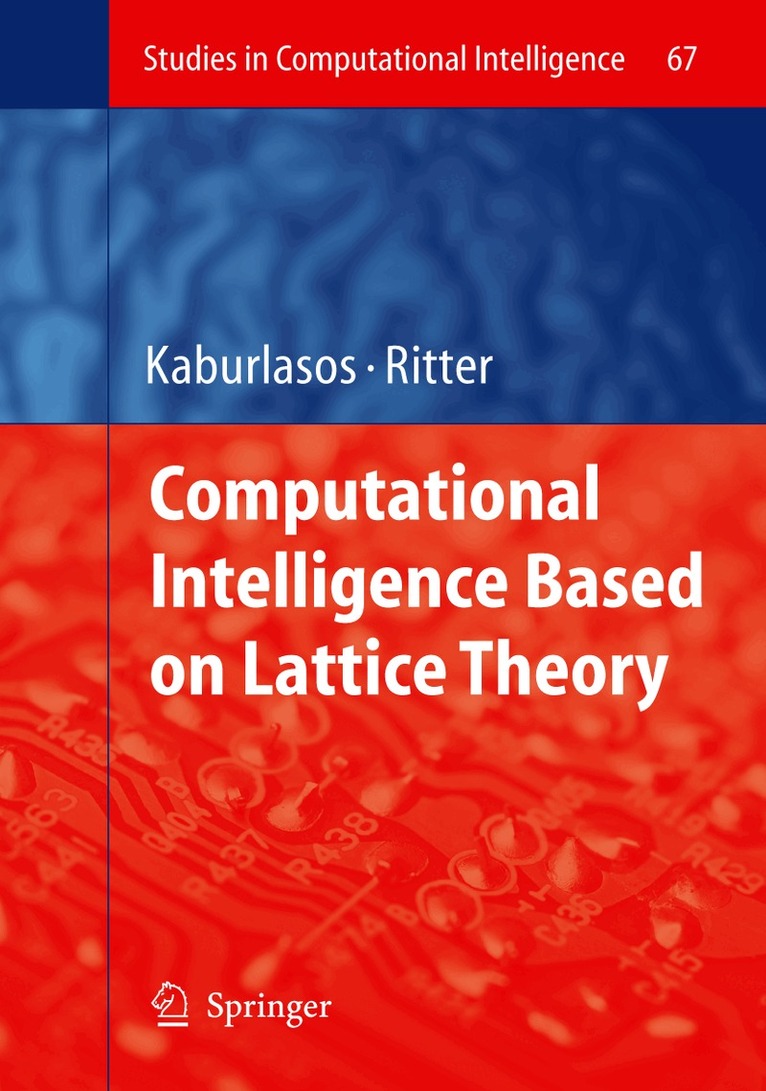
Del 67 - Studies in Computational Intelligence
Computational Intelligence Based on Lattice Theory
Inbunden, Engelska, 2007
1 636 kr
Skickas inom 10-15 vardagar
A number of di?erent instruments for design can be uni?ed in the context of lattice theory towards cross-fertilization By“latticetheory”[1]wemean,equivalently,eitherapartialordering relation [2,3]ora couple of binary algebraic operations [3, 4]. There is a growing interest in computational intelligence based on lattice theory. A number of researchers are currently active developing lattice theory based models and techniques in engineering, computer and information s- ences, applied mathematics, and other scienti?c endeavours. Some of these models and techniques are presented here. However, currently, lattice theory is not part of the mainstream of com- tationalintelligence.Amajorreasonforthisisthe“learningcurve”associated with novel notions and tools. Moreover, practitioners of lattice theory, in s- ci?c domains of interest, frequently develop their own tools and/or practices without being aware of valuable contributions made by colleagues. Hence, (potentially) useful work may be ignored, or duplicated. Yet, other times, di?erent authors may introduce a con?icting terminology. The compilation of this book is an initiative towards proliferating est- lished knowledge in the hope to further expand it, soundly. There was a critical mass of people and ideas engaged to produce this book. Around two thirds of this book’s chapters are substantial enhancements of preliminary works presented lately in a three-part special session entitled “Computational Intelligence Based on Lattice Theory” organized in the c- text of the World Congress in Computational Intelligence (WCCI), FUZZ- IEEE program, July 16-21, 2006 in Vancouver, BC, Canada. The remaining book chapters are novel contributions by other researchers.
Del 67 - Studies in Computational Intelligence
Computational Intelligence Based on Lattice Theory
Häftad, Engelska, 2010
1 589 kr
Skickas inom 10-15 vardagar
A number of di?erent instruments for design can be uni?ed in the context of lattice theory towards cross-fertilization By“latticetheory”[1]wemean,equivalently,eitherapartialordering relation [2,3]ora couple of binary algebraic operations [3, 4]. There is a growing interest in computational intelligence based on lattice theory. A number of researchers are currently active developing lattice theory based models and techniques in engineering, computer and information s- ences, applied mathematics, and other scienti?c endeavours. Some of these models and techniques are presented here. However, currently, lattice theory is not part of the mainstream of com- tationalintelligence.Amajorreasonforthisisthe“learningcurve”associated with novel notions and tools. Moreover, practitioners of lattice theory, in s- ci?c domains of interest, frequently develop their own tools and/or practices without being aware of valuable contributions made by colleagues. Hence, (potentially) useful work may be ignored, or duplicated. Yet, other times, di?erent authors may introduce a con?icting terminology. The compilation of this book is an initiative towards proliferating est- lished knowledge in the hope to further expand it, soundly. There was a critical mass of people and ideas engaged to produce this book. Around two thirds of this book’s chapters are substantial enhancements of preliminary works presented lately in a three-part special session entitled “Computational Intelligence Based on Lattice Theory” organized in the c- text of the World Congress in Computational Intelligence (WCCI), FUZZ- IEEE program, July 16-21, 2006 in Vancouver, BC, Canada. The remaining book chapters are novel contributions by other researchers.