Vassilis G. Kaburlasos - Böcker
Visar alla böcker från författaren Vassilis G. Kaburlasos. Handla med fri frakt och snabb leverans.
4 produkter
4 produkter
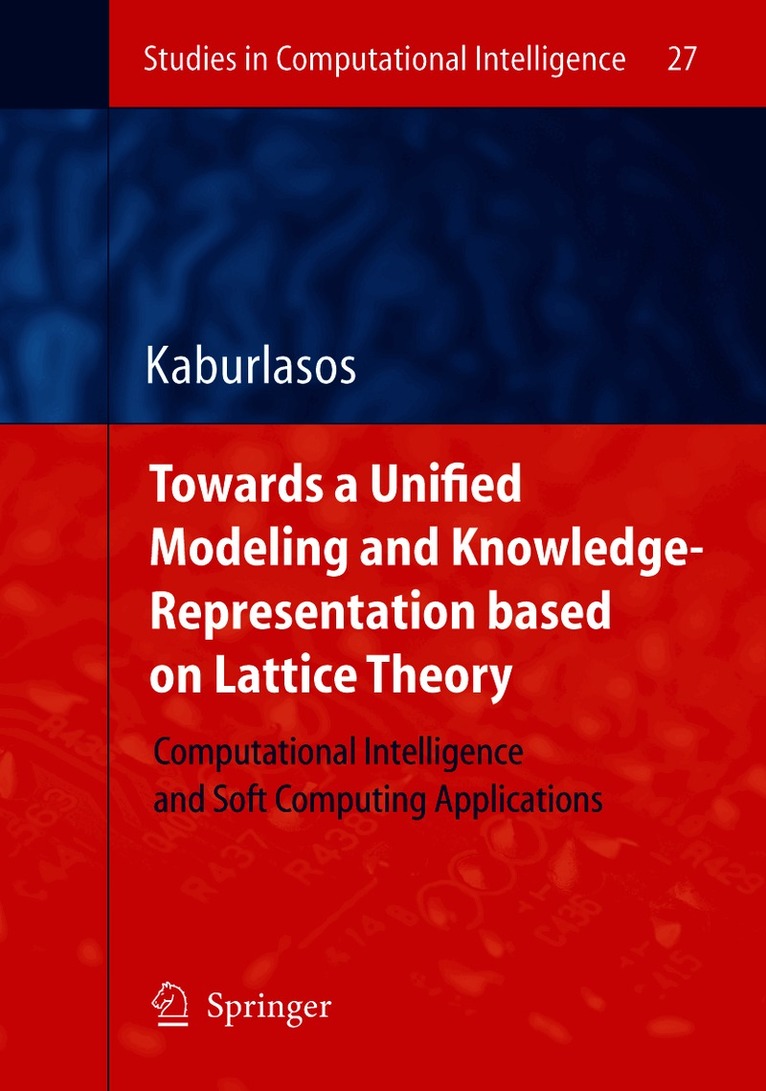
Towards a Unified Modeling and Knowledge-Representation based on Lattice Theory
Computational Intelligence and Soft Computing Applications
Inbunden, Engelska, 2006
1 062 kr
Skickas inom 10-15 vardagar
By ‘model’ we mean a mathematical description of a world aspect. With the proliferation of computers a variety of modeling paradigms emerged under computational intelligence and soft computing. An advancing technology is currently fragmented due, as well, to the need to cope with different types of data in different application domains. This research monograph proposes a unified, cross-fertilizing approach for knowledge-representation and modeling based on lattice theory. The emphasis is on clustering, classification, and regression applications. It is shown how rigorous analysis and design can be pursued in soft computing using conventional (hard computing) methods. Moreover, non-Turing computation can be pursued. The material here is multi-disciplinary based on our on-going research published in major scientific journals and conferences. Experimental results by various algorithms are demonstrated extensively. Relevant work by other authors is also presented both extensively and comparatively.
Del 67 - Studies in Computational Intelligence
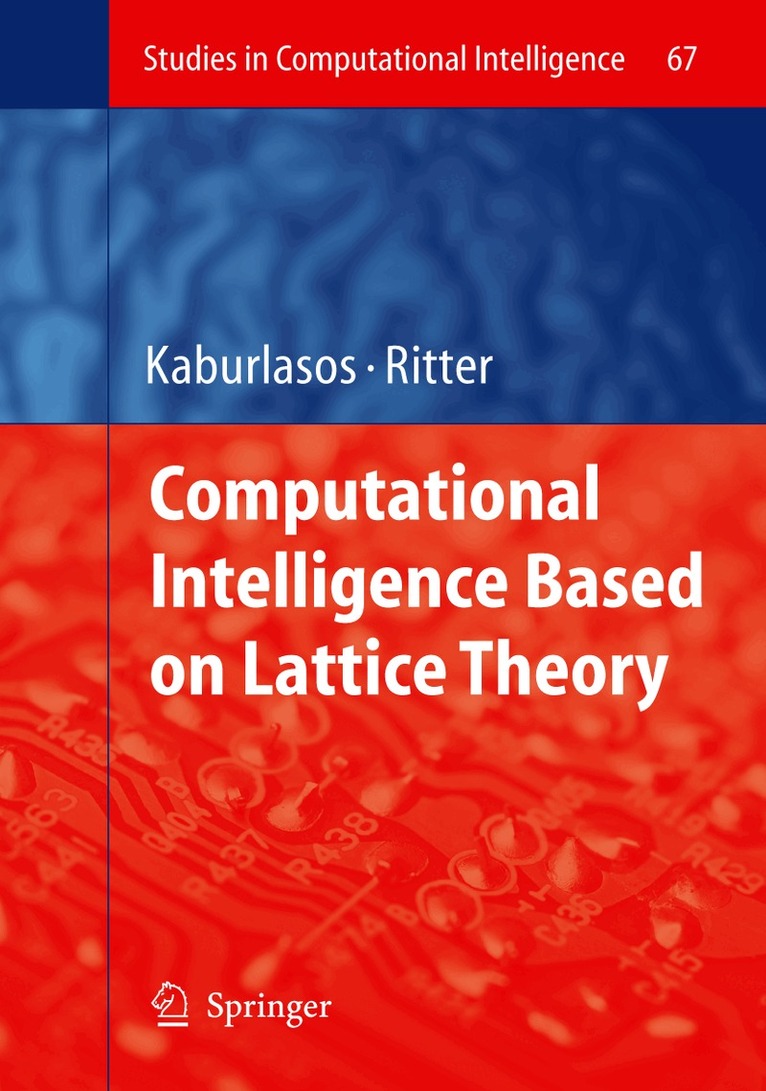
Computational Intelligence Based on Lattice Theory
Inbunden, Engelska, 2007
1 636 kr
Skickas inom 10-15 vardagar
A number of di?erent instruments for design can be uni?ed in the context of lattice theory towards cross-fertilization By“latticetheory”[1]wemean,equivalently,eitherapartialordering relation [2,3]ora couple of binary algebraic operations [3, 4]. There is a growing interest in computational intelligence based on lattice theory. A number of researchers are currently active developing lattice theory based models and techniques in engineering, computer and information s- ences, applied mathematics, and other scienti?c endeavours. Some of these models and techniques are presented here. However, currently, lattice theory is not part of the mainstream of com- tationalintelligence.Amajorreasonforthisisthe“learningcurve”associated with novel notions and tools. Moreover, practitioners of lattice theory, in s- ci?c domains of interest, frequently develop their own tools and/or practices without being aware of valuable contributions made by colleagues. Hence, (potentially) useful work may be ignored, or duplicated. Yet, other times, di?erent authors may introduce a con?icting terminology. The compilation of this book is an initiative towards proliferating est- lished knowledge in the hope to further expand it, soundly. There was a critical mass of people and ideas engaged to produce this book. Around two thirds of this book’s chapters are substantial enhancements of preliminary works presented lately in a three-part special session entitled “Computational Intelligence Based on Lattice Theory” organized in the c- text of the World Congress in Computational Intelligence (WCCI), FUZZ- IEEE program, July 16-21, 2006 in Vancouver, BC, Canada. The remaining book chapters are novel contributions by other researchers.
Del 27 - Studies in Computational Intelligence
Towards a Unified Modeling and Knowledge-Representation based on Lattice Theory
Computational Intelligence and Soft Computing Applications
Häftad, Engelska, 2010
1 062 kr
Skickas inom 10-15 vardagar
By ‘model’ we mean a mathematical description of a world aspect. With the proliferation of computers a variety of modeling paradigms emerged under computational intelligence and soft computing. An advancing technology is currently fragmented due, as well, to the need to cope with different types of data in different application domains. This research monograph proposes a unified, cross-fertilizing approach for knowledge-representation and modeling based on lattice theory. The emphasis is on clustering, classification, and regression applications. It is shown how rigorous analysis and design can be pursued in soft computing using conventional (hard computing) methods. Moreover, non-Turing computation can be pursued. The material here is multi-disciplinary based on our on-going research published in major scientific journals and conferences. Experimental results by various algorithms are demonstrated extensively. Relevant work by other authors is also presented both extensively and comparatively.
Del 67 - Studies in Computational Intelligence
Computational Intelligence Based on Lattice Theory
Häftad, Engelska, 2010
1 589 kr
Skickas inom 10-15 vardagar
A number of di?erent instruments for design can be uni?ed in the context of lattice theory towards cross-fertilization By“latticetheory”[1]wemean,equivalently,eitherapartialordering relation [2,3]ora couple of binary algebraic operations [3, 4]. There is a growing interest in computational intelligence based on lattice theory. A number of researchers are currently active developing lattice theory based models and techniques in engineering, computer and information s- ences, applied mathematics, and other scienti?c endeavours. Some of these models and techniques are presented here. However, currently, lattice theory is not part of the mainstream of com- tationalintelligence.Amajorreasonforthisisthe“learningcurve”associated with novel notions and tools. Moreover, practitioners of lattice theory, in s- ci?c domains of interest, frequently develop their own tools and/or practices without being aware of valuable contributions made by colleagues. Hence, (potentially) useful work may be ignored, or duplicated. Yet, other times, di?erent authors may introduce a con?icting terminology. The compilation of this book is an initiative towards proliferating est- lished knowledge in the hope to further expand it, soundly. There was a critical mass of people and ideas engaged to produce this book. Around two thirds of this book’s chapters are substantial enhancements of preliminary works presented lately in a three-part special session entitled “Computational Intelligence Based on Lattice Theory” organized in the c- text of the World Congress in Computational Intelligence (WCCI), FUZZ- IEEE program, July 16-21, 2006 in Vancouver, BC, Canada. The remaining book chapters are novel contributions by other researchers.