Gina Barnes – författare
Visar alla böcker från författaren Gina Barnes. Handla med fri frakt och snabb leverans.
12 produkter
State Formation in Japan
Emergence of a 4th-Century Ruling Elite
Av Gina Barnes
Inbunden, 2006
2586 kr
Lägg i varukorg
This volume brings together for the first time a significant body of Professor Barnes' scholarly writing on Japanese early state formation, brought together so that successive topics form a coherent overview of the problems and solutions of ancient Japan. The writings are, in some cases, the only …
State Formation in Japan
Emergence of a 4th-Century Ruling Elite
Av Gina Barnes
Häftad, 2010
937 kr
Lägg i varukorg
This volume brings together for the first time a significant body of Professor Barnes' scholarly writing on Japanese early state formation, brought together so that successive topics form a coherent overview of the problems and solutions of ancient Japan. The writings are, in some cases, the only …
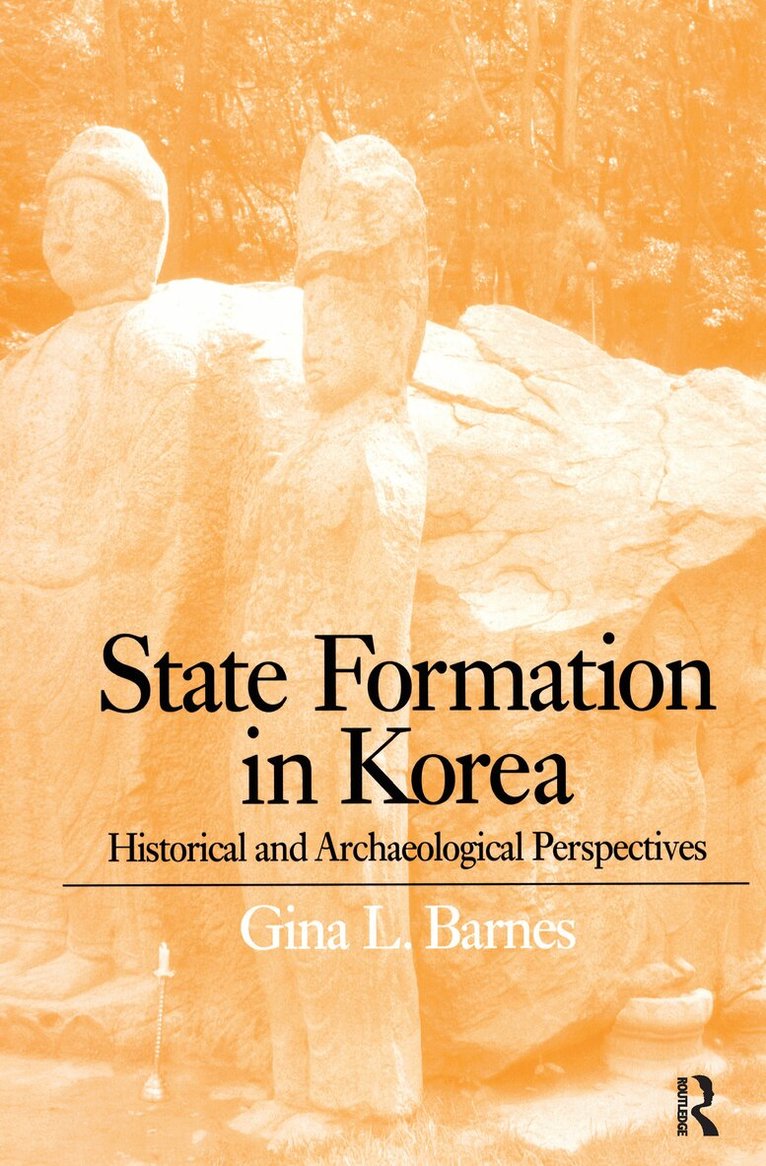
State Formation in Korea
Emerging Elites
Av Gina Barnes
Inbunden, 2001
2586 kr
Lägg i varukorg
This volume brings together for the first time a significant body of Professor Barnes' scholarly writing on early Korean state formation, integrated so that successive topics form a coherent overview of the problems and solutions in peninsular state formation.
Protohistoric Yamato
Archaeology of the First Japanese State
Av Gina L. Barnes, Gina Barnes
Häftad, 1988
270 kr
Lägg i varukorg
Nara is located in the center of what is known today as the Kinai region of Japan. The ancient name for the region was the Go-Kinai ("five-within the royal domain"), referring to the five provinces of which it was composed: Settsu, Kawachi, Izumi, Yamato and Yamashiro. The name Yamato, presented …
State Formation in Japan
Emergence of a 4th-Century Ruling Elite
Av Gina Barnes
E-bok, 2007
1082 kr
Lägg i varukorg
This volume brings together for the first time a significant body of Professor Barnes'' scholarly writing on Japanese early state formation, brought together so that successive topics form a coherent overview of the problems and solutions of ancient Japan. The writings are, in some cases, the only …
State Formation in Japan
Emergence of a 4th-Century Ruling Elite
Av Gina Barnes
E-bok, 2007
1106 kr
Lägg i varukorg
This volume brings together for the first time a significant body of Professor Barnes'' scholarly writing on Japanese early state formation, brought together so that successive topics form a coherent overview of the problems and solutions of ancient Japan. The writings are, in some cases, the only …
State Formation in Korea
Emerging Elites
Av Gina Barnes
E-bok, 2013
999 kr
Lägg i varukorg
This volume brings together for the first time a significant body of Professor Barnes'' scholarly writing on early Korean state formation, integrated so that successive topics form a coherent overview of the problems and solutions in peninsular state formation.
State Formation in Korea
Emerging Elites
Av Gina Barnes
E-bok, 2013
977 kr
Lägg i varukorg
This volume brings together for the first time a significant body of Professor Barnes'' scholarly writing on early Korean state formation, integrated so that successive topics form a coherent overview of the problems and solutions in peninsular state formation.
State Formation in Korea
Emerging Elites
Av Gina Barnes
Häftad, 2015
847 kr
Lägg i varukorg
This volume brings together for the first time a significant body of Professor Barnes' scholarly writing on early Korean state formation, integrated so that successive topics form a coherent overview of the problems and solutions in peninsular state formation.
Artie the Caterpillar Plays Hide-and-Seek
Av Gina Barnes
E-bok, 2021
193 kr
Lägg i varukorg
Artie is a monarch caterpillar who likes to play. He invites the reader into an interactive game of hide-and-seek. Readers will be encouraged to seek and find Artie as he hides among the illustrations.
Protohistoric Yamato
Archaeology of the First Japanese State
Av Gina L. Barnes, Gina Barnes
E-bok, 2020
391 kr
Lägg i varukorg
Nara is located in the center of what is known today as the Kinai region of Japan. The ancient name for the region was the Go-Kinai ("five-within the royal domain"), referring to the five provinces of which it was composed: Settsu, Kawachi, Izumi, Yamato and Yamashiro. The name Yamato, presented …