Giuseppe Zaccaria – författare
Visar alla böcker från författaren Giuseppe Zaccaria. Handla med fri frakt och snabb leverans.
4 produkter
4 produkter
Inbunden, Engelska, 2025
1 239 kr
Skickas inom 5-8 vardagar
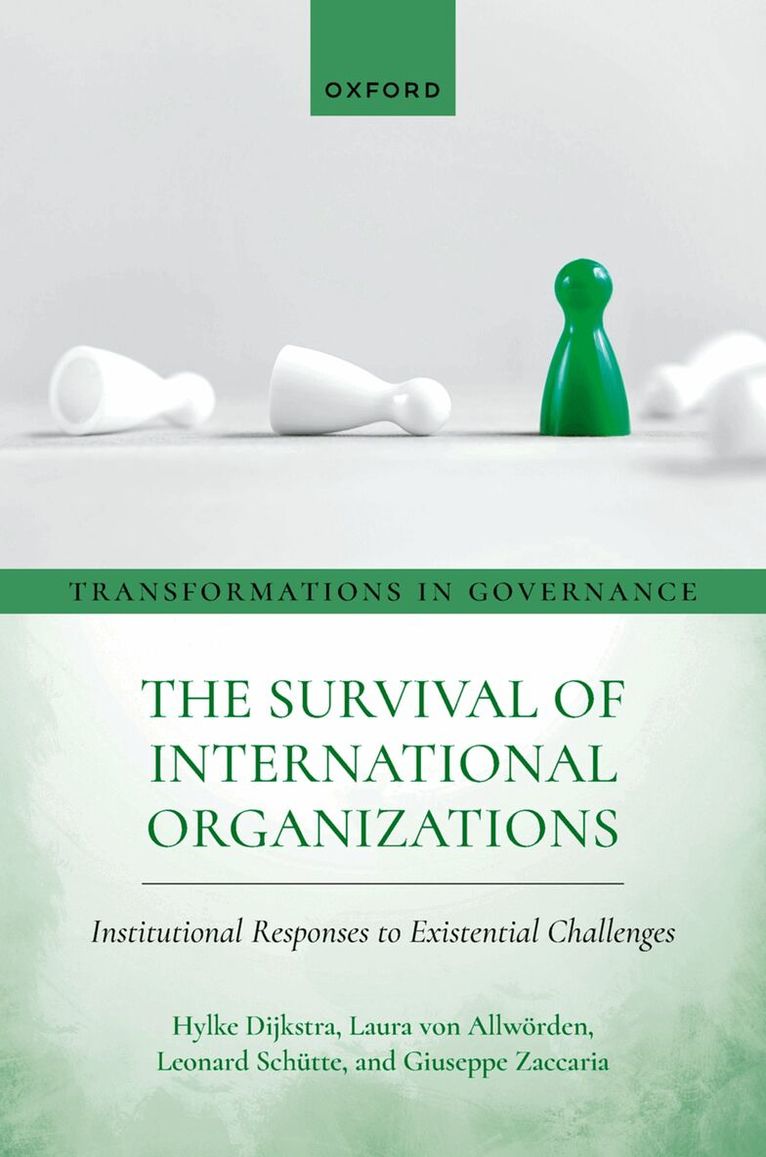
This is an open access title available under the terms of a CC BY-NC-ND 4.0 International licence. It is free to read on the Oxford Academic platform and offered as a free PDF download from OUP and selected open access locations.While international organizations (IOs) have played a central role in global governance in the post-Cold War period, during the last decade many have struggled. Due to the rise of populism, the Trump Presidency, and the renewed assertiveness of the emerging powers, various IOs have been challenged in ways that put their ability to perform core functions at risk. The Survival of International Organizations studies the responses of IOs to such existential challenges. It focuses on the central institutional actors inside IOs - IO leaders and their bureaucracies - that have a strong interest in the survival and well-being of their organizations. Presenting six case studies and drawing on more than 100 interviews, this book highlights the variation in the way in which these institutional actors try to cope with and counter existential challenges: Some fight tooth and nail to keep their IOs relevant, while other institutional actors are more circumspect in their actions. The Survival of International Organizations examines the IOs themselves as well as both those who lead IOs at the top and the desk officers who keep the machinery running. This behind-the-scenes view uncovers important processes about the survival of IOs and international institutions. It demonstrates that institutional actors try to tailor their responses to the specific types of existential challenges, but that their ability to do so depends on the quality of their leadership, organizational structure, and embedding in external networks. Transformations in Governance is a major academic book series from Oxford University Press. It is designed to accommodate the impressive growth of research in comparative politics, international relations, public policy, federalism, and environmental and urban studies concerned with the dispersion of authority from central states to supranational institutions, subnational governments, and public-private networks. It brings together work that advances our understanding of the organization, causes, and consequences of multilevel and complex governance. The series is selective, containing annually a small number of books of exceptionally high quality by leading and emerging scholars.The series is edited by Liesbet Hooghe and Gary Marks of the University of North Carolina, Chapel Hill, and Walter Mattli of the University of Oxford.
E-bok
Engelska, 20251 050 kr
Läs direkt efter köp
This is an open access title available under the terms of a CC BY-NC-ND 4.0 International licence. It is free to read on the Oxford Academic platform and offered as a free PDF download from OUP and selected open access locations. While international organizations (IOs) have played a central role in global governance in the post-Cold War period, during the last decade many have struggled. Due to the rise of populism, the Trump Presidency, and the renewed assertiveness of the emerging powers, various IOs have been challenged in ways that put their ability to perform core functions at risk. The Survival of International Organizations studies the responses of IOs to such existential challenges. It focuses on the central institutional actors inside IOs - IO leaders and their bureaucracies - that have a strong interest in the survival and well-being of their organizations. Presenting six case studies and drawing on more than 100 interviews, this book highlights the variation in the way in which these institutional actors try to cope with and counter existential challenges: Some fight tooth and nail to keep their IOs relevant, while other institutional actors are more circumspect in their actions. The Survival of International Organizations examines the IOs themselves as well as both those who lead IOs at the top and the desk officers who keep the machinery running. This behind-the-scenes view uncovers important processes about the survival of IOs and international institutions. It demonstrates that institutional actors try to tailor their responses to the specific types of existential challenges, but that their ability to do so depends on the quality of their leadership, organizational structure, and embedding in external networks. Transformations in Governance is a major academic book series from Oxford University Press. It is designed to accommodate the impressive growth of research in comparative politics, international relations, public policy, federalism, and environmental and urban studies concerned with the dispersion of authority from central states to supranational institutions, subnational governments, and public-private networks. It brings together work that advances our understanding of the organization, causes, and consequences of multilevel and complex governance. The series is selective, containing annually a small number of books of exceptionally high quality by leading and emerging scholars. The series is edited by Liesbet Hooghe and Gary Marks of the University of North Carolina, Chapel Hill, and Walter Mattli of the University of Oxford.
E-bok
PDF, Engelska, 20251 050 kr
Läs direkt efter köp
This is an open access title available under the terms of a CC BY-NC-ND 4.0 International licence. It is free to read on the Oxford Academic platform and offered as a free PDF download from OUP and selected open access locations. While international organizations (IOs) have played a central role in global governance in the post-Cold War period, during the last decade many have struggled. Due to the rise of populism, the Trump Presidency, and the renewed assertiveness of the emerging powers, various IOs have been challenged in ways that put their ability to perform core functions at risk. The Survival of International Organizations studies the responses of IOs to such existential challenges. It focuses on the central institutional actors inside IOs - IO leaders and their bureaucracies - that have a strong interest in the survival and well-being of their organizations. Presenting six case studies and drawing on more than 100 interviews, this book highlights the variation in the way in which these institutional actors try to cope with and counter existential challenges: Some fight tooth and nail to keep their IOs relevant, while other institutional actors are more circumspect in their actions. The Survival of International Organizations examines the IOs themselves as well as both those who lead IOs at the top and the desk officers who keep the machinery running. This behind-the-scenes view uncovers important processes about the survival of IOs and international institutions. It demonstrates that institutional actors try to tailor their responses to the specific types of existential challenges, but that their ability to do so depends on the quality of their leadership, organizational structure, and embedding in external networks. Transformations in Governance is a major academic book series from Oxford University Press. It is designed to accommodate the impressive growth of research in comparative politics, international relations, public policy, federalism, and environmental and urban studies concerned with the dispersion of authority from central states to supranational institutions, subnational governments, and public-private networks. It brings together work that advances our understanding of the organization, causes, and consequences of multilevel and complex governance. The series is selective, containing annually a small number of books of exceptionally high quality by leading and emerging scholars. The series is edited by Liesbet Hooghe and Gary Marks of the University of North Carolina, Chapel Hill, and Walter Mattli of the University of Oxford.
E-bok
Spanska, 2024137 kr
Läs direkt efter köp
Como señala el autor en el prólogo de este volumen, "[l]a hermenéutica no es solo el arte de interpretar, sino también, una concepción de cómo tratar el lenguaje y, aún más profundamente, una perspectiva filosófica general relacionada con la primacía de la razón práctica". Este volumen recoge la perspectiva hermenéutica con su "método de trabajo flexible" orientado a la complejidad de la interpretación del derecho en general y, en particular, a la interpretación de las constituciones del pluralismo.Existe cierto consenso, al margen de las diferentes concepciones del derecho, que en el contexto de las constituciones de la postguerra europea, el derecho ya no es visto como una entidad preestablecida, aunque enriquecida en el momento indispensable de la interpretación, sino como una actividad que toma la forma, por su carácter colectivo, de una práctica social. Con esta premisa, el autor recoge en este volumen una síntesis de la metodología y filosofía hermenéutica para mostrar el potencial de esta perspectiva a la hora de construir el sentido y significado de los principios y derechos de una constitución plural y democrática.