Gleb Kazakov – författare
Visar alla böcker från författaren . Handla med fri frakt och snabb leverans.
2 produkter
2 produkter
E-bok
PDF, Tyska, 2022713 kr
Läs direkt efter köp
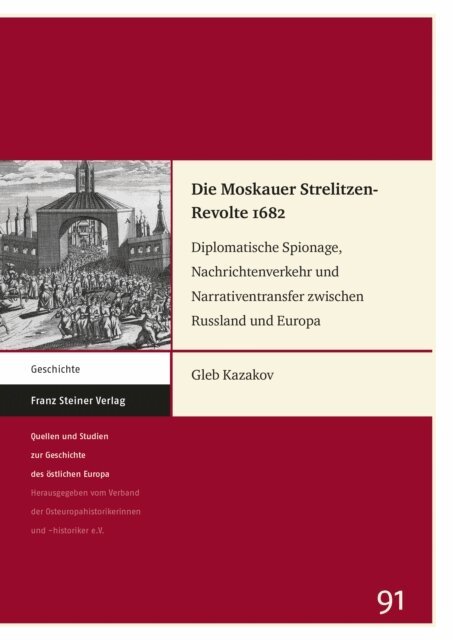
Revolten und politische Unruhen erregten groe Aufmerksamkeit in Kommunikationsnetzwerken des fruhneuzeitlichen Europas. Die Ereignisse im Osten des Kontinents, im Reich der Moskauer Zaren, wurden ebenso von Kommunikationsakteuren verfolgt. Sie gerieten in den Fokus der Beobachtung von zahlreichen europaischen Diplomaten und Zeitungsverlegern und produzierten eine Flut an Narrativen. Am Beispiel des Aufstands der zarischen Infanterietruppen der Strelitzen in Moskau im Jahr 1682 demonstriert Gleb Kazakov, wie Russland im letzten Viertel des 17. Jahrhunderts einen festen Platz auf dem europaischen Nachrichtenmarkt einnahm. Er beschreibt, wie die politische Krise im Zarenreich im Jahr 1682 sowohl in russischer als auch in europaischer Diplomatie, Publizistik und politischer Theorie gedeutet und instrumentalisiert wurde. Kazakov eroffnet durch die Untersuchung der Berichterstattung uber die Strelitzen-Revolte auch neue Perspektiven auf das Funktionieren des fruhneuzeitlichen Nachrichtenmarkts sowie auf die Wechselwirkung zwischen Netzwerken diplomatischer Korrespondenz und gedruckten Medien des 17. Jahrhunderts.
Inbunden, Engelska, 2026
2 254 kr
Skickas inom 10-15 vardagar
This book outlines major trends in language use by early modern diplomats, mainly in the European context, through a series of case studies and overviews of regional diplomatic traditions.During the early modern period, linguistic practices in European diplomacy changed drastically, as the decline of Latin and German as diplomatic languages paved the way for the rise of French as a pan-European medium of diplomacy. While it was no secret that French was the dominant language of European elites during the eighteenth century, surprisingly little is known about the way this cultural trend translated into a major linguistic shift in diplomacy. This volume offers a broader perspective, tracking these changes throughout the early modern period. Spanning three centuries and extending across and beyond continental Europe, the contributors map the pace, the mechanisms, the reasons and the limits for changes in the use of languages in early modern diplomacy and explore the linguistic practices of diplomats as an indicator of wider social, cultural, and political changes.A novel study of European diplomacy and linguistic interactions, this book will be of interest to historians, in particular those working on language practices in diplomacy and the social history of languages.The Open Access version of this book, available at http://www.taylorfrancis.com, has been made available under a Creative Commons Attribution-Non Commercial-No Derivatives (CC-BY-NC-ND) 4.0 licence.