Göran Hermerén – författare
Visar alla böcker från författaren Göran Hermerén. Handla med fri frakt och snabb leverans.
8 produkter
8 produkter
Inbunden, Engelska, 2010
2 226 kr
Skickas inom 10-15 vardagar
For many years, the ethical discussion surrounding human embryonic stem cell research has focused on the moral status of the embryo. This text takes a wider moral berth and focuses on numerous ethical, legal and social aspects involved in translating the results of stem cell research into diagnostic and therapeutic applications.Translational Stem Cell Research is broken into ten sections. It opens with an overview of the latest in stem cell research, focusing on specific diseases and the treatment of burn victims. Part II discusses the issues involved in the many steps from bench to bedside, ranging from first research in vitro to clinical trials. Part III covers scientific, regulatory and ethical challenges to basic research, and Part IV details issues regarding stem cell banks. Part V explores ethical, economic and strategic issues involved in collaboration between universities and industry, and Part VI addresses legal problems raised by patents on human stem-cell based inventions plus the extent to which there can be technological solutions to a moral dilemma. Part VII presents imaginative ways of communicating research to the general public and how to create conditions for a constructive dialogue. Part VIII probes psychosocial and cultural factors affecting judgment and decisions about translational stem cell research, and Part IX explores problems and procedures raised by an examination of the evaluation of stem cell research projects in research ethics committees. The book closes with a look into the future of translational stem cell research and stem cell-based therapeutic applications.
Häftad, Engelska, 2013
2 221 kr
Skickas inom 10-15 vardagar
For many years, the ethical discussion surrounding human embryonic stem cell research has focused on the moral status of the embryo. This text takes a wider moral berth and focuses on numerous ethical, legal and social aspects involved in translating the results of stem cell research into diagnostic and therapeutic applications.Translational Stem Cell Research is broken into ten sections. It opens with an overview of the latest in stem cell research, focusing on specific diseases and the treatment of burn victims. Part II discusses the issues involved in the many steps from bench to bedside, ranging from first research in vitro to clinical trials. Part III covers scientific, regulatory and ethical challenges to basic research, and Part IV details issues regarding stem cell banks. Part V explores ethical, economic and strategic issues involved in collaboration between universities and industry, and Part VI addresses legal problems raised by patents on human stem-cell based inventions plus the extent to which there can be technological solutions to a moral dilemma. Part VII presents imaginative ways of communicating research to the general public and how to create conditions for a constructive dialogue. Part VIII probes psychosocial and cultural factors affecting judgment and decisions about translational stem cell research, and Part IX explores problems and procedures raised by an examination of the evaluation of stem cell research projects in research ethics committees. The book closes with a look into the future of translational stem cell research and stem cell-based therapeutic applications.
Häftad, Svenska, 1991
148 kr
Skickas
Häftad, Engelska, 1999
148 kr
Skickas
Inbunden, Engelska, 2006
279 kr
Skickas
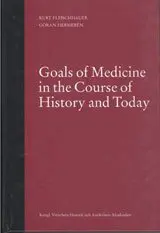
Some widely beliefs about the goals of medicine are: we know what they are, they have always been the same, and they do not conflict with each other. In this book all these beliefs are questioned. It will be shown that when trying to achieve the ends of medicine at different times old goals have changed and new ones appeared. Between different medical goals tensions and clashes exist which may cause difficult ethical problems. Kurt Fleischhauer, born in 1929, is a medical doctor and emeritus professor of anatomy. He was from 1968 director of the Anatomical Institute of the University of Bonn. From 1985 to 1992, he was Rector (Vice-Chancellor) of Bonn University. He has numerous publications particularly on the histology and pharmacology of the central nervous system, and on general aspects of medicine. Göran Hermerén, born in 1938, is a philosopher and emeritus professor of medical ethics at Lund University, Sweden. He is currently President of the European Group on Ethics in Science and New Technologies, Brussels, and involved in several EU-funded research projects. He has numerous publications, mainly on ethical problems in medicine, besides authoring and editing books on research ethics. Extract from a review in Medicine, Health Care and Philosophy; A European Journal, volume 11, no. 2, June 2008: "In short, this is a book worth reading. It serves as a good starting point for those who wish to understand how ethical problems emerged in medicine, how they were conceptualized in different times and what is the state of affairs now in analyzing these issues." Jozsef Kovacs
Del 74 - Konferenser / Kungl. Vitterhets historie och antikvitets akademien
Universitetsrankning och bibliometriska mätningar : konsekvenser för forskning och kunskapsutveckling
Häftad, Svenska, 2011
114 kr
Skickas
Rankning och bibliometriska mätningar breder ut sig. Forskningens och forskares kvalitet uttrycks många gånger i termer av citeringsanalyser och andra bibliometriska mått. Sådana bedömningar läggs också till grund för bland annat initiativ till samarbeten, sakkunnigprövningar och resursfördelning. Vid ett seminarium i maj 2010 diskuterades mätningarnas utbredning samt dess konsekvenser för forskning och kunskapsutveckling. I denna rapport sammanfattas delar av seminariets presentationer och diskussioner. Några frågor som diskuterades är: går det att mäta vetenskaplig kvalitet på det sätt som görs, och ger dessa mätningar en rättvis och på lång sikt hållbar bedömning av kvalitet? Särskilt uppmärksammades den begränsade användbarheten av bibliometri och rankning för att mäta kvalitet i humanistisk och samhällsvetenskaplig forskning. Vid seminariet ägnades också stort utrymme åt frågor rörande vilka konsekvenser den utbredda länkningen och bibliometrin kan förväntas få för forskares och forskningens villkor - och i förlängningen för forskningens kvalitet och för kunskapsutvecklingen i stort.
Häftad, Engelska, 2013
123 kr
Skickas
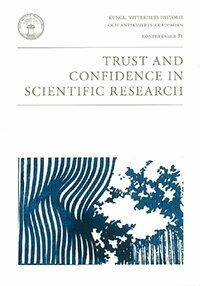
TRUST IS HARD TO EARN and easy to lose. This is well-known. Public trust in research is decreasing - why? Is it a problem? Have ghostwriting, salami publications, misconduct and distrust something to do with this loss? Is the reason simply that contemporary science seems to focus on productivity more than creativity? From various perspectives the papers and presentations in this volume focus on the ways in which factors affecting distrust and trust, including criteria of quality, are identified, measured and dealt with by universities and other institutions. But the authors do not merely identify a set of problems. They also discuss what is currently being done - and what could and should be done - to deal with the problems. Editors: Göran Hermeren, Kerstin Sahlin & Nils-Eric Sahlin. The volume is a collection of n papers and presentations by participants in a symposium at Kungl. Vitterhetsakademien (The Royal Swedish Academy of Letters, History and Antiquities).
E-bok
Svenska, 2015169 kr
Läs direkt efter köp
Människans livsvillkor har förändrats dramatiskt genom historien i takt med att tekniken utvecklats. Ny kunskap ger nya möjligheter. Föräsndringen kommer med all säkerhet att fortsätta. Men hur? År 2003 förklarade The International Human Gemone Organisation att arbetet med att kartlägga människans arvsmassa hade förverkligats snabbare än förväntat. Därmed öppnades möjligheter att än en gång förändra människans livsvillkor, och på ett mera grundläggande sätt än tidigare. Nu kan vi inte bara förändra vår omgivning utan dessutom med genteknik och nanoteknik påverka vad en människa är. Den möjligheten är en etisk utmaning. Vad betyder riskbedömningar, etik, livsåskådningar och kulturella föreställningar när vi väljer hur den nya tekniken ska användas? Att forma vår framtid belyser dagens arbete med stamcellsforskning och nanoteknik. Texterna diskuterar frågor som hantering av genetisk information, kommersialisering och postgenom forskning i ett globalt perspektiv.