Gonzalvez-Garcia Francisco Gonzalvez-Garcia – författare
Visar alla böcker från författaren Gonzalvez-Garcia Francisco Gonzalvez-Garcia. Handla med fri frakt och snabb leverans.
5 produkter
5 produkter
E-bok
PDF, Engelska, 20141 353 kr
Läs direkt efter köp
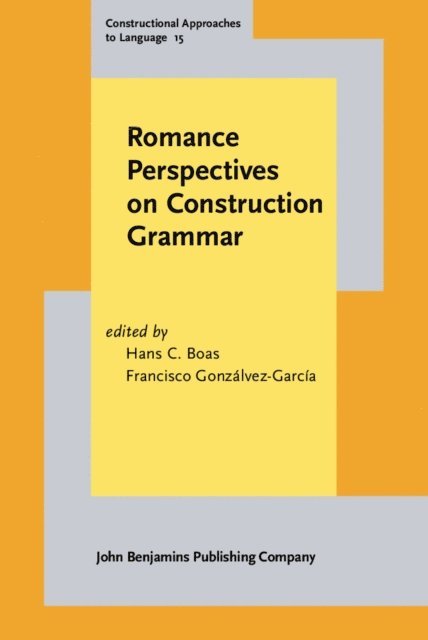
The chapters in this book show how the different flavors of Construction Grammar provide illuminating insights into the syntax, semantics, pragmatics and discourse-functional properties of specific phenomena in Romance languages such as (Castilian) Spanish, French, Romanian, and Latin from a synchronic as well as a diachronic viewpoint. The phenomena surveyed include the role of constructional meanings in novel verb-noun compounds in Spanish, the relevance of lexicalization for a constructionist analysis of complex prepositions in French, the complementariness of fragments, patterns and constructions as theoretical and explanatory constructs in verb complementation in French, Latin, and Spanish, non-constituent coordination phenomena (e.g. Right Node Raising, Argument Cluster Coordination and Gapping) in Romanian, and variable type framing in Spanish constructions of directed motion in the light of Leonard Talmy’s (2000) typological differences of lexicalization between satellite-framed and verb-framed languages.
E-bok
PDF, Engelska, 20141 434 kr
Läs direkt efter köp
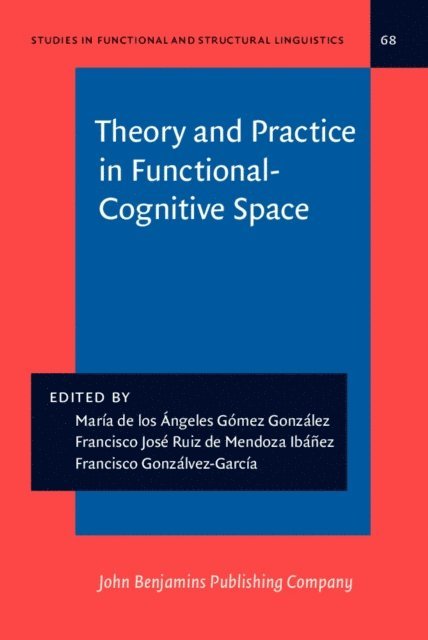
The differences among functionalist, cognitivist and/or constructionist models are generally taken to be not absolute, but rather a matter of emphasis and degree, with an increasing permeability between paradigms arising from cross-fertilizing influences. This book further explores this burgeoning area of research through the notion of functional-cognitive space, namely, the topography of the space occupied by functional, cognitivist and/or constructionist models against the background of formalist approaches in general and of Chomsky’s Minimalism in particular. Specifically, the twelve contributions in the present volume update the reader on recent developments in functionalism (Systemic Functional Grammar, Functional Discourse Grammar and Role and Reference Grammar) and cognitivism (Word Grammar, (Cognitive) Construction Grammar and the Lexical Contructional Model). Plotting cognitive-space proves particularly adequate for situating the six models represented in this volume, not only in relation to each other, but also potentially with respect to a wide spectrum of functionalist, cognitivist and/or constructionist models.
E-bok
PDF, Engelska, 20141 258 kr
Läs direkt efter köp
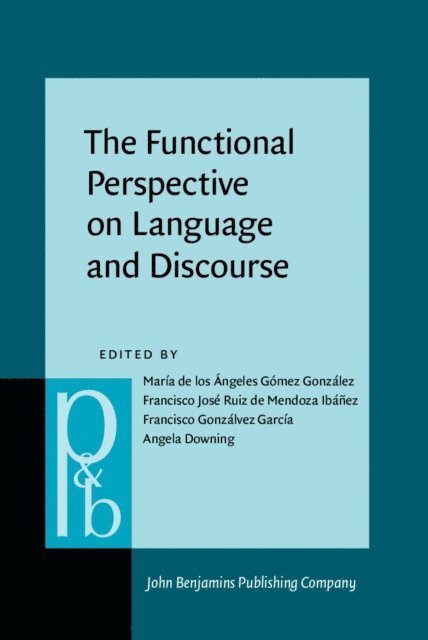
Over the last forty years, the functionalist approach to linguistic description and explanation has given rise to several major schools of thought that share two crucial assumptions: (i) form is not independent of meaning/function or language use; and (ii) linguistic description and explanation need to take into account the communicative function of language. This volume offers readers interested in functional linguistics a selected sample of studies that jointly prove the efficacy of the analytical tools and procedures broadly accepted within the functionalist tradition in order to investigate language and discourse, with special focus on key pragmatic/discourse notions such as contextualization, grammaticalisation, reference, politeness, (in-)directness, discourse markers, speech acts, subjective evaluation and sentiment analysis in texts, among others. In addition, this volume offers specific corpus-based techniques for the objective contextualisation of linguistic data, which is crucial given the central role allotted to context in both functional linguistics and pragmatics/discourse analysis.
E-bok
PDF, Engelska, 20141 434 kr
Läs direkt efter köp
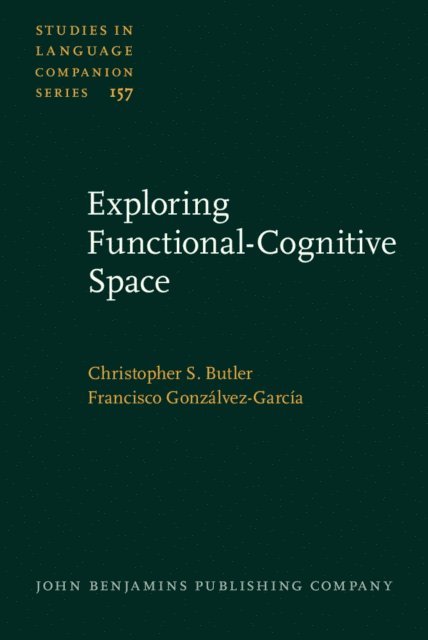
This book, intended primarily for researchers and advanced students, expands greatly on previous work by the authors exploring the topography of the multidimensional “functional-cognitive space” within which functional, cognitive and/or constructionist approaches to language can be located. The analysis covers a broad range of 16 such approaches, with some additional references to Chomskyan minimalism, and is based on 58 questionnaire items, each rated by 29 experts on particular models for their importance in the model concerned. These ratings are analysed statistically to reveal overall patterns of (dis)similarity across models. The questionnaire ratings and experts’ comments are then used, together with the authors’ close reading of the literature, in detailed discussion leading to a final dichotomous rating for each feature in each model, the results again being analysed statistically. The final chapter presents the overall conclusions and suggests how existing collaborations between approaches could be strengthened, and new ones created, in future research.Exploring Functional-Cognitive Space has been awarded the 2016 prize of the Spanish Association for Applied Linguistics (Asociación Española de Lingüística Aplicada, AESLA) for work by experienced researchers.
E-bok
PDF, Engelska, 20131 258 kr
Läs direkt efter köp
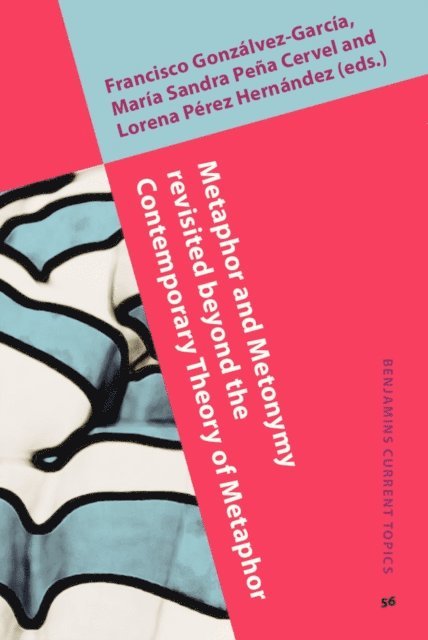
The contributions in this volume go beyond the Contemporary Theory of Metaphor complementing it in a number of relevant ways. Some of the papers argue for a more dynamic, interdisciplinary approach to metaphor looking into it from semiotic, psychological and socio-cultural perspectives. Other contributions focus on the crucial role played by metaphor and metonymy in meaning construction at a discourse/textual level. Finally, the volume also includes proposals which revolve around the alleged universal nature of metaphorical mappings and their suitability to account for grammatical phenomena.The contributions in this volume display an ample gamut of theoretical approaches pointing to the viability of taking a functional-cognitive stance on the analysis of metaphor and metonymy in contrast to a purely cognitive one.This book is structured into three major sections: i) the Contemporary Theory of Metaphor: revisions and recent developments; ii) metaphor and/or metonymy across different discourse/genre types; and iii) the Contemporary Theory of Metaphor: current applications. Originally published in Review of Cognitive Linguistics 9:1 (2011).