Gregory P. Lee – författare
Visar alla böcker från författaren Gregory P. Lee. Handla med fri frakt och snabb leverans.
5 produkter
5 produkter
E-bok
Engelska, 2010637 kr
Läs direkt efter köp
This book provides essential information about the variety of seizure disorders and serves as a basic epilepsy reference guide for students and practicing clinical neuropsychologists. In addition to epilepsy neuropsychological assessment issues, the book provides an overview of the known cognitive effects of seizures as well as the adaptive, emotional, and psychiatric consequences of epilepsy including a chapter on psychogenic nonepileptic seizures. Diagnostic tests, such as EEG and structural neuroimaging, are described and the leading treatment options are detailed with a chapter on pharmacologic therapies which reviews the known cognitive and behaivoral side effects of specific antiepileptic drugs. Many of the more rare epilepsy disorders have been included in the appendices for quick and easy reference. The book also details the role of neuropsychology within the epilepsy surgery process including pre-and post-surgery cognitive evaluations, cortical stimulation mapping, functional neuroimaging, and intracarotid amobarbital (Wada) procedures and reviews the major surgical treatment options used in the intractable epilepsies. Case examples are dispersed throughout the text with neuropsychological results as heuristic aids. The book concludes with a glossary of epilepsy terms.
Häftad, Engelska, 2010
749 kr
Skickas inom 5-8 vardagar
This book provides essential information about the variety of seizure disorders to serve as a basic epilepsy reference guide for students and practicing clinical neuropsychologists. In addition to epilepsy neuropsychological assessment issues, the book provides an overview of the known cognitive effects of seizures as well as the adaptive, emotional, and psychiatric consequences of epilepsy including a chapter on psychogenic nonepileptic seizures. Diagnostic tests, such as EEG and structural neuroimaging, are described and the leading treatment options are detailed with a chapter on pharmacologic therapies which reviews the known cognitive and behaivoral side effects of specific antiepileptic drugs. Many of the more rare epilepsy disorders have been included in the appendices for quick and easy reference. The book also details the role of neuropsychology within the epilepsy surgery process including pre/post surgery cognitive evaluations, cortical stimulation mapping, functional neuroimaging, and intracarotid amobarbital (Wada) procedures and reviews the major surgical treatment options used in the intractable epilepsies. Case examples are dispersed throughout the text with neuropsychological results as heuristic aids. The book ends with a glossary of epilepsy terms that may be used as a dictionary for the more experienced clinician or as a tool to assist students and residents in learning.
E-bok
PDF, Engelska, 2010637 kr
Läs direkt efter köp
This book provides essential information about the variety of seizure disorders and serves as a basic epilepsy reference guide for students and practicing clinical neuropsychologists. In addition to epilepsy neuropsychological assessment issues, the book provides an overview of the known cognitive effects of seizures as well as the adaptive, emotional, and psychiatric consequences of epilepsy including a chapter on psychogenic nonepileptic seizures. Diagnostic tests, such as EEG and structural neuroimaging, are described and the leading treatment options are detailed with a chapter on pharmacologic therapies which reviews the known cognitive and behaivoral side effects of specific antiepileptic drugs. Many of the more rare epilepsy disorders have been included in the appendices for quick and easy reference. The book also details the role of neuropsychology within the epilepsy surgery process including pre-and post-surgery cognitive evaluations, cortical stimulation mapping, functional neuroimaging, and intracarotid amobarbital (Wada) procedures and reviews the major surgical treatment options used in the intractable epilepsies. Case examples are dispersed throughout the text with neuropsychological results as heuristic aids. The book concludes with a glossary of epilepsy terms.
E-bok
PDF, Engelska, 2012865 kr
Läs direkt efter köp
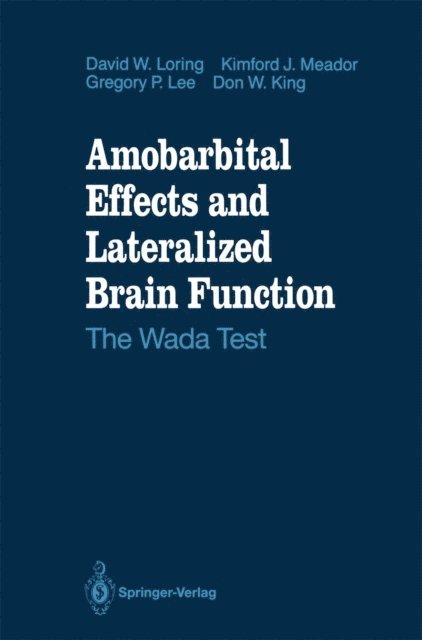
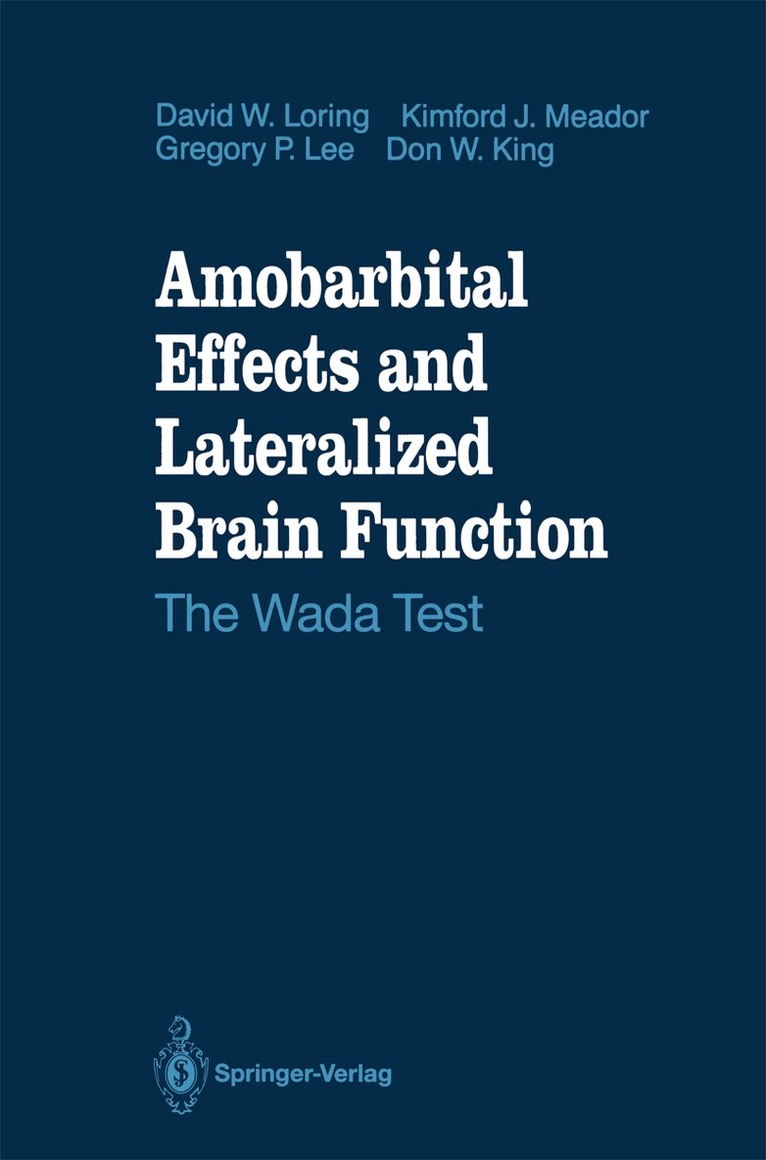
The intracarotid amobarbital (or Amytal) procedure is commonly referred to as the Wada test in tribute to Juhn Wada, the physician who devised the technique and performed the fIrst basic animal research and clinical studies with this method. Wada testing has become an integral part of the pre operative evaluation for epilepsy surgery. Interestingly, however, Wada initially developed this method as a technique to assess language dominance in psychiatric patients in order that electroconvulsant therapy could be applied unilaterally to the non-dominant hemisphere. Epilepsy surgery has matured as a viable treatment for intractable seizures and is no longer confmed to a few major universities and medical institutes. Yet, as is increasingly clear by examining the surveys of approaches used by epilepsy surgery centers (e.g., Rausch, 1987; Snyder, Novelly, & Harris, 1990), there is not only great heterogeneity in the methods used during Wada testing to assess language and memory functions, but there also seems to be a lack of consensus regarding the theoretical assumptions, and perhaps, even the goals of this procedure.
Häftad, Engelska, 2013
677 kr
Skickas inom 10-15 vardagar
The intracarotid amobarbital (or Amytal) procedure is commonly referred to as the Wada test in tribute to Juhn Wada, the physician who devised the technique and performed the fIrst basic animal research and clinical studies with this method. Wada testing has become an integral part of the pre operative evaluation for epilepsy surgery. Interestingly, however, Wada initially developed this method as a technique to assess language dominance in psychiatric patients in order that electroconvulsant therapy could be applied unilaterally to the non-dominant hemisphere. Epilepsy surgery has matured as a viable treatment for intractable seizures and is no longer confmed to a few major universities and medical institutes. Yet, as is increasingly clear by examining the surveys of approaches used by epilepsy surgery centers (e.g., Rausch, 1987; Snyder, Novelly, & Harris, 1990), there is not only great heterogeneity in the methods used during Wada testing to assess language and memory functions, but there also seems to be a lack of consensus regarding the theoretical assumptions, and perhaps, even the goals of this procedure.