Hal Caswell - Böcker
Visar alla böcker från författaren Hal Caswell. Handla med fri frakt och snabb leverans.
7 produkter
7 produkter
1 473 kr
Skickas inom 10-15 vardagar
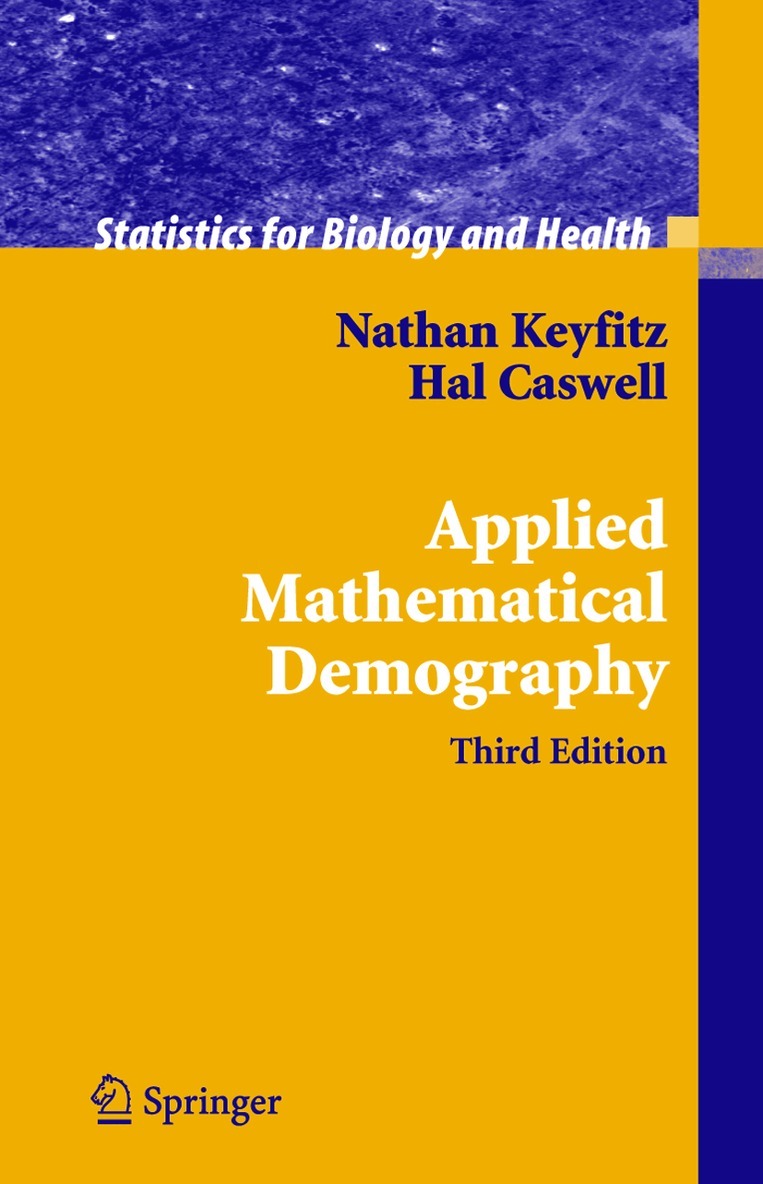
The third edition of this classic text maintains its focus on applications of demographic models, while extending its scope to matrix models for stage-classified populations. The authors first introduce the life table to describe age-specific mortality, and then use it to develop theory for stable populations and the rate of population increase. This theory is then revisited in the context of matrix models, for stage-classified as well as age-classified populations. Reproductive value and the stable equivalent population are introduced in both contexts, and Markov chain methods are presented to describe the movement of individuals through the life cycle. Applications of mathematical demography to population projection and forecasting, kinship, microdemography, heterogeneity, and multi-state models are considered.The new edition maintains and extends the book's focus on the consequences of changes in the vital rates. Methods are presented for calculating the sensitivity and elasticity of population growth rate, life expectancy, stable stage distribution, and reproductive value, and for applying those results in comparative studies.Stage-classified models are important in both human demography and population ecology, and this edition features examples from both human and non-human populations. In short, this third edition enlarges considerably the scope and power of demography. It will be an essential resource for students and researchers in demography and in animal and plant population ecology. Nathan Keyfitz is Professor Emeritus of Sociology at Harvard University. After holding positions at Canada's Dominion Bureau of Statistics, the University of Chicago, and the University of California at Berkeley, he became Andelot Professor of Sociology and Demography at Harvard in 1972. After retiring from Harvard, he became Director of the Population Program at the International Institute for Applied Systems Analysis (IIASA) in Vienna from 1983 to 1993. Keyfitz is a member of the U.S. National Academy of Sciences and the Royal Society of Canada, and a Fellow of the American Academy of Arts and Sciences.He has received the Mindel Sheps Award of the Population Association of America and the Lazarsfeld Award of the American Sociological Association, and was the 1997 Laureate of the International Union for the Scientific Study of Population. He has written 12 books, including Introduction to the Mathematics of Population (1968) and, with Fr. Wilhelm Flieger, SVD, World Population Growth and Aging: Demographic Trends in the Late Twentieth Century (1990). Hal Caswell is a Senior Scientist in the Biology Department of the Woods Hole Oceanographic Institution, where he holds the Robert W. Morse Chair for Excellence in Oceanography. He is a Fellow of the American Academy of Arts and Sciences. He has held a Maclaurin Fellowship from the New Zealand Institute of Mathematics and its Applications and a John Simon Guggenheim Memorial Fellowship. His research focuses on mathematical population ecology with applications in conservation biology. He is the author of Matrix Population Models: Construction, Analysis, and Interpretation (2001).
1 578 kr
Skickas inom 10-15 vardagar
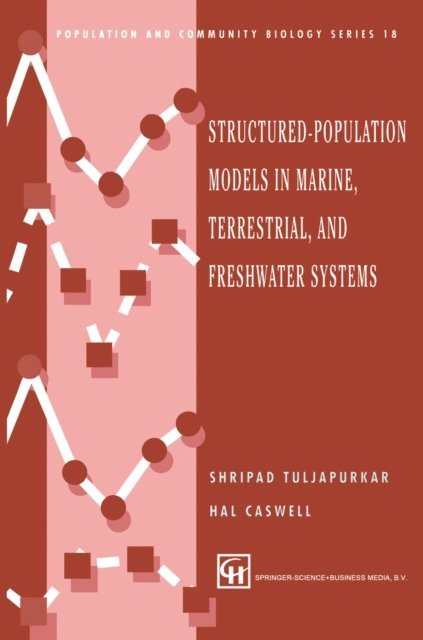
This volume describes the biology of the life cycle (age, size, development stage, for example) and follows the transitions of individuals through stages in the life cycle (survival, growth, development, and reproduction). They are an alternative to models that describe populations in terms of total numbers or biomass. Such models, which depend much more intensively on computer firepower than aggregate or logistic models, have taken a central place in ecological investigations in the last decade. Making appropriate assumptions about their parameters, the ecologist can describe constant environments, time-varying environments, density-dependent populations, and species-species or species-resource interactions with these models.
1 154 kr
Skickas
Published by Sinauer Associates, an imprint of Oxford University Press. Matrix Population Models, Second Edition, is a comprehensive treatment of matrix population models and their applications in ecology and demography. It begins with simple cases, presented in detail so that beginning students can learn how to use these powerful models. It goes on to cover advanced topics in stochastic and nonlinear models. Analytical methods and theoretical issues are illustrated with empirical examples throughout.The decade since the publication of the First Edition of this book has seen enormous progress in the theory and application of matrix population models. The new edition includes greatly expanded treatment of stochastic and density-dependent models, sensitivity analysis, and statistical inference, and new chapters on parameter estimation, structured population models, demographic stochasticity, and applications of matrix models in conservation biology.Matrix Population Models, Second Edition, is an indispensable reference for graduate students and researchers in ecology, population biology, conservation biology, and human demography
651 kr
Skickas inom 5-8 vardagar
705 kr
Skickas inom 5-8 vardagar
1 473 kr
Skickas inom 10-15 vardagar
The third edition of this classic text maintains its focus on applications of demographic models, while extending its scope to matrix models for stage-classified populations. The authors first introduce the life table to describe age-specific mortality, and then use it to develop theory for stable populations and the rate of population increase. This theory is then revisited in the context of matrix models, for stage-classified as well as age-classified populations. Reproductive value and the stable equivalent population are introduced in both contexts, and Markov chain methods are presented to describe the movement of individuals through the life cycle. Applications of mathematical demography to population projection and forecasting, kinship, microdemography, heterogeneity, and multi-state models are considered. The new edition maintains and extends the book's focus on the consequences of changes in the vital rates. Methods are presented for calculating the sensitivity and elasticity of population growth rate, life expectancy, stable stage distribution, and reproductive value, and for applying those results in comparative studies.Stage-classified models are important in both human demography and population ecology, and this edition features examples from both human and non-human populations. In short, this third edition enlarges considerably the scope and power of demography. It will be an essential resource for students and researchers in demography and in animal and plant population ecology. Nathan Keyfitz is Professor Emeritus of Sociology at Harvard University. After holding positions at Canada's Dominion Bureau of Statistics, the University of Chicago, and the University of California at Berkeley, he became Andelot Professor of Sociology and Demography at Harvard in 1972. After retiring from Harvard, he became Director of the Population Program at the International Institute for Applied Systems Analysis (IIASA) in Vienna from 1983 to 1993. Keyfitz is a member of the U.S. National Academy of Sciences and the Royal Society of Canada, and a Fellow of the American Academy of Arts and Sciences.He has received the Mindel Sheps Award of the Population Association of America and the Lazarsfeld Award of the American Sociological Association, and was the 1997 Laureate of the International Union for the Scientific Study of Population. He has written 12 books, including Introduction to the Mathematics of Population (1968) and, with Fr. Wilhelm Flieger, SVD, World Population Growth and Aging: Demographic Trends in the Late Twentieth Century (1990). Hal Caswell is a Senior Scientist in the Biology Department of the Woods Hole Oceanographic Institution, where he holds the Robert W. Morse Chair for Excellence in Oceanography. He is a Fellow of the American Academy of Arts and Sciences. He has held a Maclaurin Fellowship from the New Zealand Institute of Mathematics and its Applications and a John Simon Guggenheim Memorial Fellowship. His research focuses on mathematical population ecology with applications in conservation biology. He is the author of Matrix Population Models: Construction, Analysis, and Interpretation (2001).
536 kr
Skickas inom 10-15 vardagar
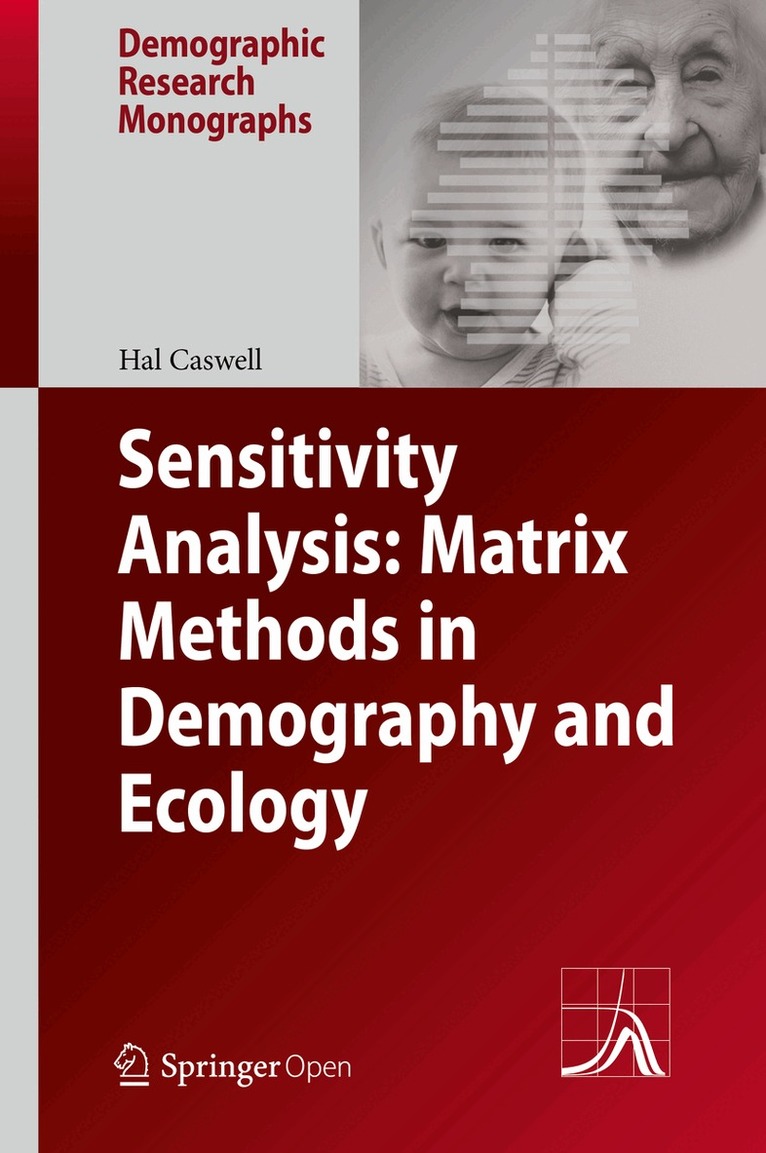
They will also see applications of sensitivity analysis to population growth rates, stable population structures, reproductive value, equilibria under immigration and nonlinearity, and population cycles.