Hans Maier – författare
Visar alla böcker från författaren Hans Maier. Handla med fri frakt och snabb leverans.
20 produkter
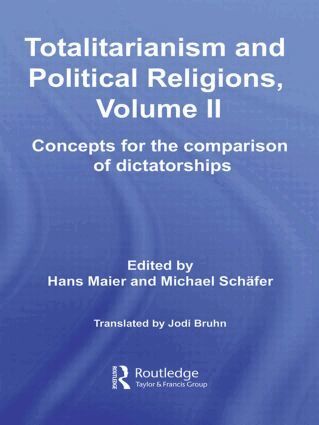
Totalitarianism and Political Religions, Volume II
Concepts for the Comparison Of Dictatorships
Av Hans Maier, Michael Schäfer
Inbunden, 2007
2749 kr
Lägg i varukorg
Available for the first time in English language translation, this is the long-awaited second volume of the three part set on Totalitarianism and Political Religions, edited by the eminent Professor Hans Maier. This represents a major study, with contributions from leading scholars of political …
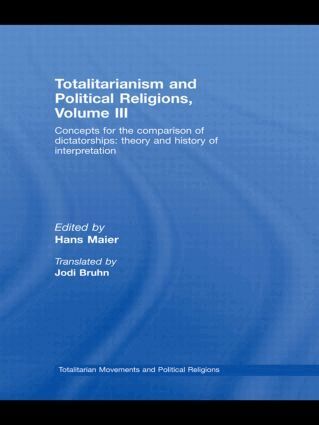
Totalitarianism and Political Religions Volume III
Concepts for the Comparison Of Dictatorships - Theory & History of Interpretations
Av Hans Maier
Inbunden, 2007
2710 kr
Lägg i varukorg
Available for the first time in English language translation, the third volume of Totalitarianism and Political Religions completes the set. It provides a comprehensive overview of key theories and theorists of totalitarianism and of political religions, from Hannah Arendt and Raymond Aron to Leo …
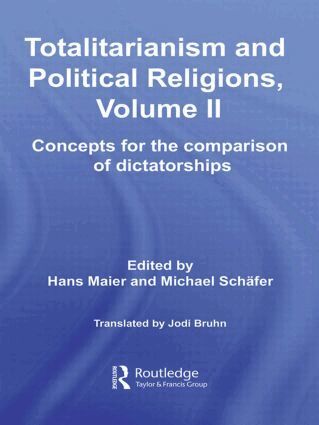
Totalitarianism and Political Religions, Volume II
Concepts for the Comparison Of Dictatorships
Av Hans Maier, Michael Schäfer
Häftad, 2012
938 kr
Lägg i varukorg
Available for the first time in English language translation, this is the long-awaited second volume of the three part set on Totalitarianism and Political Religions, edited by the eminent Professor Hans Maier. This represents a major study, with contributions from leading scholars of political …
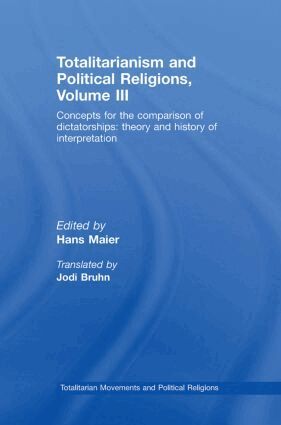
Totalitarianism and Political Religions Volume III
Concepts for the Comparison Of Dictatorships - Theory & History of Interpretations
Av Hans Maier
Häftad, 2012
938 kr
Lägg i varukorg
Available for the first time in English language translation, the third volume of Totalitarianism and Political Religions completes the set. It provides a comprehensive overview of key theories and theorists of totalitarianism and of political religions, from Hannah Arendt and Raymond Aron to Leo …
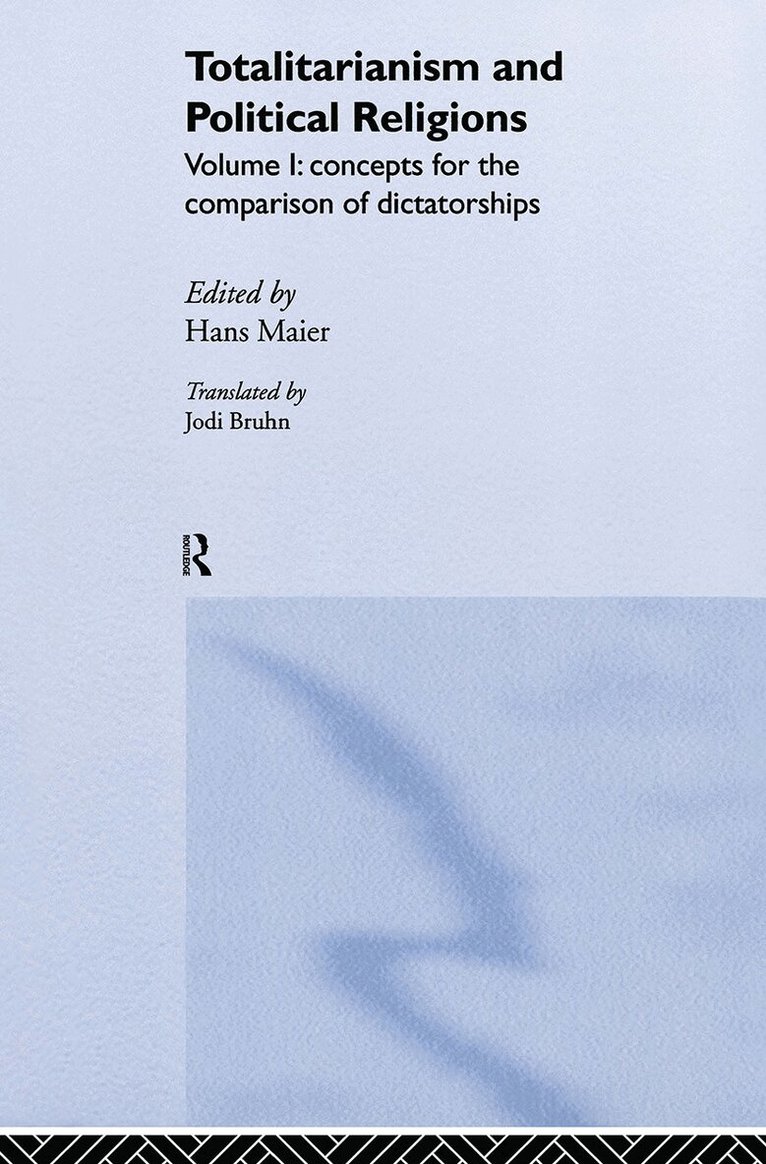
Totalitarianism and Political Religions, Volume 1
Concepts for the Comparison of Dictatorships
Av Hans Maier
Inbunden, 2004
2506 kr
Lägg i varukorg
We are used to distinguishing the despotic regimes of the 20th century - communism, fascism, National Socialism, Maoism - very precisely according to place and time, origins and influences. But what should we call that which they have in common? On this question, there has been and is still a …
Totalitarianism and Political Religions, Volume 1
Concepts for the Comparison of Dictatorships
Av Hans Maier
Häftad, 2004
1169 kr
Lägg i varukorg
We are used to distinguishing the despotic regimes of the 20th century - communism, fascism, National Socialism, Maoism - very precisely according to place and time, origins and influences. But what should we call that which they have in common? On this question, there has been and is still a …
Totalitarianism and Political Religions Volume III
Concepts for the Comparison Of Dictatorships - Theory & History of Interpretations
Av Hans Maier
E-bok, 2008
1106 kr
Lägg i varukorg
Available for the first time in English language translation, the third volume of Totalitarianism and Political Religions completes the set. It provides a comprehensive overview of key theories and theorists of totalitarianism and of political religions, from Hannah Arendt and Raymond Aron to Leo …
Totalitarianism and Political Religions Volume III
Concepts for the Comparison Of Dictatorships - Theory & History of Interpretations
Av Hans Maier
E-bok, 2008
1106 kr
Lägg i varukorg
Available for the first time in English language translation, the third volume of Totalitarianism and Political Religions completes the set. It provides a comprehensive overview of key theories and theorists of totalitarianism and of political religions, from Hannah Arendt and Raymond Aron to Leo …
Totalitarianism and Political Religions, Volume II
Concepts for the Comparison Of Dictatorships
Av Michael Schafer, Hans Maier
E-bok, 2007
1106 kr
Lägg i varukorg
Available for the first time in English language translation, this is the long-awaited second volume of the three part set on Totalitarianism and Political Religions , edited by the eminent Professor Hans Maier. This represents a major study, with contributions from leading scholars of political …
Totalitarianism and Political Religions, Volume 1
Concepts for the Comparison of Dictatorships
Av Hans Maier
E-bok, 2004
1427 kr
Lägg i varukorg
We are used to distinguishing the despotic regimes of the 20th century - communism, fascism, National Socialism, Maoism - very precisely according to place and time, origins and influences. But what should we call that which they have in common? On this question, there has been and is still a …
Totalitarianism and Political Religions, Volume 1
Concepts for the Comparison of Dictatorships
Av Hans Maier
E-bok, 2004
1396 kr
Lägg i varukorg
We are used to distinguishing the despotic regimes of the 20th century - communism, fascism, National Socialism, Maoism - very precisely according to place and time, origins and influences. But what should we call that which they have in common? On this question, there has been and is still a …
Über die Reichsverfassung
Av Georg Wilhelm Friedrich Hegel, Hans Maier
E-bok, 2004
170 kr
Lägg i varukorg
Hegels Schrift »Über die Reichsverfassung« – beginnend mit dem Satz »Deutschland ist kein Staat mehr« – war ein Kind der bewegten Zeit unmittelbar vor und nach 1800, dem Siegeszug Napoleons im deutsch-französischen Krieg, und blieb lange ein Stiefkind der Forschung. Nicht nur, dass es bis 1998 …