Hans-Rolf Gregorius – författare
Visar alla böcker från författaren Hans-Rolf Gregorius. Handla med fri frakt och snabb leverans.
4 produkter
4 produkter
Del 60 - Lecture Notes in Biomathematics
Population Genetics in Forestry
Proceedings of the Meeting of the IUFRO Working Party “Ecological and Population Genetics” held in Göttingen, August 21–24, 1984
Häftad, Engelska, 1985
550 kr
Skickas inom 10-15 vardagar
When we consider the main object of forestry, the tree, it immediately becomes clear why experimental population geneticists have been so hesitant in making this object a primary concern of their research. Trees are very long-living organisms with generation intervals frequently exceeding those of their investigators by multiples. They virtually exclude, therefore, application of the classical methods of population genetics since these are based on observing genetic structures over generations. This situation, where the limits set to observation are so severe, particularly requires close cooperation between theory and experiment. It also requires careful consideration of results obtained for organisms other than trees, in order to gain additional insights by comparing the results for trees with those for other organisms. Yet, the greatest challenge to population and ecological genetics probably originates from the fact that forests are very likely to be the most complex ecosystems of all, even in some cases where they are subject to intense management. This complexity, which equally comprises biotic and abiotic factors varying both in time and space, makes extremely high demands on the adaptational capacity and thus flexibility of the carriers of such an ecosystem. Longevity combined with immobility during the vegetative phase, however, appears to contradict the obvious necessity of adaptational flexibility in forest tree populations when compared with short lived and/or mobile organisms.
E-bok
PDF, Engelska, 2013687 kr
Läs direkt efter köp
When we consider the main object of forestry, the tree, it immediately becomes clear why experimental population geneticists have been so hesitant in making this object a primary concern of their research. Trees are very long-living organisms with generation intervals frequently exceeding those of their investigators by multiples. They virtually exclude, therefore, application of the classical methods of population genetics since these are based on observing genetic structures over generations. This situation, where the limits set to observation are so severe, particularly requires close cooperation between theory and experiment. It also requires careful consideration of results obtained for organisms other than trees, in order to gain additional insights by comparing the results for trees with those for other organisms. Yet, the greatest challenge to population and ecological genetics probably originates from the fact that forests are very likely to be the most complex ecosystems of all, even in some cases where they are subject to intense management. This complexity, which equally comprises biotic and abiotic factors varying both in time and space, makes extremely high demands on the adaptational capacity and thus flexibility of the carriers of such an ecosystem. Longevity combined with immobility during the vegetative phase, however, appears to contradict the obvious necessity of adaptational flexibility in forest tree populations when compared with short lived and/or mobile organisms.
1 416 kr
Läs direkt efter köp
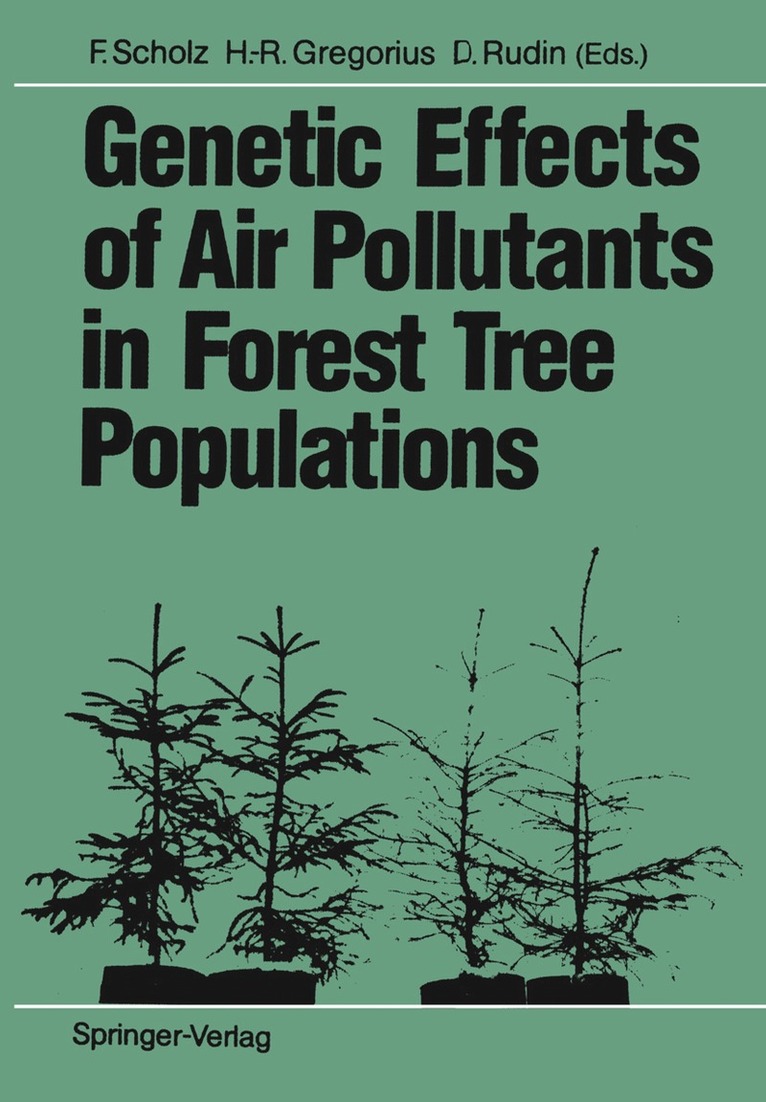
Air pollutants provide environmental conditions that drastically differ in many respects from those to which forest trees are naturally adapted. Leading experts in the field here consider these questions of immediate relevance arising from the changing environment: (1) Do air pollutants introduce effects of selection that differ from those known for populations that are not subject to such stress conditions? (2) If air pollutants introduce quantitatively or even qualitatively novel selective effects, which consequences might arise from the adaptation of forest tree populations to the present conditions as well as for the preservation of adaptability to future conditions? In addition to these questions, concepts for preservation of genetic resources are discussed.
1 092 kr
Skickas inom 10-15 vardagar
Air pollutants provide environmental conditions that drastically differ in many respects from those to which forest trees are naturally adapted. Leading experts in the field here consider these questions of immediate relevance arising from the changing environment: (1) Do air pollutants introduce effects of selection that differ from those known for populations that are not subject to such stress conditions? (2) If air pollutants introduce quantitatively or even qualitatively novel selective effects, which consequences might arise from the adaptation of forest tree populations to the present conditions as well as for the preservation of adaptability to future conditions? In addition to these questions, concepts for preservation of genetic resources are discussed.