Haojiang Ding – författare
Visar alla böcker från författaren Haojiang Ding. Handla med fri frakt och snabb leverans.
3 produkter
3 produkter
Inbunden, Engelska, 2006
1 626 kr
Skickas inom 10-15 vardagar
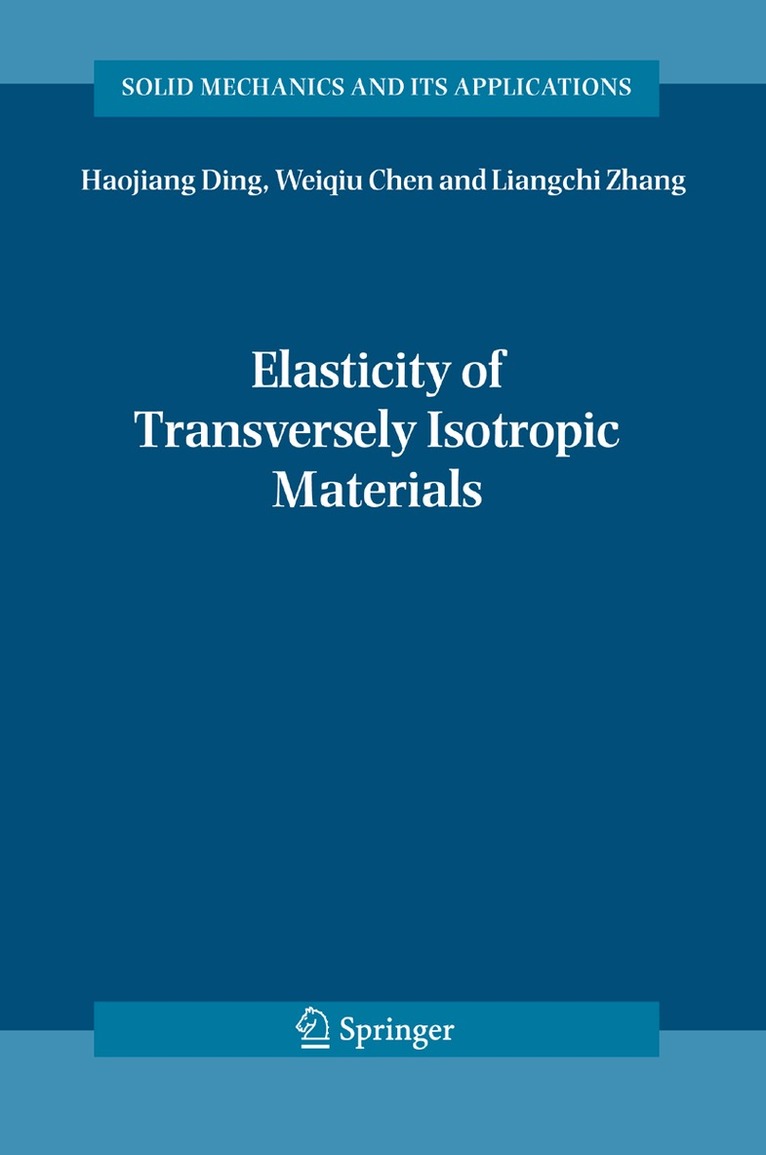
This book aims to provide a comprehensive introduction to the theory and applications of the mechanics of transversely isotropic elastic materials. There are many reasons why it should be written. First, the theory of transversely isotropic elastic materials is an important branch of applied mathematics and engineering science; but because of the difficulties caused by anisotropy, the mathematical treatments and descriptions of individual problems have been scattered throughout the technical literature. This often hinders further development and applications. Hence, a text that can present the theory and solution methodology uniformly is necessary. Secondly, with the rapid development of modern technologies, the theory of transversely isotropic elasticity has become increasingly important. In addition to the fields with which the theory has traditionally been associated, such as civil engineering and materials engineering, many emerging technologies have demanded the development of transversely isotropic elasticity. Some immediate examples are thin film technology, piezoelectric technology, functionally gradient materials technology and those involving transversely isotropic and layered microstructures, such as multi-layer systems and tribology mechanics of magnetic recording devices. Thus a unified mathematical treatment and presentation of solution methods for a wide range of mechanics models are of primary importance to both technological and economic progress.
E-bok
PDF, Engelska, 20061 977 kr
Läs direkt efter köp
This book aims to provide a comprehensive introduction to the theory and applications of the mechanics of transversely isotropic elastic materials. There are many reasons why it should be written. First, the theory of transversely isotropic elastic materials is an important branch of applied mathematics and engineering science; but because of the difficulties caused by anisotropy, the mathematical treatments and descriptions of individual problems have been scattered throughout the technical literature. This often hinders further development and applications. Hence, a text that can present the theory and solution methodology uniformly is necessary. Secondly, with the rapid development of modern technologies, the theory of transversely isotropic elasticity has become increasingly important. In addition to the fields with which the theory has traditionally been associated, such as civil engineering and materials engineering, many emerging technologies have demanded the development of transversely isotropic elasticity. Some immediate examples are thin film technology, piezoelectric technology, functionally gradient materials technology and those involving transversely isotropic and layered microstructures, such as multi-layer systems and tribology mechanics of magnetic recording devices. Thus a unified mathematical treatment and presentation of solution methods for a wide range of mechanics models are of primary importance to both technological and economic progress.
Häftad, Engelska, 2010
1 633 kr
Skickas inom 10-15 vardagar
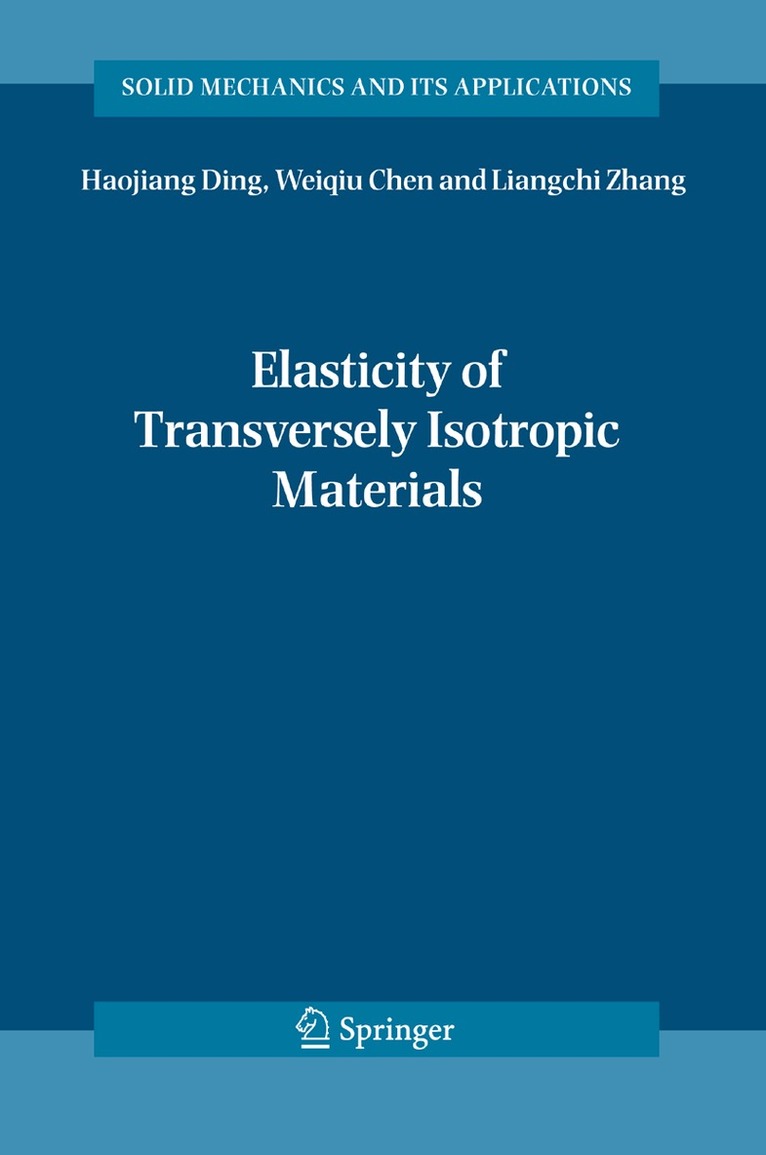
This book aims to provide a comprehensive introduction to the theory and applications of the mechanics of transversely isotropic elastic materials. There are many reasons why it should be written. First, the theory of transversely isotropic elastic materials is an important branch of applied mathematics and engineering science; but because of the difficulties caused by anisotropy, the mathematical treatments and descriptions of individual problems have been scattered throughout the technical literature. This often hinders further development and applications. Hence, a text that can present the theory and solution methodology uniformly is necessary. Secondly, with the rapid development of modern technologies, the theory of transversely isotropic elasticity has become increasingly important. In addition to the fields with which the theory has traditionally been associated, such as civil engineering and materials engineering, many emerging technologies have demanded the development of transversely isotropic elasticity. Some immediate examples are thin film technology, piezoelectric technology, functionally gradient materials technology and those involving transversely isotropic and layered microstructures, such as multi-layer systems and tribology mechanics of magnetic recording devices. Thus a unified mathematical treatment and presentation of solution methods for a wide range of mechanics models are of primary importance to both technological and economic progress.