Harry First - Böcker
Visar alla böcker från författaren Harry First. Handla med fri frakt och snabb leverans.
5 produkter
5 produkter
Expanding the Boundaries of Intellectual Property
Innovation Policy for the Knowledge Society
Inbunden, Engelska, 2001
1 937 kr
Skickas inom 5-8 vardagar
This book focuses on the question of how much control innovators should be given over their works. The first parts examine the trend to increase control: first, by expanding the scope of intellectual property rights to add new subject matter; secondly, through increasing transactional autonomy. The former issue represents the key concerns of the intellectual property community; the latter issue is currently before both state and national legislatures.The question that these groups are debating is the subject of the next part: whether strong intellectual property rights, coupled with a high degree of transactional autonomy, promote innovation or chill interchange. One view is that the current legal regime should not be altered because it represents the right balance between the needs of information producers and the requirements of users. The contrary view is that stronger rights would allow potential collaborators to find one another, bargain for beneficial exchanges, and reallocate rights. The final sections explore the bases in constitutions, laws, and treaties for protecting the public domain. Four judges from the US federal courts and the UK high court then debate the practicalities of the frameworks proposed.
Working Within the Boundaries of Intellectual Property
Innovation Policy For The Knowledge Society
Inbunden, Engelska, 2010
3 100 kr
Skickas inom 5-8 vardagar
This book is the long-awaited companion volume to the highly acclaimed Expanding the Boundaries of Intellectual Property, published by Oxford University Press in 2001. That book argued for strong private rights whilst at the same time calling for caution in the expansionary trend. In the period since the first volume, intellectual property protection has grown ever stronger, and this new book focuses on finding ways to cope with the fragmentation of rights and the complex framework this expansion of rights has created. At the core of the book are considerations of such initiatives as patent clearing models, standard setting organizations, licensing arrangements and informal work-arounds. It also examines the measures that seek to protect the public domain, including strategic licensing, collective rights organizations, and non-profit ventures such as creative commons and open-source publishing. Drawing on expertise from a number of disciplines including law, economics and sociology, the book is international in approach and fuses scholarly research with legal practice. It will be of great interest to scholars in intellectual property and innovation, policy-makers, and practitioners with an interest in the future of the field.
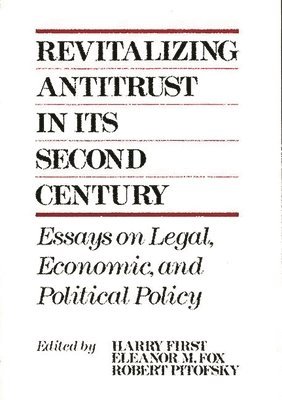
Revitalizing Antitrust in its Second Century
Essays on Legal, Economic, and Political Policy
Inbunden, Engelska, 1991
928 kr
Skickas inom 10-15 vardagar
America has entered its second century of antitrust law. The United States has come through the 1980s of laissez faire when antitrust had its lowest profile since the Hoover days, lawyers advised clients that anything goes, and theorists justified non-enforcement of the law by Chicago School economics--the claim that antitrust exists only to create efficiency and that business freedom creates efficiency. Meanwhile, the European Community has a developing body of antitrust law. It rejects the Chicago School as ignoring market realities, and it incorporates into its law values of opportunity, access, open markets and the right to be free from exploitation. The newly democratized European nations and Russia all have moved to market economies and adopted antitrust law in the image of the European Community, in spite of the carpet baggers trying to sell laissez faire. The Supreme Court of the United States has now reversed the swing of the U.S. antitrust pendulum, rejecting Chicago School theory in favor of market reality and accepting the fact that there is an antitrust right not to be coerced and abused by market power.What is the intellectual foundation of this new antitrust--this law that respects efficiency, progressiveness, access, and freedom from abuse of power, and which reflects the need of business firms to be active and agile players in a global marketplace? That foundation is contained in Revitalizing Antitrust in its Second Century. This is the only book that provides the underpinnings for the new antitrust. It is the only book that helps the scholar/lawyer/business advisor/student understand the direction of antitrust and how to predict the course of the law. Four of the authors in the book were cited by the Supreme Court in its June opinion; one was cited eleven times. Revitalizing Antitrust in its Second Century is an indispensable volume for lawyers, economists, business advisors, sholars and students of law, economics, business and political economy.
1 510 kr
Skickas inom 5-8 vardagar
1 724 kr
Skickas inom 5-8 vardagar