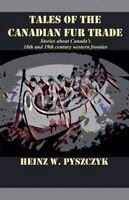
This book is a compilation of ten stories of historical fiction about the 18th and 19th-century fur trade era in western Canada. As a historical archaeologist who has excavated at Fort Edmonton, Vermilion, and Dunvegan (among others), I have walked in places that Peter Pond, David Thompson, Alexander Mackenzie, and Peter Fidler once frequented. I often found myself imagining the interesting lives they led. These men frequently had a more personal or lesser-known side to them. In the first two stories, Mr. Pond's Finest Set of China, and Mr. Pond's Most Magnificent Map, I explore how the American, Peter Pond, known for his unpredictable, violent temper, and his considerable skills in cartography, finally manages to control his moods (or does he?) when dealing with his Canadian adversaries in today's northern Saskatchewan and Alberta. In We'll Build Us a 'Yole' the Hudson's Bay Company trader and mapmaker, Peter Fidler, tackles the daunting transportation logistics of the fur trade, becoming one of the first men to build the York Boat at Buckingham House on the North Saskatchewan River during the 1790s. Considered a calm, quiet, intelligent man, in my story, I ask and explore the question: What if Peter had a more calculating, aggressive side lurking within him?I also write about the histories of the First Nations and Métis men and women who did not write down their stories and histories, and who, through their efforts, contributed considerably. In Better Days Ahead, Elizabeth, the Metis wife of Clerk Colin Campbell at Fort Vermilion, uses her Native knowledge to save the fort inhabitants from certain starvation. In Pick Your Poison: Louis' Peculiar Tobacco Pipe, I explore the life of a French-Canadian voyageur, Louis, at Fort Vermilion, whose peculiar tobacco pipe is the envy of his comrades - until it isn't. Beware Those Bearing Gifts describes the initial move by the major fur trade Companies up the Peace River into today's northern Alberta in the 1780s. It tries to capture the turmoil, the violence and tension existing between the local Dunne-za and the first white traders entering the region. In the mid-19th century story, entitled, My Boy Twist, I chronicle the coming of the first missionaries to the central Peace River Region in northern Alberta, and the ensuing clash between traditional Native spiritualism and Christianity. The central character, a young Metis interpreter, negotiates a path riddled with conflict between both worlds.I have, for many years, through my writing and lectures, championed the idea that Canadian history contains objects (artifacts, food, buildings, etc.) that enable us to write about history. In my stories, there is one object, be it a tobacco pipe, cattail, or York Boat, which drives the narrative and plot. In The 'Little Emperor's' Toothbrush, I conjecture that the Governor of the Hudson's Bay Company, George Simpson, who, while visiting Fort Vermilion in 1822, carried with him a rare bone toothbrush like the one found at Fort Vermilion. In The Trader's Private Stock, trader Angus Shaw, while at his North West Company post, Fort George (1792-1800) overlooking the North Saskatchewan River, runs short on alcohol. He becomes overly suspicious that some of his men might be pilfering it and makes plans to stop the thieving. In The Sampleman's Gambit, a young German businessman (known as a sampleman) attempts to entice the women of Fort Edmonton to buy his glass beads during the late 1840s. While all three stories contain a bit of 'tongue in cheek', they bring out the excessive abuse of power by an elite fur trade officer class; excessive use of alcohol by the Companies to boost trade; and excessive and ruthless competition for furs using whatever means to encourage Indigenous populations to trade.