Henning Borm – författare
Visar alla böcker från författaren . Handla med fri frakt och snabb leverans.
10 produkter
10 produkter
Del 735 - Urban-Taschenbücher
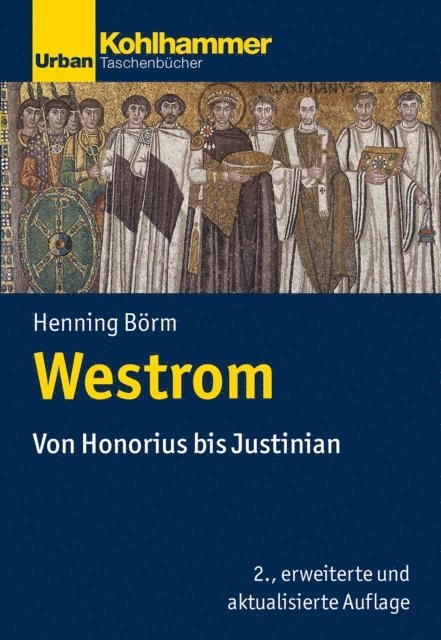
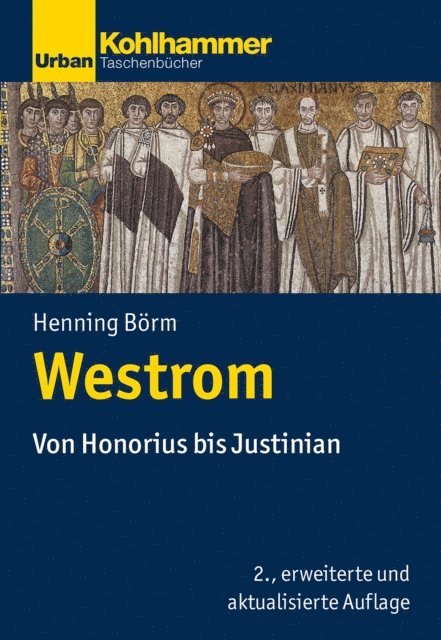
Westrom: Von Honorius Bis Justinian
Häftad, Tyska, 2018
323 kr
Skickas inom 3-6 vardagar
E-bok
PDF, Tyska, 2018272 kr
Läs direkt efter köp
The West of the Roman Empire experienced a chain of dramatic events and development from 396 AD onwards. The last Western emperor was deposed in 476 AD and Justinian abolished the Western Roman court in 554 AD. These events, which mark the transition from antiquity tothe Middle Ages in Europe, are often explained by a "civic migration". However, this book, by contrast, highlights internal Roman conflicts: Western Rome was not conquered. Its successive empires only superseded the authority of the imperial government, when endlesscivil wars had led to the collapse of Roman rule. A systematicoverview of Empire, administration, army, economy and religion completes the presentation.
E-bok
Tyska, 2018272 kr
Läs direkt efter köp
The West of the Roman Empire experienced a chain of dramatic events and development from 396 AD onwards. The last Western emperor was deposed in 476 AD and Justinian abolished the Western Roman court in 554 AD. These events, which mark the transition from antiquity tothe Middle Ages in Europe, are often explained by a "civic migration". However, this book, by contrast, highlights internal Roman conflicts: Western Rome was not conquered. Its successive empires only superseded the authority of the imperial government, when endlesscivil wars had led to the collapse of Roman rule. A systematicoverview of Empire, administration, army, economy and religion completes the presentation.
E-bok
PDF, Engelska, 2016828 kr
Läs direkt efter köp
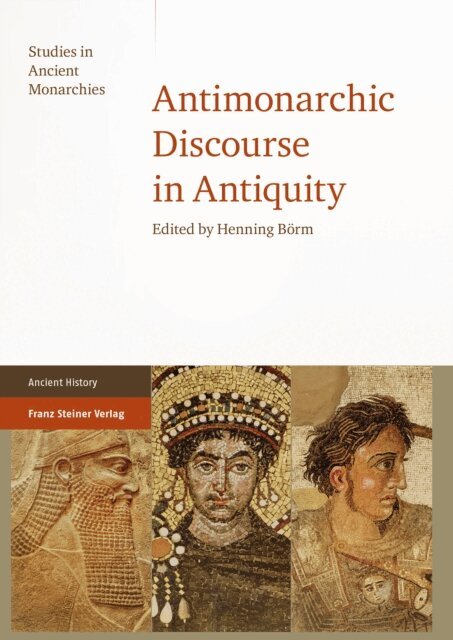
When analyzing the character of monarchic regimes and their strategies for creating obedience and acceptance, the focus usually lies on the ruler ideology and the self-representation of the individual monarch. However, the contributions to the present volume try to approach the matter from the angle of the - real or merely anticipated - criticism against the background of which monarchic legitimization was expressed: what conditions, what elements, and what strategies were characteristic of a critical discussion of monocracy in antiquity, and to what extent was the relationship between ruler ideology and antimonarchic sentiment marked by mutual dependence? What significance did the eternal background noise possess which as a contre-discourse compelled rulers in Egypt, Persia, Judea, Greece and Rome to justify themselves again and again?
1 716 kr
Skickas inom 3-6 vardagar
E-bok
PDF, Engelska, 2015891 kr
Läs direkt efter köp
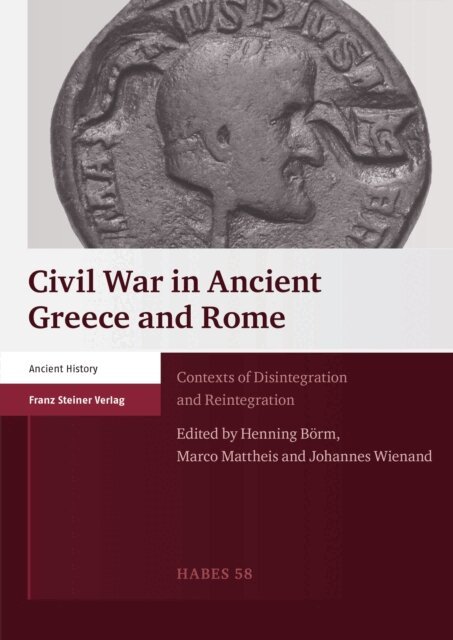
Civil war is the most radical form of political conflict. This volume analyses the impact of civil war on society and culture in Greco-Roman antiquity. The collected papers examine phenomena such as tyrannicide, staseis and usurpations from the classical age to late antiquity. The focus lies on the lasting impact violence and disorder had on political discourse and memory culture. In particular, the contributions explore how internal conflicts were staged and performed. Beyond spectacular triumphal celebrations there existed a broad range of symbolic forms of communication pertaining to civil war: rituals of reconciliation, reintegration and restoration as well as acts of commemoration and condemnation. The multidisciplinary volume aims at contributing to a better understanding of the performative and communicative logic of civil conflict within the ancient societies of Greece and Rome.
E-bok
PDF, Engelska, 2018700 kr
Läs direkt efter köp
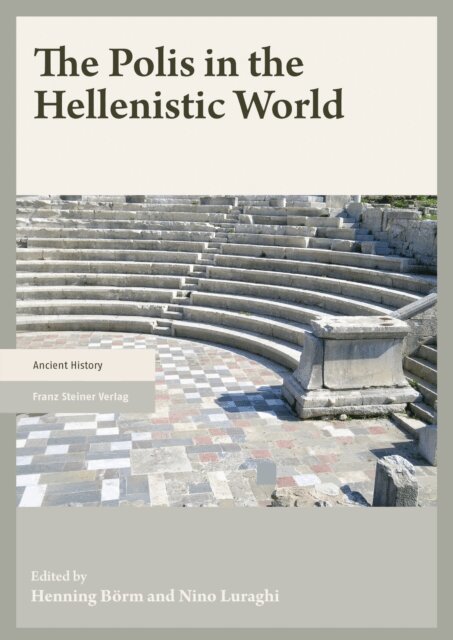
After having been for decades the province of a relatively small group of scholars, the Hellenistic polis has become central to the research agenda of Ancient historians more broadly. This development can be traced from the early nineties of the last century, and has picked up pace in a sustained fashion at the turn of the millennium. Recent research has started approaching the Greek polis of the centuries between Alexander and Cleopatra as a specific historical phenomenon, striving to define its most peculiar aspects from as many angles as possible, and to point to new avenues of interpretation that might contribute to recognizing its historical role. In this general framework, this volume attempts to explore new lines of thought, to question established ways of reading the evidence, and to take stock of recent developments. The contributors do not subscribe to any particular shared approach; on the contrary, their approaches and questions stem from many different scholarly traditions and methodologies. Rather than seeking to achieve a complete coverage, the volume provides a selection of current research agendas, in many cases offering glimpses of ongoing projects.
E-bok
PDF, Tyska, 2019891 kr
Läs direkt efter köp
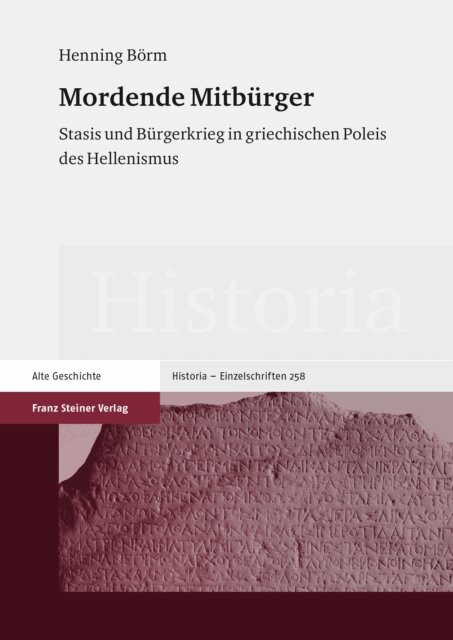
Das Phanomen der teils burgerkriegsartigen Konflikte in griechischen Poleis, das die Forschung unter dem Begriff "e;Stasis"e; zusammenfasst, ist in der Vergangenheit vorwiegend mit Blick auf die Archaik und Klassik untersucht worden. Henning Borm zeigt hingegen, dass es auch nach Alexander dem Groen in den Stadten, die sich zunachst im Spannungsfeld der makedonischen Monarchien, spater dann unter romischer Dominanz wiederfanden, vielfach zu Staseis kam. Ausgehend von einer Auswertung der literarischen und epigraphischen Uberlieferung fragt Borm nach den Hintergrunden und Konsequenzen der auffalligen Anfalligkeit vieler hellenistischer Poleis fur innere Konflikte. Die Neigung zur Stasis lasst sich dabei nicht nur als Epiphanomen und Katalysator, sondern auch als Inhibitor von Transformationsprozessen in der griechischen Welt deuten. Statt eine bloe Randerscheinung zu sein, war Stasis vielmehr ein zentraler Faktor, dessen Analyse dazu beitragt, sowohl die Entwicklung der Poleis zwischen Alexander und Augustus besser zu verstehen als auch die Mechanismen der romischen Expansion im Osten des Mittelmeerraums.
E-bok
PDF, Tyska, 2019866 kr
Läs direkt efter köp
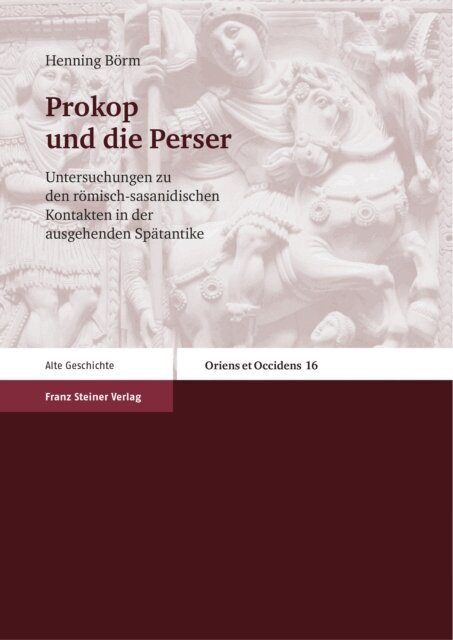
Wahrend der gesamten Spatantike standen die Romer im Orient den sasanidischen Persern gegenuber. Nach anfangs heftigen Konflikten hatten im funften Jahrhundert friedliche Kontakte das Bild gepragt. Unter Kaiser Justinian traten die Beziehungen dann um 530 in eine entscheidende Phase: Sollte man nun, neu erstarkt, den Konflikt erneuern, oder weiter auf Koexistenz setzen? Das Scheitern der Bemuhungen um einen dauerhaften Ausgleich und die Eskalation der militarischen Konflikte sollten letztlich zum Zusammenbruch beider Reiche und dem Ende der Alten Welt beitragen. Der wichtigste Zeuge fur diese Ereignisse ist Prokop von Caesarea (ca. 500 560), der letzte gro e antike Historiker. Neben seinem Bericht uber die politischen Kontakte und militarischen Konflikte steht vor allem eine systematische Sichtung und Prufung seiner Angaben uber Persien und die Perser im Mittelpunkt dieser Studie: Was wu te man im spatantiken Imperium uber die ostlichen Nachbarn, und welche Faktoren pragten Prokops Sicht auf die Perser?Pressestimmen"e;Der Leser erhalt in dieser Arbeit einen hervorragenden und kompetenten Kommentar zu allen Stellen bei Prokopios, die sich auf Persien und persische Realien beziehen, zudem findet er hier eine nuchterne Analyse der romischen Ostpolitik im 6. Jahrhundert. Die Arbeit von Borm enthalt zahlreiche neue, wichtige Erkenntnisse, die ihr zweifellos einen bedeutenden Rang in der modernen Prokopios-Forschung garantieren werden."e;H-Soz-u-Kult
E-bok
PDF, Engelska, 2023739 kr
Läs direkt efter köp
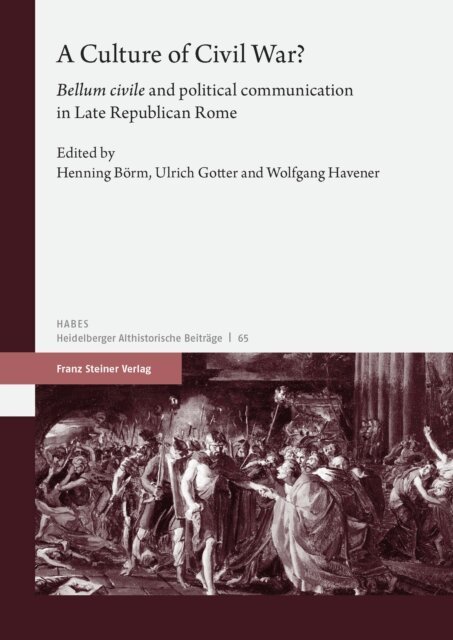
The civil wars of the first century BCE disrupted Roman society, which in turn was a major cause of the destabilisation of the political system. While this has of course long been recognised, the cultural dimension of the disintegration of the res publica demands equal attention. The present volume aims for an analysis of the more implicit, yet fundamental effects which the increasingly militarised conflict had on Roman society, starting with the assumption that the radical dynamics and intrinsic brutality constituted a completely new experience for contemporaries. To solve this problem, Romans of the late Republican period devised multiple strategies for coping with the phenomenon of civil war. While some turned to narrative patterns deployed by the Greeks who had been accustomed to civil conflict for centuries, the bella civilia also influenced many other aspects of cultural life. The latent fear of permanent civil strife thus became a source of innovation on multiple levels which (re-)shaped Roman collective imaginary. The resulting structures and developments constituted a highly elaborate and comprehensive "e;culture of civil war"e;.