Herbert Bless - Böcker
Visar alla böcker från författaren Herbert Bless. Handla med fri frakt och snabb leverans.
4 produkter
4 produkter
1 506 kr
Tillfälligt slut
2 029 kr
Skickas inom 10-15 vardagar
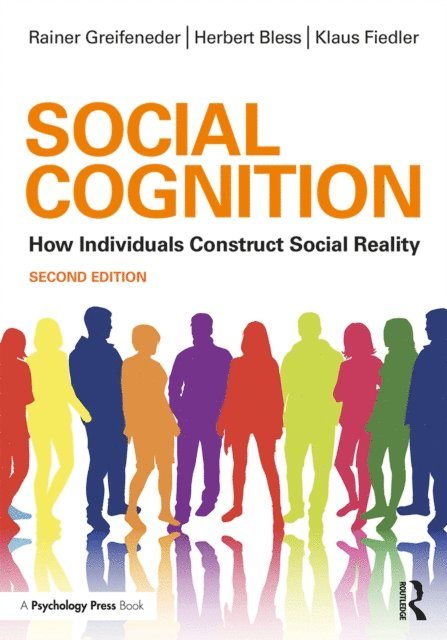
Social cognition is a key area of social psychology, which focuses on cognitive processes that are involved when individuals make sense of, and navigate in their social world. For instance, individuals need to understand what they perceive, they learn and recall information from memory, they form judgments and decisions, they communicate with others, and they regulate their behavior. While all of these topics are also key to other fields of psychological research, it’s the social world—which is dynamic, complex, and often ambiguous—that creates particular demands. This accessible book introduces the basic themes within social cognition and asks questions such as: How do individuals think and feel about themselves and others? How do they make sense of their social environment? How do they interact with others in their social world? The book is organized along an idealized sequence of social information processing that starts at perceiving and encoding, and moves on to learning, judging, and communicating. It covers not only processes internal to the individual, but also facets of the environment that constrain cognitive processing.Throughout the book, student learning is fostered with examples, additional materials, and discussion questions. With its subdivision in ten chapters, the book is suitable both for self-study and as companion material for those teaching a semester-long course. This is the ideal comprehensive introduction to this thriving and captivating field of research for students of psychology.
771 kr
Skickas inom 10-15 vardagar
Social cognition is a key area of social psychology, which focuses on cognitive processes that are involved when individuals make sense of, and navigate in their social world. For instance, individuals need to understand what they perceive, they learn and recall information from memory, they form judgments and decisions, they communicate with others, and they regulate their behavior. While all of these topics are also key to other fields of psychological research, it’s the social world—which is dynamic, complex, and often ambiguous—that creates particular demands. This accessible book introduces the basic themes within social cognition and asks questions such as: How do individuals think and feel about themselves and others? How do they make sense of their social environment? How do they interact with others in their social world? The book is organized along an idealized sequence of social information processing that starts at perceiving and encoding, and moves on to learning, judging, and communicating. It covers not only processes internal to the individual, but also facets of the environment that constrain cognitive processing.Throughout the book, student learning is fostered with examples, additional materials, and discussion questions. With its subdivision in ten chapters, the book is suitable both for self-study and as companion material for those teaching a semester-long course. This is the ideal comprehensive introduction to this thriving and captivating field of research for students of psychology.
Message Within
The Role of Subjective Experience In Social Cognition And Behavior
Häftad, Engelska, 2001
797 kr
Skickas inom 10-15 vardagar
This provocative book provides the first comprehensive and informative overview of the role of various subjective experiences in social cognition and behavior, and argues that the study of such experiences may be one of the key unifying themes of social psychology. Based on recent theoretical and empirical developments in the discipline, this select group of leading international researchers surveys extensive evidence and shows that subjective experiences play a key role in most aspects of social cognition and social behavior. The book contains five main sections, discussing the role of subjective experiences in social information processing (Part 1), their influence on memory (Part 2) and their role in intergroup contexts (Part 3). The role of affective experiences in social thinking and behavior is analyzed (Part 4), and the influence of subjective experiences on the development and change of attitudes and stereotypes is also addressed (Part 5).