Klaus Fiedler – författare
2 366 kr
Skickas inom 10-15 vardagar
610 kr
Skickas inom 10-15 vardagar
720 kr
Skickas inom 10-15 vardagar
2 366 kr
Skickas inom 10-15 vardagar
507 kr
Skickas inom 7-10 vardagar
974 kr
Skickas inom 7-10 vardagar
3 754 kr
Skickas inom 3-6 vardagar
The first part of the book outlines a number of general frameworks that inform the applications of social psychology, namely language, attitudes, decision-making and survey research; Part Two focuses on major behavioural domains, including health and economic behaviour; Part Three explains the relationship between social psychology and social institutions, highlighting, for instance, the media, law and politics; and the final part addresses the broader social and cultural implications of contemporary social psychology, covering such key concerns as violence, ageing and cross-cultural questions.
1 910 kr
Skickas inom 3-6 vardagar
The first part of the book outlines a number of general frameworks that inform the applications of social psychology, namely language, attitudes, decision-making and survey research; Part Two focuses on major behavioural domains, including health and economic behaviour; Part Three explains the relationship between social psychology and social institutions, highlighting, for instance, the media, law and politics; and the final part addresses the broader social and cultural implications of contemporary social psychology, covering such key concerns as violence, ageing and cross-cultural questions.
2 191 kr
Skickas inom 5-8 vardagar
583 kr
Skickas inom 10-15 vardagar
706 kr
Läs direkt efter köp
This book explores what social psychology can contribute to our understanding of real-life problems and how it can inform rational interventions in any area of social life. By reviewing some of the most recent achievements in applying social psychology to pressing contemporary problems, Forgas, Crano, and Fiedler convey a fundamentally optimistic message about social psychology’s achievements and prospects.
The book is organized into four sections. Part I focuses on the basic issues and methods of applying social psychology to real-life problems, discussing evolutionary influences on human sociability, the role of psychological ‘mindsets’ in interpreting reality, and the use of attitude change techniques to promote adaptive behaviors. Part II explores the applications of social psychology to improve individual health and well-being, including managing aggression, eating disorders, and improving therapeutic interactions. Part III turns to the application of social psychology to improve interpersonal relations and communication, including attachment processes in social relationships, the role of parent-child interaction in preventing adolescent suicide, and analyzing social relations in legal settings and online social networks. Finally, Part IV addresses the question of how social psychology may improve our understanding of public affairs and political behavior.
The book will be of interest to students and academics in social psychology, and professionals working in applied settings.
706 kr
Läs direkt efter köp
This book explores what social psychology can contribute to our understanding of real-life problems and how it can inform rational interventions in any area of social life. By reviewing some of the most recent achievements in applying social psychology to pressing contemporary problems, Forgas, Crano, and Fiedler convey a fundamentally optimistic message about social psychology’s achievements and prospects.
The book is organized into four sections. Part I focuses on the basic issues and methods of applying social psychology to real-life problems, discussing evolutionary influences on human sociability, the role of psychological ‘mindsets’ in interpreting reality, and the use of attitude change techniques to promote adaptive behaviors. Part II explores the applications of social psychology to improve individual health and well-being, including managing aggression, eating disorders, and improving therapeutic interactions. Part III turns to the application of social psychology to improve interpersonal relations and communication, including attachment processes in social relationships, the role of parent-child interaction in preventing adolescent suicide, and analyzing social relations in legal settings and online social networks. Finally, Part IV addresses the question of how social psychology may improve our understanding of public affairs and political behavior.
The book will be of interest to students and academics in social psychology, and professionals working in applied settings.
841 kr
Läs direkt efter köp
The recent rise of populist politics represent a major challenge for liberal democracies. This important book explores the psychological reasons for the rise of populism, featuring contributions from leading international researchers in the fields of psychology and political science.
Unlike liberal democracy based on the Enlightenment values of individual freedom, autonomy and rationality, both right-wing and left-wing populism offer collectivist, autocratic formulations reminiscent of the evolutionary history and tribal instincts of our species. The book offers a comprehensive overview of the psychology of populism, covering such phenomena as identity seeking, anger and fear, collective narcissism, grievance, norms, perceptions of powerlessness and deprivation, authoritarianism, nationalism, radicalism, propaganda and persuasion, ethnocentrism, xenophobia and the effects of globalization.
The book is divided into four parts. Part I deals with the motivational and emotional factors that attract voters to populist causes, and the human needs and values that populist movements satisfy. Part II analyzes the cognitive features of populist appeals, especially their emphasis on simplicity, epistemic certainty and moral absolutism. Part III turns to one of the defining features of populism: its offer of a powerful tribal identity and collectivist ideology that provide meaning and personal significance to its followers. Finally, in Part IV, the propaganda tactics used by populist movements are analysed, including the role of charismatic leadership, authoritarianism, and nationalism and the use of conspiracy narratives and persuasive strategies.
This is fascinating reading on a highly topical issue. The book will be of interest to students, researchers, and applied professionals in all areas of psychology and the social sciences as a textbook or reference book, and to anyone interested in the global rise of populism.
Please follow this link for an insightful interview by one of the editors of the book - Joseph P. Forgas: https://www.routledge.com/blog/article/editor-interview-the-psychology-of-populism
We have also created a short promotional video for the book here - https://www.youtube.com/watch?v=iK1BEF8WyMA.
841 kr
Läs direkt efter köp
The recent rise of populist politics represent a major challenge for liberal democracies. This important book explores the psychological reasons for the rise of populism, featuring contributions from leading international researchers in the fields of psychology and political science.
Unlike liberal democracy based on the Enlightenment values of individual freedom, autonomy and rationality, both right-wing and left-wing populism offer collectivist, autocratic formulations reminiscent of the evolutionary history and tribal instincts of our species. The book offers a comprehensive overview of the psychology of populism, covering such phenomena as identity seeking, anger and fear, collective narcissism, grievance, norms, perceptions of powerlessness and deprivation, authoritarianism, nationalism, radicalism, propaganda and persuasion, ethnocentrism, xenophobia and the effects of globalization.
The book is divided into four parts. Part I deals with the motivational and emotional factors that attract voters to populist causes, and the human needs and values that populist movements satisfy. Part II analyzes the cognitive features of populist appeals, especially their emphasis on simplicity, epistemic certainty and moral absolutism. Part III turns to one of the defining features of populism: its offer of a powerful tribal identity and collectivist ideology that provide meaning and personal significance to its followers. Finally, in Part IV, the propaganda tactics used by populist movements are analysed, including the role of charismatic leadership, authoritarianism, and nationalism and the use of conspiracy narratives and persuasive strategies.
This is fascinating reading on a highly topical issue. The book will be of interest to students, researchers, and applied professionals in all areas of psychology and the social sciences as a textbook or reference book, and to anyone interested in the global rise of populism.
Please follow this link for an insightful interview by one of the editors of the book - Joseph P. Forgas: https://www.routledge.com/blog/article/editor-interview-the-psychology-of-populism
We have also created a short promotional video for the book here - https://www.youtube.com/watch?v=iK1BEF8WyMA.
817 kr
Läs direkt efter köp
This edited volume brings together the latest research in understanding the nature, origins, and evolution of human sociability, one of the most intriguing aspects of human psychology.
Sociability—our sophisticated ability to interact with others, imagine, plan, and execute interdependent behaviours—lies at the heart of our evolutionary success, and is the most important prerequisite for the development of increasingly elaborate civilizations. With contributions from internationally renowned researchers in areas of social psychology as well as anthropology and evolutionary psychology, this book demonstrates the role of social psychology in explaining how human sociability evolved, how it shapes our mental and emotional lives, and how it influences both large-scale civilizational practices and intimate interpersonal relations. Chapters cover the core psychological characteristics that shape human sociability, including such phenomena as the role of information exchange, affective processes, social norms, power relations, personal relationships, attachment patterns, personality characteristics, and evolutionary pressures.
Featuring a wide variety of empirical and theoretical backgrounds, the book will be of interest to students and researchers in all areas of the social sciences, as well as practitioners and applied professionals who deal with issues related to sociability in their daily lives.
817 kr
Läs direkt efter köp
This edited volume brings together the latest research in understanding the nature, origins, and evolution of human sociability, one of the most intriguing aspects of human psychology.
Sociability—our sophisticated ability to interact with others, imagine, plan, and execute interdependent behaviours—lies at the heart of our evolutionary success, and is the most important prerequisite for the development of increasingly elaborate civilizations. With contributions from internationally renowned researchers in areas of social psychology as well as anthropology and evolutionary psychology, this book demonstrates the role of social psychology in explaining how human sociability evolved, how it shapes our mental and emotional lives, and how it influences both large-scale civilizational practices and intimate interpersonal relations. Chapters cover the core psychological characteristics that shape human sociability, including such phenomena as the role of information exchange, affective processes, social norms, power relations, personal relationships, attachment patterns, personality characteristics, and evolutionary pressures.
Featuring a wide variety of empirical and theoretical backgrounds, the book will be of interest to students and researchers in all areas of the social sciences, as well as practitioners and applied professionals who deal with issues related to sociability in their daily lives.
795 kr
Läs direkt efter köp
Insecurity is an inevitable part of being human. Although life is insecure for every organism, humans alone are burdened by knowing that this is so. This ground-breaking volume features contributions by leading international researchers exploring the social psychology of insecurity and how existential, metaphysical, and social uncertainty influence human social behaviour.
Chapters in the book investigate the psychological origins of insecurity, evolutionary theorizing about the functions of insecurity, the motivational strategies people adopt to manage insecurity, self-regulation strategies, the role of insecurity in the formation and maintenance of social relationships, and the influence of insecurity and uncertainty on the organization of larger social systems and public affairs. The chapters also discuss how insecurity influences many areas of contemporary social life, highlighting the applied implications of this line of research. Topics covered include the role of insecurity in social communication, social judgments, decision-making, group identification, morality, interpersonal behaviour, relationships, attitudes, and many applied aspects of social life and politics where understanding the psychology of insecurity is of critical importance.
This accessible and engaging book will be of interest to students, researchers, and practitioners as a textbook or reference book in behavioural and social science fields, as well as to a broad spectrum of intelligent lay audiences seeking to understand one of the most intriguing issues that shapes human social life.
824 kr
Läs direkt efter köp
Insecurity is an inevitable part of being human. Although life is insecure for every organism, humans alone are burdened by knowing that this is so. This ground-breaking volume features contributions by leading international researchers exploring the social psychology of insecurity and how existential, metaphysical, and social uncertainty influence human social behaviour.
Chapters in the book investigate the psychological origins of insecurity, evolutionary theorizing about the functions of insecurity, the motivational strategies people adopt to manage insecurity, self-regulation strategies, the role of insecurity in the formation and maintenance of social relationships, and the influence of insecurity and uncertainty on the organization of larger social systems and public affairs. The chapters also discuss how insecurity influences many areas of contemporary social life, highlighting the applied implications of this line of research. Topics covered include the role of insecurity in social communication, social judgments, decision-making, group identification, morality, interpersonal behaviour, relationships, attitudes, and many applied aspects of social life and politics where understanding the psychology of insecurity is of critical importance.
This accessible and engaging book will be of interest to students, researchers, and practitioners as a textbook or reference book in behavioural and social science fields, as well as to a broad spectrum of intelligent lay audiences seeking to understand one of the most intriguing issues that shapes human social life.
624 kr
Läs direkt efter köp
646 kr
Läs direkt efter köp
468 kr
Skickas
713 kr
Skickas inom 10-15 vardagar
2 195 kr
Skickas inom 10-15 vardagar
706 kr
Skickas inom 10-15 vardagar
2 010 kr
Skickas inom 10-15 vardagar
404 kr
Läs direkt efter köp
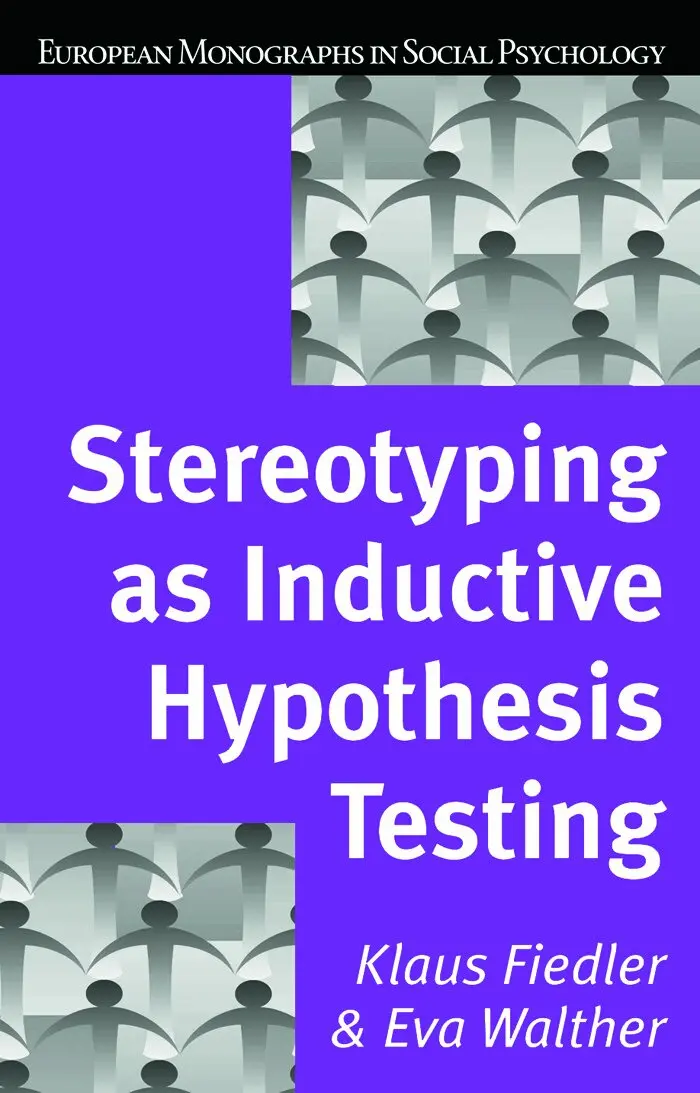
Traditional social hypotheses have a built-in tendency to verify themselves and so involuntarily resist attempts at stereotype change or correction. This is the insight demonstrated and discussed as the start point for an alternative approach to the problem of stereotyping and hypothesis testing. Stereotyping as Inductive Hypothesis Testing explicates the proposition that many stereotypes originate not so much in individual brains, but in the stimulus environment that interacts with and constitutes the social individual. This cognitive-ecological approach is then used to analyse the different aspects of language, sign systems and communication that can implicitly govern hypothesis testing procedures and lead to circular or reinforcing outcomes. The authors describe factors in tests such as judgment, memory and expectation and go on to suggest viable ecological learning approaches to them. An original research project based on a classroom situation is used to demonstrate and verify findings. The cognitive-ecological approach is then contextualised in relation to both the traditional approaches it can replace and the contemporary statistical sampling practices it can improve. Written with a profound understanding of the link between theoretical rigour and good empirical research practice this monograph will be invaluable to anyone with an interest in stereotyping or who wishes to enhance the reliability and self-awareness of their research methods.
404 kr
Läs direkt efter köp
Traditional social hypotheses have a built-in tendency to verify themselves and so involuntarily resist attempts at stereotype change or correction. This is the insight demonstrated and discussed as the start point for an alternative approach to the problem of stereotyping and hypothesis testing. Stereotyping as Inductive Hypothesis Testing explicates the proposition that many stereotypes originate not so much in individual brains, but in the stimulus environment that interacts with and constitutes the social individual. This cognitive-ecological approach is then used to analyse the different aspects of language, sign systems and communication that can implicitly govern hypothesis testing procedures and lead to circular or reinforcing outcomes. The authors describe factors in tests such as judgment, memory and expectation and go on to suggest viable ecological learning approaches to them. An original research project based on a classroom situation is used to demonstrate and verify findings. The cognitive-ecological approach is then contextualised in relation to both the traditional approaches it can replace and the contemporary statistical sampling practices it can improve. Written with a profound understanding of the link between theoretical rigour and good empirical research practice this monograph will be invaluable to anyone with an interest in stereotyping or who wishes to enhance the reliability and self-awareness of their research methods.
824 kr
Läs direkt efter köp
The connection between mental and social life remains one of the most intriguing topics in all of psychology. This book reviews some of the most recent advances in research exploring the links between how people think and behave in interpersonal situations. The chapters represent a variety of theoretical orientations, ranging from evolutionary approaches through cognitive and affective theories, all the way to considering social and cultural influences on the relationship between social cognition and interpersonal behavior.
Given its breadth of coverage, this volume is useful both as a basic reference book and as an informative textbook for advanced courses dealing with social cognition and interpersonal behavior. The main target audience comprises researchers, students, and professionals in all areas of the social and behavioral sciences, including social, cognitive, clinical, counseling, personality, organizational, forensic, and applied psychology, as well as sociology, communication studies, and social work. Written in a readable yet scholarly style, this volume serves as an engaging overview of the field for students in courses dealing with social cognition and social interaction at undergraduate and graduate levels.
824 kr
Läs direkt efter köp
The connection between mental and social life remains one of the most intriguing topics in all of psychology. This book reviews some of the most recent advances in research exploring the links between how people think and behave in interpersonal situations. The chapters represent a variety of theoretical orientations, ranging from evolutionary approaches through cognitive and affective theories, all the way to considering social and cultural influences on the relationship between social cognition and interpersonal behavior.
Given its breadth of coverage, this volume is useful both as a basic reference book and as an informative textbook for advanced courses dealing with social cognition and interpersonal behavior. The main target audience comprises researchers, students, and professionals in all areas of the social and behavioral sciences, including social, cognitive, clinical, counseling, personality, organizational, forensic, and applied psychology, as well as sociology, communication studies, and social work. Written in a readable yet scholarly style, this volume serves as an engaging overview of the field for students in courses dealing with social cognition and social interaction at undergraduate and graduate levels.
1 009 kr
Läs direkt efter köp