Jerker Denrell – författare
Visar alla böcker från författaren Jerker Denrell. Handla med fri frakt och snabb leverans.
4 produkter
4 produkter
E-bok
Engelska, 2023624 kr
Läs direkt efter köp
Sampling approaches to judgment and decision making are distinct from traditional accounts in psychology and neuroscience. While these traditional accounts focus on limitations of the human mind as a major source of bounded rationality, the sampling approach originates in a broader cognitive-ecological perspective. It starts from the fundamental assumption that in order to understand intra-psychic cognitive processes one first has to understand the distributions of, and the biases built into, the environmental information that provides input to all cognitive processes. Both the biases and restriction, but also the assets and capacities, of the human mind often reflect, to a considerable degree, the irrational and rational features of the information environment and its manifestations in the literature, the Internet, and collective memory. Sampling approaches to judgment and decision making constitute a prime example of theory-driven research that promises to help behavioral scientists cope with the challenges of replicability and practical usefulness.
E-bok
PDF, Engelska, 2023624 kr
Läs direkt efter köp
Sampling approaches to judgment and decision making are distinct from traditional accounts in psychology and neuroscience. While these traditional accounts focus on limitations of the human mind as a major source of bounded rationality, the sampling approach originates in a broader cognitive-ecological perspective. It starts from the fundamental assumption that in order to understand intra-psychic cognitive processes one first has to understand the distributions of, and the biases built into, the environmental information that provides input to all cognitive processes. Both the biases and restriction, but also the assets and capacities, of the human mind often reflect, to a considerable degree, the irrational and rational features of the information environment and its manifestations in the literature, the Internet, and collective memory. Sampling approaches to judgment and decision making constitute a prime example of theory-driven research that promises to help behavioral scientists cope with the challenges of replicability and practical usefulness.
Häftad, Engelska, 2023
452 kr
Skickas
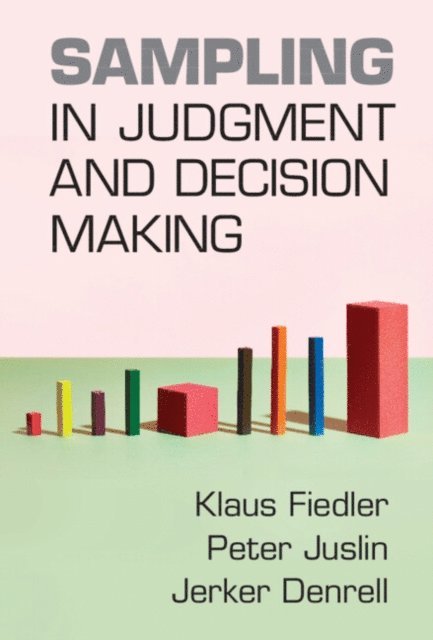
Sampling approaches to judgment and decision making are distinct from traditional accounts in psychology and neuroscience. While these traditional accounts focus on limitations of the human mind as a major source of bounded rationality, the sampling approach originates in a broader cognitive-ecological perspective. It starts from the fundamental assumption that in order to understand intra-psychic cognitive processes one first has to understand the distributions of, and the biases built into, the environmental information that provides input to all cognitive processes. Both the biases and restriction, but also the assets and capacities, of the human mind often reflect, to a considerable degree, the irrational and rational features of the information environment and its manifestations in the literature, the Internet, and collective memory. Sampling approaches to judgment and decision making constitute a prime example of theory-driven research that promises to help behavioral scientists cope with the challenges of replicability and practical usefulness.
Inbunden, Engelska, 2023
1 596 kr
Skickas inom 7-10 vardagar
Sampling approaches to judgment and decision making are distinct from traditional accounts in psychology and neuroscience. While these traditional accounts focus on limitations of the human mind as a major source of bounded rationality, the sampling approach originates in a broader cognitive-ecological perspective. It starts from the fundamental assumption that in order to understand intra-psychic cognitive processes one first has to understand the distributions of, and the biases built into, the environmental information that provides input to all cognitive processes. Both the biases and restriction, but also the assets and capacities, of the human mind often reflect, to a considerable degree, the irrational and rational features of the information environment and its manifestations in the literature, the Internet, and collective memory. Sampling approaches to judgment and decision making constitute a prime example of theory-driven research that promises to help behavioral scientists cope with the challenges of replicability and practical usefulness.