Hermes Mianzan – författare
Visar alla böcker från författaren Hermes Mianzan. Handla med fri frakt och snabb leverans.
5 produkter
5 produkter
Häftad, Engelska, 2015
545 kr
Skickas inom 10-15 vardagar
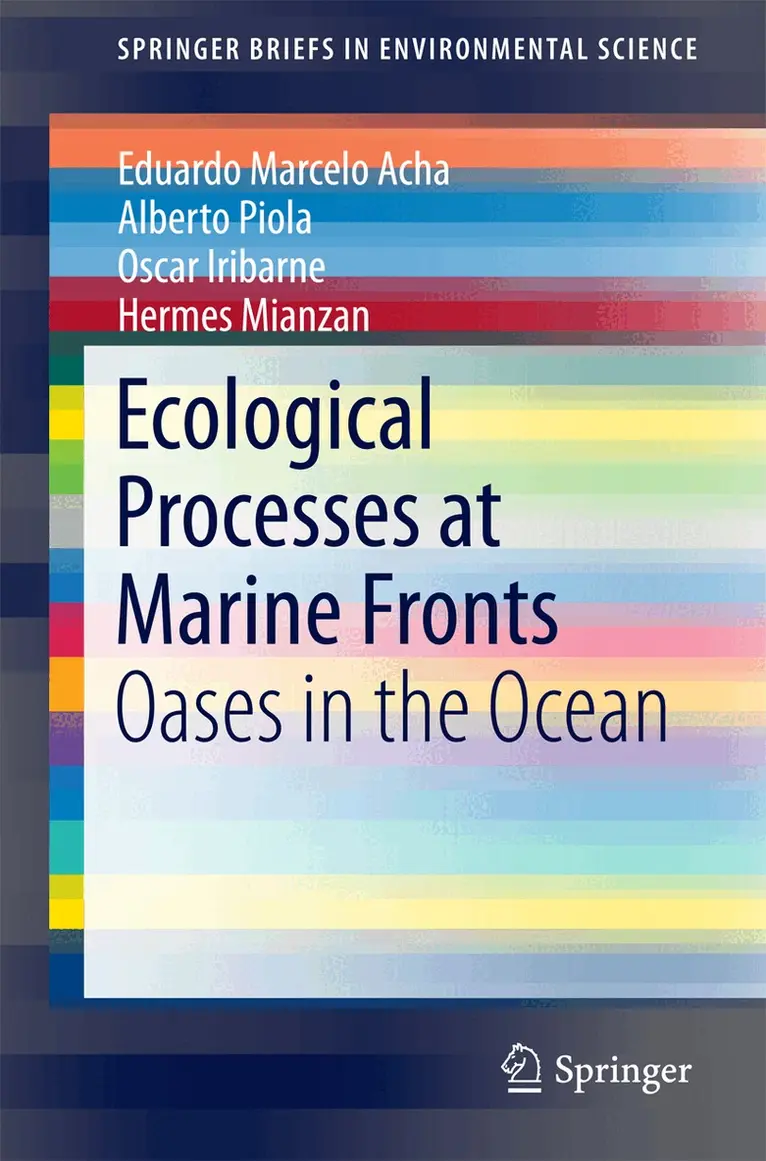
This book reviews and summarizes the results and hypotheses raised by studies directly or indirectly dealing with the ecology of fronts and aims to identify the themes that connect them to produce a synthesis of this knowledge.Though not immediately perceived the ocean is highly structured and fronts are one of the most important components of its structural complexity. Marine fronts have been known since the early 20th Century, however, the more recent availability of high resolution satellite imagery, field measurements and numerical simulations have greatly advanced our understanding of their ecological impact. This work touches on topics such as front types, its biology and its comparisons with other bounderies at sea, as well as comparisons of fronts with terrestrial boundaries and the ‘ecotone’ concept. Furthermore, it also looks at the management and conservation of marine life.
E-bok
PDF, Engelska, 2015687 kr
Läs direkt efter köp
This book reviews and summarizes the results and hypotheses raised by studies directly or indirectly dealing with the ecology of fronts and aims to identify the themes that connect them to produce a synthesis of this knowledge.Though not immediately perceived the ocean is highly structured and fronts are one of the most important components of its structural complexity. Marine fronts have been known since the early 20th Century, however, the more recent availability of high resolution satellite imagery, field measurements and numerical simulations have greatly advanced our understanding of their ecological impact. This work touches on topics such as front types, its biology and its comparisons with other bounderies at sea, as well as comparisons of fronts with terrestrial boundaries and the ‘ecotone’ concept. Furthermore, it also looks at the management and conservation of marine life.
Inbunden, Engelska, 2012
1 605 kr
Skickas inom 10-15 vardagar
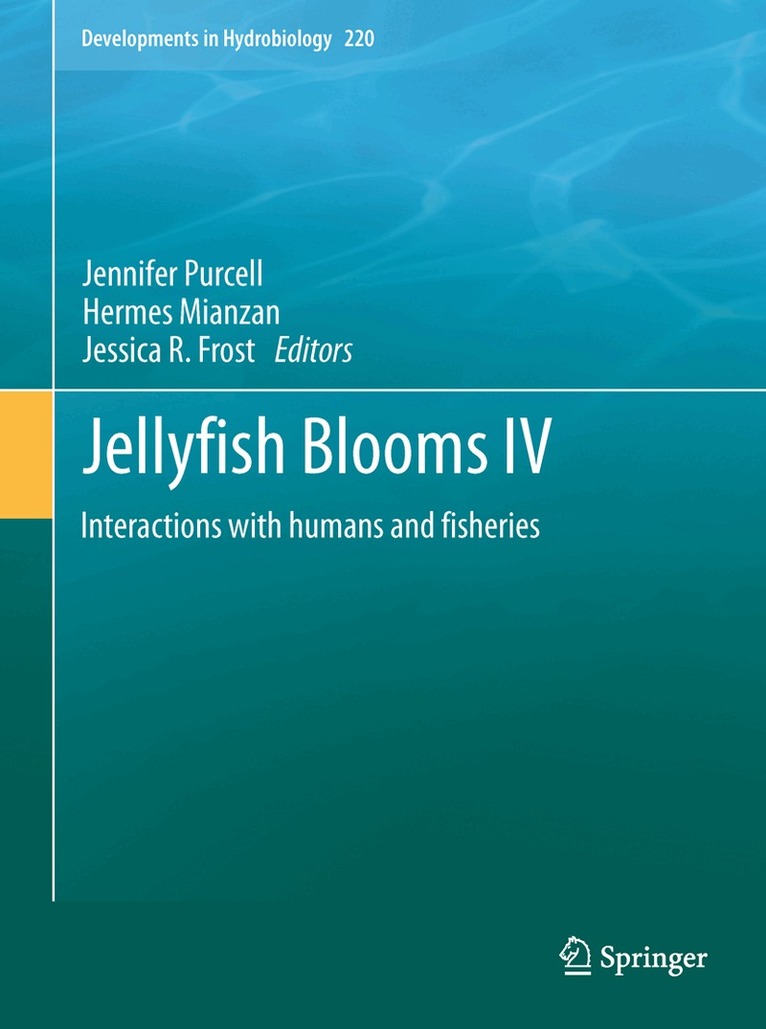
Jellyfish generally are considered to be nuisances because they interfere with human activities by stinging swimmers, clogging power plant intakes and nets of fishermen, killing fish in aquaculture pens, and being both predators and competitors of fish. There is concern that environmental changes such as global warming, eutrophication, over-fishing, and coastal construction may benefit jellyfish populations. During this past decade following the first Jellyfish Blooms volume, some species have bloomed more frequently, expanded their range, and caused more problems for humans. Mnemiopsis leidyi, the ctenophore that invaded the Black Sea in the 1980s and damaged fisheries, now also blooms in the North, Baltic, and Mediterranean seas. Nemopilema nomurai, a giant Asian jellyfish, has bloomed frequently during this decade, causing severe damage to the Japanese fishing industry. Jellyfish Blooms: Interactions with Humans and Fisheries is the fourth volume in this series. Syntheses andoriginal research articles address the question if jellyfish have increased globally and what factors may have contributed to the abundance of jellyfish. This volume is the most extensive to date, containing papers from all continents (except Antarctica) on scyphozoans, hydrozoans, cubozoans, staurozoans, and ctenophores, and on the fate of jellyfish blooms. This is a key reference for students and professional marine biologists, oceanographers, and fishery scientists and managers. Previously published in Hydrobiologia, vol. 690, 2012
E-bok
PDF, Engelska, 20151 977 kr
Läs direkt efter köp
Jellyfish generally are considered to be nuisances because they interfere with human activities by stinging swimmers, clogging power plant intakes and nets of fishermen, killing fish in aquaculture pens, and being both predators and competitors of fish. There is concern that environmental changes such as global warming, eutrophication, over-fishing, and coastal construction may benefit jellyfish populations. During this past decade following the first Jellyfish Blooms volume, some species have bloomed more frequently, expanded their range, and caused more problems for humans. Mnemiopsis leidyi, the ctenophore that invaded the Black Sea in the 1980s and damaged fisheries, now also blooms in the North, Baltic, and Mediterranean seas. Nemopilema nomurai, a giant Asian jellyfish, has bloomed frequently during this decade, causing severe damage to the Japanese fishing industry. Jellyfish Blooms: Interactions with Humans and Fisheries is the fourth volume in this series. Syntheses andoriginal research articles address the question if jellyfish have increased globally and what factors may have contributed to the abundance of jellyfish. This volume is the most extensive to date, containing papers from all continents (except Antarctica) on scyphozoans, hydrozoans, cubozoans, staurozoans, and ctenophores, and on the fate of jellyfish blooms. This is a key reference for students and professional marine biologists, oceanographers, and fishery scientists and managers. Previously published in Hydrobiologia, vol. 690, 2012
Häftad, Engelska, 2014
1 605 kr
Skickas inom 10-15 vardagar
Jellyfish generally are considered to be nuisances because they interfere with human activities by stinging swimmers, clogging power plant intakes and nets of fishermen, killing fish in aquaculture pens, and being both predators and competitors of fish. There is concern that environmental changes such as global warming, eutrophication, over-fishing, and coastal construction may benefit jellyfish populations. During this past decade following the first Jellyfish Blooms volume, some species have bloomed more frequently, expanded their range, and caused more problems for humans. Mnemiopsis leidyi, the ctenophore that invaded the Black Sea in the 1980s and damaged fisheries, now also blooms in the North, Baltic, and Mediterranean seas. Nemopilema nomurai, a giant Asian jellyfish, has bloomed frequently during this decade, causing severe damage to the Japanese fishing industry. Jellyfish Blooms: Interactions with Humans and Fisheries is the fourth volume in this series. Syntheses andoriginal research articles address the question if jellyfish have increased globally and what factors may have contributed to the abundance of jellyfish. This volume is the most extensive to date, containing papers from all continents (except Antarctica) on scyphozoans, hydrozoans, cubozoans, staurozoans, and ctenophores, and on the fate of jellyfish blooms. This is a key reference for students and professional marine biologists, oceanographers, and fishery scientists and managers. Previously published in Hydrobiologia, vol. 690, 2012