Herwig Verschueren - Böcker
Visar alla böcker från författaren Herwig Verschueren. Handla med fri frakt och snabb leverans.
2 produkter
2 produkter
820 kr
Skickas inom 5-8 vardagar
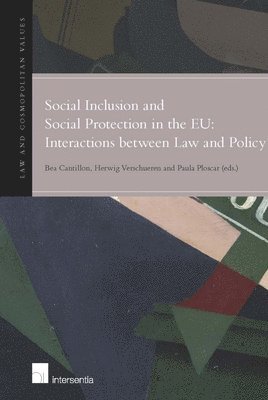
Issues of social inclusion and social protection were brought to the fore of political and academic discussions once again by the Treaty of Lisbon. The fight against social exclusion, the promotion of social justice and protection, as well as social cohesion are confirmed to be among the aims of the Union (Article 3 TEU). Moreover, requirements linked to the guarantee of adequate social protection and the fight against social exclusion should be considered both at the levels of design and implementation of EU policies and activities (Article 9 TFEU). The interaction between legal instruments and policy coordination in the field of social inclusion and social protection constitutes the theme of this book. The contributions essentially inquire whether there is any interaction at all, or if the two realms of law and policy of the EU function in parallel. If there is any sort of interchange between the two, in what areas is it taking place, and what does it result into? Legal and political scholars were invited to address these questions and analyse the involvement of the European Union in promoting social inclusion and protection.The book opens with two introductory chapters on the political and legal contexts, and then focuses on the specific cases of health care, pension systems, and means of combating poverty. Each subject matter has been addressed in a complementary fashion through the lenses of juridical and political sciences, which lends the book a cross-disciplinary approach.
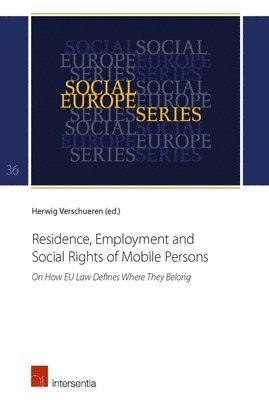
Del 36 - Social Europe Series
Residence, Employment and Social Rights of Mobile Persons
On How EU Law Defines Where They Belong
Häftad, Engelska, 2016
1 097 kr
Skickas inom 5-8 vardagar
Where do I belong? This is a question all mobile persons are bound to ask themselves at one time or another. When crossing borders, individuals establish links with States, which can be the basis for legal claims against these States.This book discusses the issue of these links and, more specifically, the question of how EU law defines the link needed to obtain the right to reside in a Member State and the right to social and employment protection in that State. When it comes to claiming rights from States, traditionally nationality is the answer to the question where a person belongs. However, in the context of European integration and the development of an EU legal framework of internal market rules, citizenship rights and immigration rules, different answers to these questions have been developedFrom this perspective the various chapters of this book examine instruments such as the Citizens Directive 2004/38, the Family Reunification Directive 2003/86, the Long-term Residence Directive 2003/109, the Social Security Coordination Regulation 883/2004, the Rome I Regulation 593/2008 and the Posting of Workers Directive 96/71. The case-law of the Court of Justice on these issues is of course a central element therein.The analyses of scholars from different legal disciplines in the fourteen chapters of this book show that EU law gives a multitude of answers to the question which link is necessary and sufficient to create an individual's right vis--vis a State. The definition of this link, the criteria used and the legal consequences differ according to the legal framework the individual finds himself/herself in and the legal instrument he/she invokes. Moreover, the criteria used in legislation and case-law continue to be the subject of problems of interpretation and application, which in turn leads to legal uncertainty or even confusion.