Hideyuki Okano – författare
Visar alla böcker från författaren Hideyuki Okano. Handla med fri frakt och snabb leverans.
4 produkter
4 produkter
Inbunden, Engelska, 2019
2 239 kr
Skickas inom 10-15 vardagar
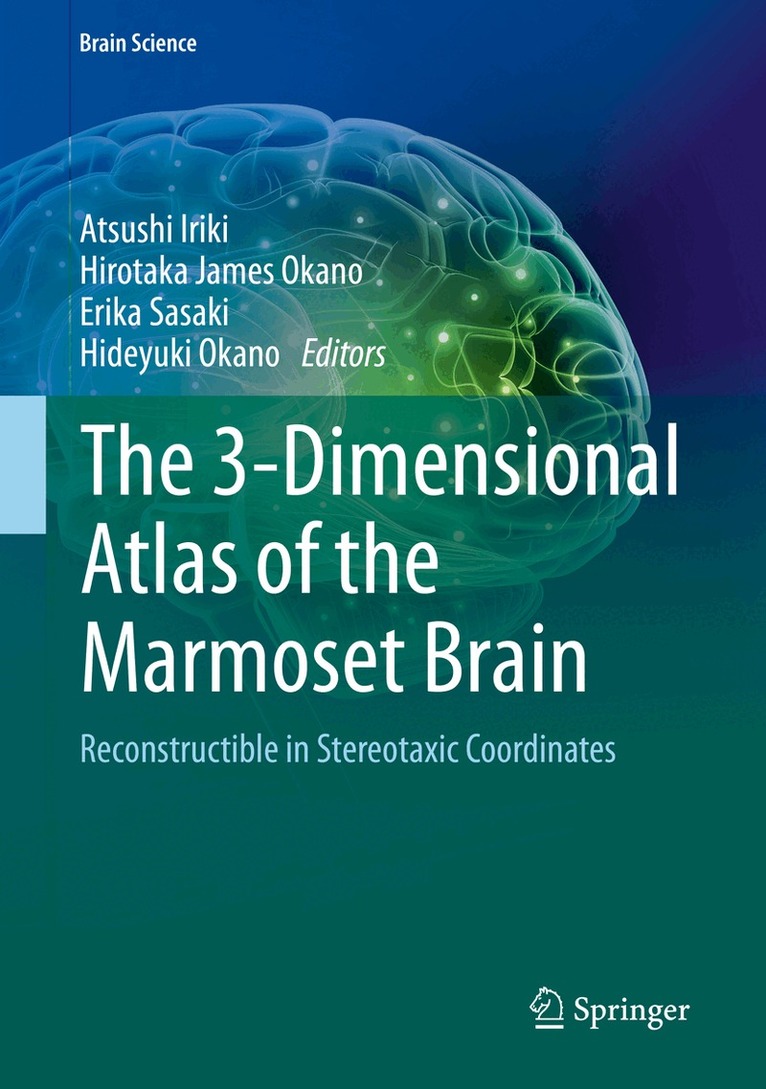
This book provides accurate, comprehensive, and convenient reference for usages of the “freely rotatable three dimensional combined Nissl-stained and MRI digital data of the marmoset brain”. The key features of the original 3D digital data and of this atlas are: 1. The original digital datasets are freely rotatable in three dimensions, thus expected to be useful for any disciplines and anatomical interest, using any coordinate system, 2. Combined Nissl stained and MRI images are obtained from the same marmoset, to allow cross-modality matched references for multiple usages, 3. 86 Horizontal Series of Images with Neurosurgical Plane (based on the actual data), with more accuracy and resolution (Chapter 2) than the web-based digital images, 4. 32 Coronal Series of Images with Neurosurgical Plane (reproduced from the brain model) (Chapter 3), 5. 10 Parasagittal Series of Images with Neurosurgical Plane (reproduced from the brain model) (Chapter 4), 6. 3 Omnidirectionally Sliceable Planes (reproduced from the brain model) (Chapter 5), 7. In order to provide higher resolution structures to match systematic accuracy for supplementation of the digital data on the website, additional information are included. They are: 1) Nomenclature, 2) List of Brain Structures in Hierarchical Order, 3) Index of Abbreviations, together with 143 useful Bibliographic References list as of 2016, 8. Horsley-Clarke’s stereotaxic coordinates were adopted in the present atlas.
E-bok
Engelska, 20182 848 kr
Läs direkt efter köp
This book provides accurate, comprehensive, and convenient reference for usages of the “freely rotatable three dimensional combined Nissl-stained and MRI digital data of the marmoset brain”. The key features of the original 3D digital data and of this atlas are: 1. The original digital datasets are freely rotatable in three dimensions, thus expected to be useful for any disciplines and anatomical interest, using any coordinate system, 2. Combined Nissl stained and MRI images are obtained from the same marmoset, to allow cross-modality matched references for multiple usages, 3. 86 Horizontal Series of Images with Neurosurgical Plane (based on the actual data), with more accuracy and resolution (Chapter 2) than the web-based digital images, 4. 32 Coronal Series of Images with Neurosurgical Plane (reproduced from the brain model) (Chapter 3), 5. 10 Parasagittal Series of Images with Neurosurgical Plane (reproduced from the brain model) (Chapter 4), 6. 3 Omnidirectionally Sliceable Planes (reproduced from the brain model) (Chapter 5), 7. In order to provide higher resolution structures to match systematic accuracy for supplementation of the digital data on the website, additional information are included. They are: 1) Nomenclature, 2) List of Brain Structures in Hierarchical Order, 3) Index of Abbreviations, together with 143 useful Bibliographic References list as of 2016, 8. Horsley-Clarke’s stereotaxic coordinates were adopted in the present atlas.
Häftad, Engelska, 2019
679 kr
Skickas inom 5-8 vardagar
E-bok
PDF, Engelska, 2019816 kr
Läs direkt efter köp
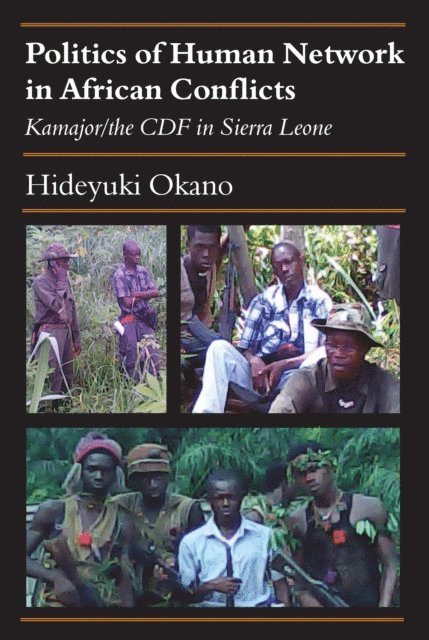
Sierra Leone experienced 11 years'' civil war after the incursion of the Revolutionary United Front (RUF) from adjacent Liberia. The war of Sierra Leone is one of the most researched in Africa. However, the foci of studies are mostly on the RUF. Other armed groups are not sufficiently studied. This book focuses on the governmental side of the Kamajor and the Civil Defence Force (CDF). Kamajors were community-based vigilantes mobilised by paramount chiefs in various Mende communities. During the course of the war, the government organised Kamajors into a pro-governmental militia, the CDF. This book examines how human networks worked in the course of the formation of Kamajor and of the CDF. Even though the roles of human networks have been discussed in the realm of African politics, they have been left hypothetical. Few studies demonstrate the whole picture on how neopatrimonialism, patron-client relations or informal networks function within an organisation. This book describes the course of Kamajor/CDF along with functions of the human networks. In the networks, the threads of human relations are interwoven by subsuming the local, the international and the global dimensions of the armed conflict. Some connect to governmental figures. Others have transnational networks in adjacent Liberia. In the changing situations of the war, some of the relations are maintained, while some relations are disintegrated. Those who emerge as prominent figures in the Kamajor/CDF use their own human networks to obtain resources for the Kamajor/CDF, which in turn, afford themselves higher positions in the force.