Hiroakira Ono – författare
1 451 kr
Läs direkt efter köp
Residuated Lattices: An Algebraic Glimpse at Substructural Logics
1 973 kr
Skickas inom 5-8 vardagar
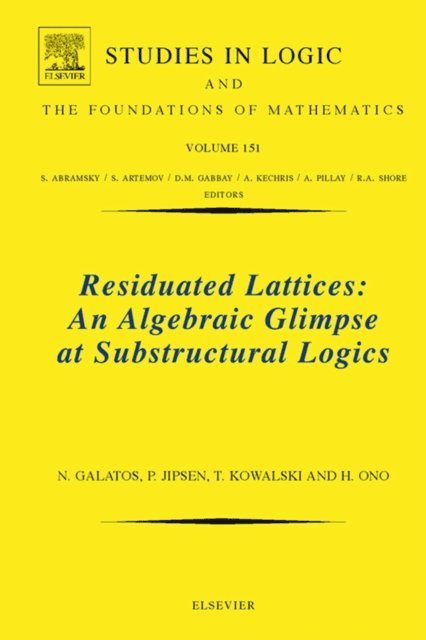
The book is meant to serve two purposes. The first and more obvious one is to present state of the art results in algebraic research into residuated structures related to substructural logics. The second, less obvious but equally important, is to provide a reasonably gentle introduction to algebraic logic. At the beginning, the second objective is predominant. Thus, in the first few chapters the reader will find a primer of universal algebra for logicians, a crash course in nonclassical logics for algebraists, an introduction to residuated structures, an outline of Gentzen-style calculi as well as some titbits of proof theory - the celebrated Hauptsatz, or cut elimination theorem, among them. These lead naturally to a discussion of interconnections between logic and algebra, where we try to demonstrate how they form two sides of the same coin. We envisage that the initial chapters could be used as a textbook for a graduate course, perhaps entitled Algebra and Substructural Logics.
As the book progresses the first objective gains predominance over the second. Although the precise point of equilibrium would be difficult to specify, it is safe to say that we enter the technical part with the discussion of various completions of residuated structures. These include Dedekind-McNeille completions and canonical extensions. Completions are used later in investigating several finiteness properties such as the finite model property, generation of varieties by their finite members, and finite embeddability. The algebraic analysis of cut elimination that follows, also takes recourse to completions. Decidability of logics, equational and quasi-equational theories comes next, where we show how proof theoretical methods like cut elimination are preferable for small logics/theories, but semantic tools like Rabin's theorem work better for big ones. Then we turn to Glivenko's theorem, which says that a formula is an intuitionistic tautology if and only if its double negation is a classical one. We generalise it to the substructural setting, identifying for each substructural logic its Glivenko equivalence class with smallest and largest element. This is also where we begin investigating lattices of logics and varieties, rather than particular examples. We continue in this vein by presenting a number of results concerning minimal varieties/maximal logics. A typical theorem there says that for some given well-known variety its subvariety lattice has precisely such-and-such number of minimal members (where values for such-and-such include, but are not limited to, continuum, countably many and two). In the last two chapters we focus on the lattice of varieties corresponding to logics without contraction. In one we prove a negative result: that there are no nontrivial splittings in that variety. In the other, we prove a positive one: that semisimple varieties coincide with discriminator ones.
Within the second, more technical part of the book another transition process may be traced. Namely, we begin with logically inclined technicalities and end with algebraically inclined ones. Here, perhaps, algebraic rendering of Glivenko theorems marks the equilibrium point, at least in the sense that finiteness properties, decidability and Glivenko theorems are of clear interest to logicians, whereas semisimplicity and discriminator varieties are universal algebra par exellence. It is for the reader to judge whether we succeeded in weaving these threads into a seamless fabric.
Considers both the algebraic and logical perspective within a common framework Written by experts in the area Easily accessible to graduate students and researchers from other fields Results summarized in tables and diagrams to provide an overview of the area Useful as a textbook for a course in algebraic logic, with exercises and suggested research directions Provides a concise introduction to the subject and leads directly to research topics The ideas from algebra and logic are developed hand-in-hand and the connections are shown in every level2 680 kr
Läs direkt efter köp
561 kr
Skickas inom 10-15 vardagar
687 kr
Läs direkt efter köp
Edited in collaboration with FoLLI, the Association of Logic, Language and Information, this book constitutes the 4th volume of the FoLLI LNAI subline; containing the refereed proceedings of the 16h International Workshop on Logic, Language, Information and Computation, WoLLIC 2009, held in Tokyo, Japan, in June 2009.
The 25 revised full papers presented together with six tutorials and invited talks were carefully reviewed and selected from 57 submissions. The papers cover some of the most active areas of research on the frontiers between computation, logic, and linguistics, with particular interest in cross-disciplinary topics. Typical areas of interest are: foundations of computing and programming; novel computation models and paradigms; broad notions of proof and belief; formal methods in software and hardware development; logical approach to natural language and reasoning; logics of programs, actions and resources; foundational aspects of information organization, search, flow, sharing, and protection.
544 kr
Skickas inom 10-15 vardagar
687 kr
Läs direkt efter köp
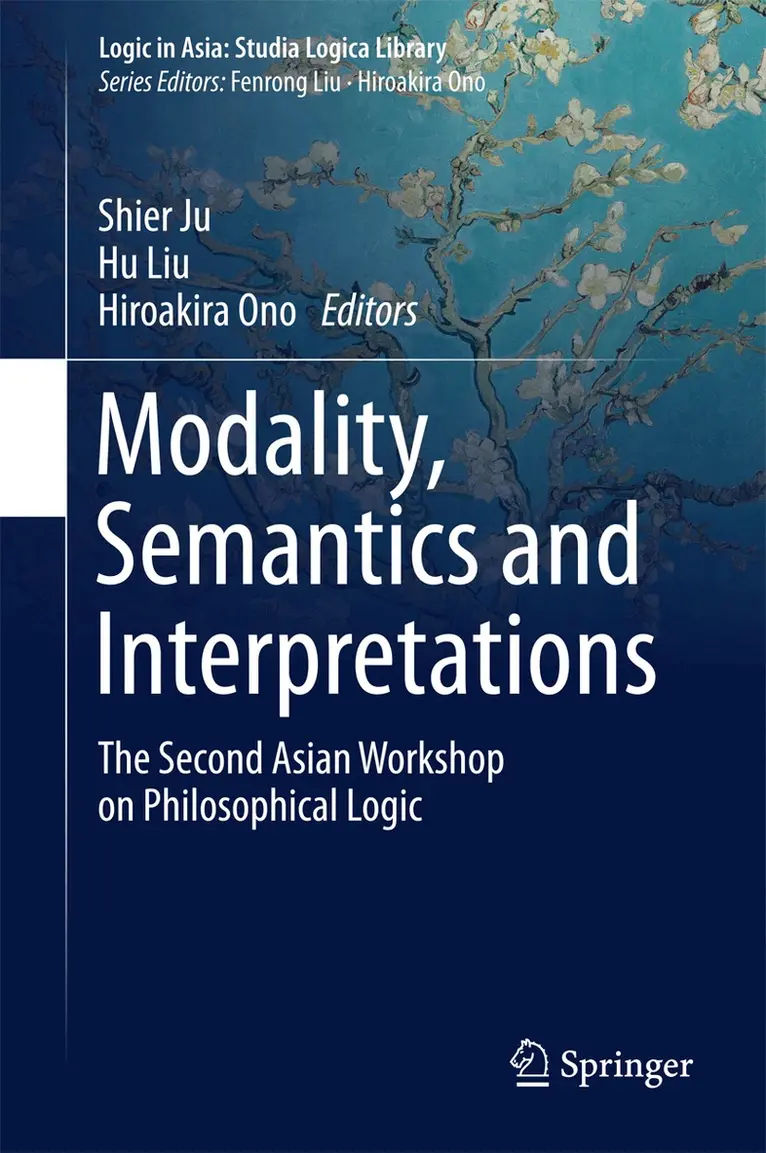
This contributed volume includes both theoretical research on philosophical logic and its applications in artificial intelligence, mostly employing the concepts and techniques of modal logic. It collects selected papers presented at the Second Asia Workshop on Philosophical Logic, held in Guangzhou, China in 2014, as well as a number of invited papers by specialists in related fields. The contributions represent pioneering philosophical logic research in Asia.
544 kr
Skickas inom 10-15 vardagar
1 605 kr
Skickas inom 10-15 vardagar
1 977 kr
Läs direkt efter köp
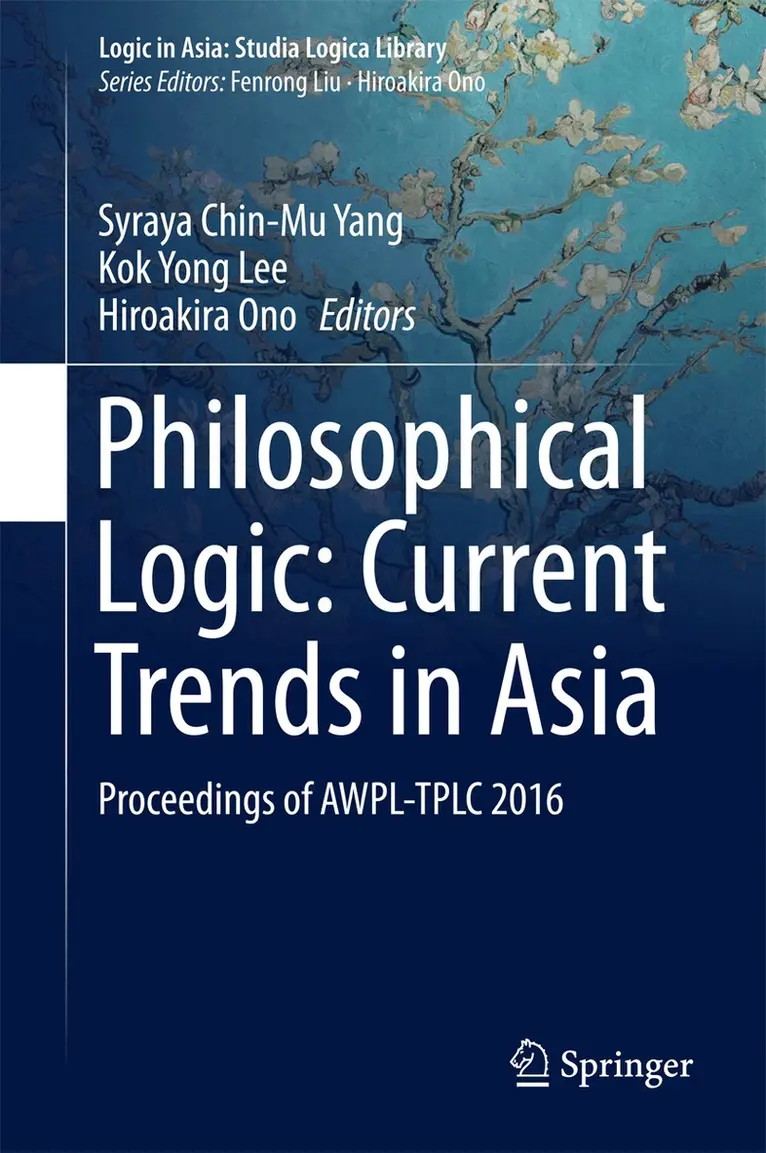
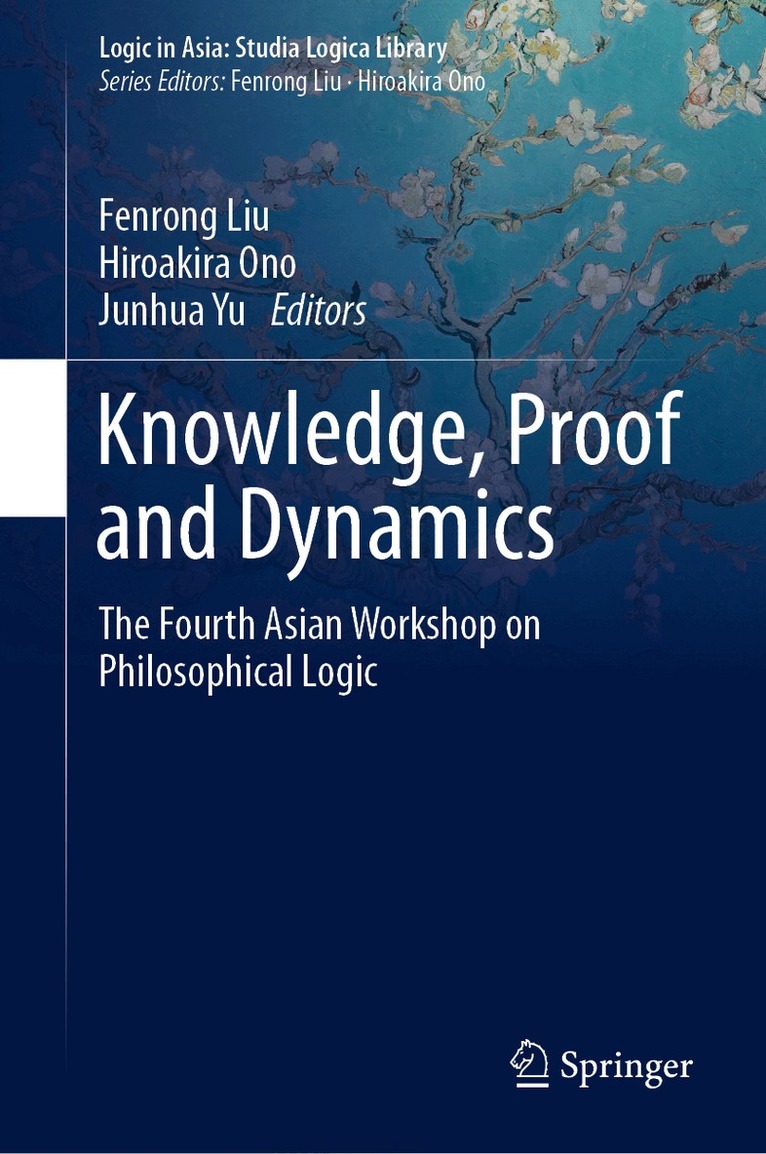
This volume brings together a group of logic-minded philosophers and philosophically oriented logicians, mainly from Asia, to address a variety of logical and philosophical topics of current interest, offering a representative cross-section of the philosophical logic landscape in early 21st-century Asia. It surveys a variety of fields, including modal logic, epistemic logic, formal semantics, decidability and mereology.
The book proposes new approaches and constructs more powerful frameworks, such as cover theory, an algebraic approach to cut-elimination, and a Boolean approach to causal discovery, to name but a few. Readers may find a wide range of applications of these original works in current research of philosophical logic, especially in the structural and conceptual analysis of some significant semantic properties and formal systems. The variety of topics and issues discussed here will appeal to readers from a broad spectrum of disciplines, ranging from mathematical/philosophical logic, computing science, cognitive science and artificial intelligence, to linguistics, game theory and beyond.1 620 kr
Skickas inom 11-20 vardagar
412 kr
Skickas inom 10-15 vardagar
509 kr
Läs direkt efter köp
1 605 kr
Skickas inom 10-15 vardagar
1 977 kr
Läs direkt efter köp
1 605 kr
Skickas inom 10-15 vardagar
2 104 kr
Skickas inom 5-8 vardagar
1 925 kr
Skickas inom 10-15 vardagar
2 457 kr
Läs direkt efter köp
1 623 kr
Tillfälligt slut