Holger Straßheim - Böcker
Visar alla böcker från författaren Holger Straßheim. Handla med fri frakt och snabb leverans.
3 produkter
3 produkter
3 093 kr
Skickas inom 7-10 vardagar
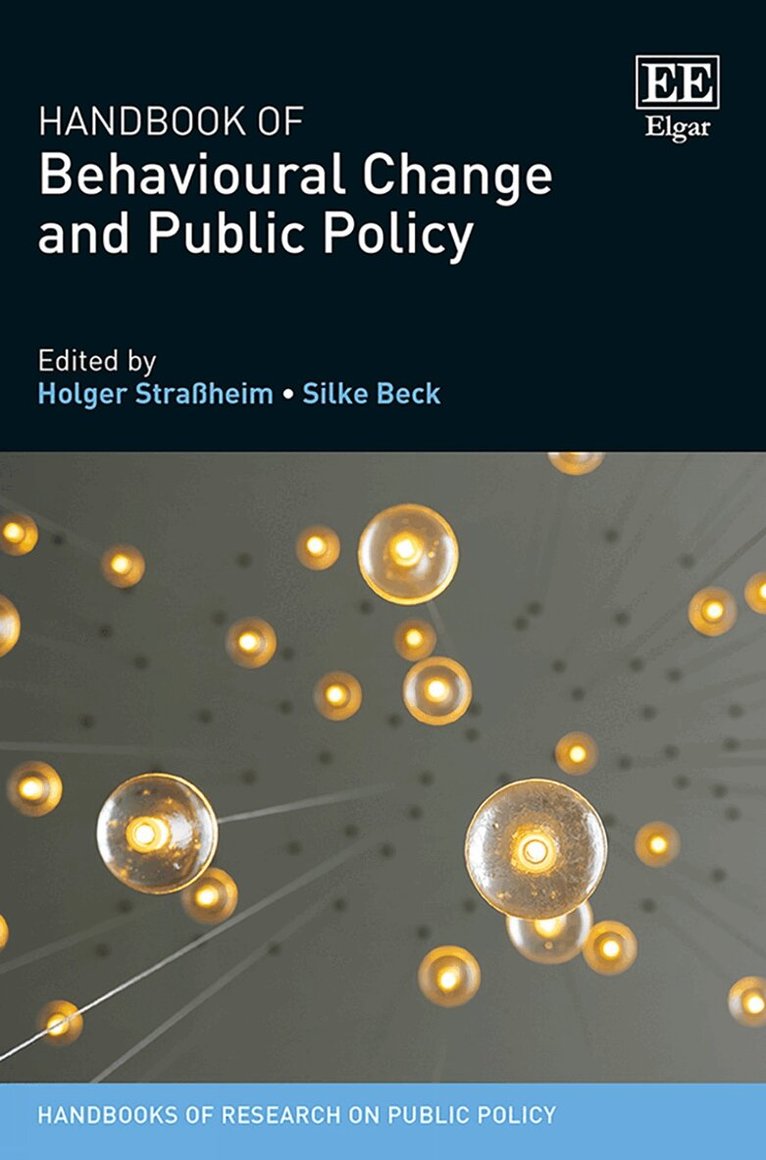
Behavioural change has become a core issue of public policy in recent years. This comprehensive Handbook takes a multidisciplinary approach to examine the relationship between the two, exploring the ever-increasing analysis of behavioural change and the importance of 'nudge' in terms of public policy. Uniting interdisciplinary scholarship, Holger Straßheim and Silke Beck have drawn together a wide variety of perspectives, allowing for the legal, political, economic and social aspects of behavioural change and public policy to be explored. Contributions by renowned experts critically assess the theories and conceptual developments from early experiments to recent strategies of behavioural public policy. Chapters also cover the proliferation and professionalization of these strategies in Europe and beyond, the application of behavioural insights and instruments across areas including health, sustainability, employment, pensions, development and taxation, and the normative ideas and political consequences of knowing and governing behaviour.Political science and public policy scholars will find the inclusion of both critical and theory-driven research a vital tool, while policy-makers will appreciate the practical suggestions included in this Handbook.Contributors include: A. Alemanno, C. Berndt, B. Bornemann, S. Botzem, P. Burger, E. Ciriolo, A.-M. Farrell, J. Feitsma, R. Graf, P. Guldborg Hansen, F. Hörisch, M. Howlett, R. Jones, F. Lebaron, L. Leone, R. Lepenies, K. Loer, M. Malecka, J. Pykett, M. Quigley, S. Rafael Almeida, S. Rawat, T. Schillemans, J. Sousa Lourenço, H. Straßheim, C.R. Sunstein, M. Tallacchini, J. Tosun, R. Tyers, A. van Aaken, R.K. Weaver, M.D. White, M. Whitehead, P.W. Zuidhof
Worldviews of Ice
Constructions of the Arctic at the Science/Politics Interface
Inbunden, Engelska, 2026
1 528 kr
Kommande
This book refers to the foundations for the empirical analysis by grounding the inquiry into the circle of Arctic knowledge production and the science/politics interface in a theoretical background that we establish on the basis of various approaches primarily drawn from the fields of International Relations (IR) and Sociology. While at the core we look for the formation and re-production of worldviews in and between science and politics, we also pay particular attention to important boundary processes and boundary organisations in order to explore how Arctic knowledge is validated, shared and transferred both within and between science and politics. In doing so, we also need to tie back these concepts to the even broader (and older) debates on the operative autonomy of different (functionally differentiated) social systems and the resulting problems of communication. After all, to put it bluntly, the often-heard frustration on the side of scientists (‘we have all the results, but the politicians won’t listen’) is not a frustration that would be peculiar to, for example, glaciologists working on the mass loss of the Greenland ice sheet. Rather, it points to rather basic issues of the autonomy of social systems as well as the possibilities and limits of directed steering. We will draw from these extensive debates in order to inquire how, and to which degree, the ‘boundary work’ between science and politics in our circle could be improved. We deliberately take such a conceptually rather ‘deep’ approach in order to forestall assumptions according to which the problem of hand might be reduced to a problem of simply ‘communicating science better’ (and, most notably, hiring more communications staff or training scientists to become better communicators).
Renaissance der Verkehrspolitik
Politik- und mobilitätswissenschaftliche Perspektiven
Häftad, Tyska, 2023
688 kr
Skickas inom 10-15 vardagar
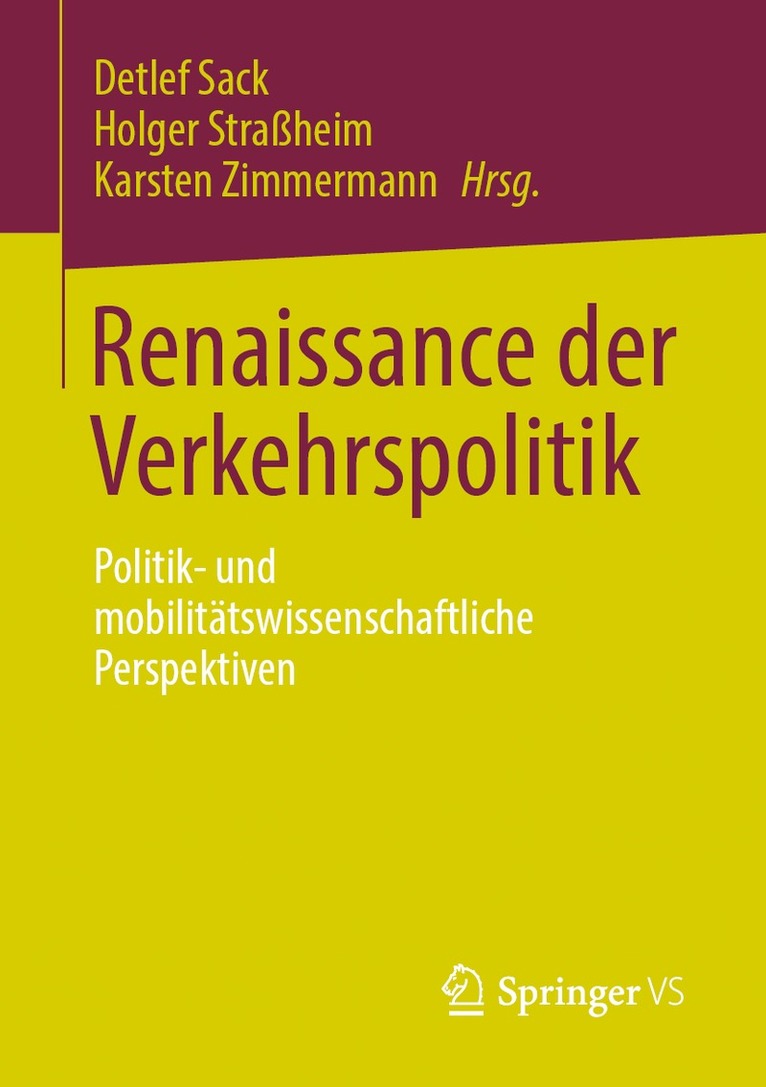
Der Band versammelt mobilitäts- und politikwissenschaftliche Beiträge zu verkehrspolitischen Entscheidungen und Richtungswechseln auf verschiedenen Ebenen (Bund, Land, Kommune) und zu verschiedenen Verkehrsträgern bzw.