Holm Tiessen - Böcker
Visar alla böcker från författaren Holm Tiessen. Handla med fri frakt och snabb leverans.
4 produkter
4 produkter
Managing Organic Matter in Tropical Soils: Scope and Limitations
Proceedings of a Workshop organized by the Center for Development Research at the University of Bonn (ZEF Bonn) — Germany, 7–10 June, 1999
Inbunden, Engelska, 2002
1 061 kr
Skickas inom 10-15 vardagar
Soil organic matter is a reservoir for plant nutrients, it provides water-holding capacity, stabilizes soil structure against compaction and erosion, and thus determines soil productivity. All agriculture to some degree depends on soil organic matter. It has long been known that soil organic matter declines when land is taken into cultivation, and that the productivity of new agricultural land is governed by fertility contributions from decomposing natural organic matter. The expansion of agriculture to ever new and more fragile lands, particularly in tropical and developing regions, causes environmental degradation with local effects on soil quality, regional effects on landscape integrity and water quality, and global effects on carbon cycles and the atmosphere. Rates of soil organic matter loss, equilibrium levels under different land use, and management options for stabilizing or reversing losses have been documented for temperate ecosystems. This has provided options not only for improved fertility management and lowered inputs but also for mitigation of greenhouse gas emissions.The understanding of processes governing organic matter in the tropics is documented in this book, and critical gaps in knowledge and management are explored for a readership of resource scientists, economists and advanced students.
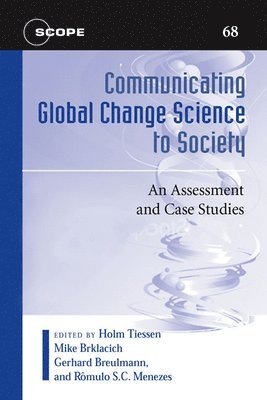
Communicating Global Change Science to Society
An Assessment and Case Studies
Inbunden, Engelska, 2007
1 462 kr
Tillfälligt slut
The Scientific Committee on Problems of the Environment (SCOPE) was established by the International Council for Science (ICSU) in 1969, to bring together natural and social scientists to identify emerging or potential environmental issues and to address jointly the nature and solution of global environmental problems.National governments and research scientists may be equally concerned with issues of global environmental change, but their interests - and their timelines - are not the same. Governments are often focused on short-term effects and local impacts of global phenomena. Scientists, on the other hand, are loath to engage in speculation about the specific consequences of large-scale environmental trends.How then can we translate scientific understanding of these trends into public policy?"Communicating Global Change Science to Society" examines the growing number of instances in which governments and scientists have engaged in research projects in which the goal is to inform policy decisions. It assesses these experiences and suggests their implications for future collaborations.The book begins with a discussion of interactions between science and policy, particularly as they relate to the broad significance of environmental change.It then addresses concerns that emerge from this discussion, including how scientific research results are communicated in democratic societies, the uses (and misuses) of scientific findings, and what the natural and social sciences could learn from each other.
526 kr
Skickas inom 7-10 vardagar
The Scientific Committee on Problems of the Environment (SCOPE) was established by the International Council for Science (ICSU) in 1969, to bring together natural and social scientists to identify emerging or potential environmental issues and to address jointly the nature and solution of global environmental problems.National governments and research scientists may be equally concerned with issues of global environmental change, but their interests - and their timelines - are not the same. Governments are often focused on short-term effects and local impacts of global phenomena. Scientists, on the other hand, are loath to engage in speculation about the specific consequences of large-scale environmental trends.How then can we translate scientific understanding of these trends into public policy?"Communicating Global Change Science to Society" examines the growing number of instances in which governments and scientists have engaged in research projects in which the goal is to inform policy decisions. It assesses these experiences and suggests their implications for future collaborations.The book begins with a discussion of interactions between science and policy, particularly as they relate to the broad significance of environmental change.It then addresses concerns that emerge from this discussion, including how scientific research results are communicated in democratic societies, the uses (and misuses) of scientific findings, and what the natural and social sciences could learn from each other.
1 061 kr
Skickas inom 10-15 vardagar
Soil organic matter is a reservoir for plant nutrients, provides water-holding capacity, stabilizes soil structure against compaction and erosion, and thus determines soil productivity. All agriculture to some degree depends on soil organic matter. It has long been known that soil organic matter declines when land is taken into cultivation, and that the productivity of new agricultural land is governed by fertility contributions from decomposing natural organic matter. The expansion of agriculture to ever new and more fragile lands, particularly in tropical and developing regions, causes environmental degradation with local effects on soil quality, regional effects on landscape integrity and water quality, and global effects on carbon cycles and the atmosphere. This book summarizes current knowledge of the properties and dynamics of soil organic matter in the tropics, its role in determining soil quality, its stability and turnover, and the options for management in the context of tropical landuse systems, for a readership of resource scientists, economists and advanced students. Maintenance of organic matter is critical for preventing land degradation. Case studies and practical applications are therefore an important part of the book, as are the exploration of future directions in research and management.